Promotional price valid on web orders only. Your contract pricing may differ. Interested in signing up for a dedicated account number?
Learn More

Invitrogen™ Phospho-Progesterone Receptor (Ser294) Monoclonal Antibody (608)
GREENER_CHOICE

Catalog No. MA1414
Change view
Click to view available options
Quantity:
200 μg
1 product options available for selection
Product selection table with 1 available options. Use arrow keys to navigate and Enter or Space to select.
Catalog No. Quantity
MA1-414 200 μg
Use arrow keys to navigate between rows. Press Enter or Space to select a product option. 1 options available.
1 options
Catalog No. MA1-414 Supplier Invitrogen™ Supplier No. MA1414
Add to Cart
Edge
Add to Cart

Mouse Monoclonal Antibody

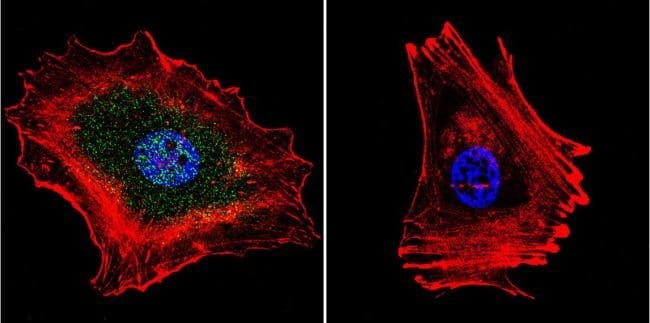
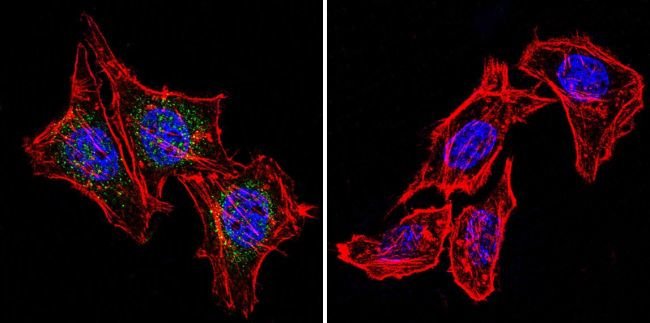
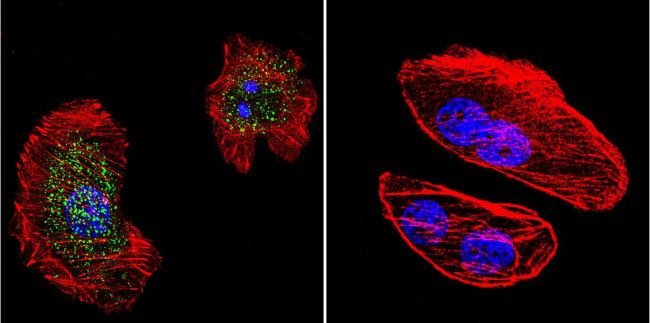
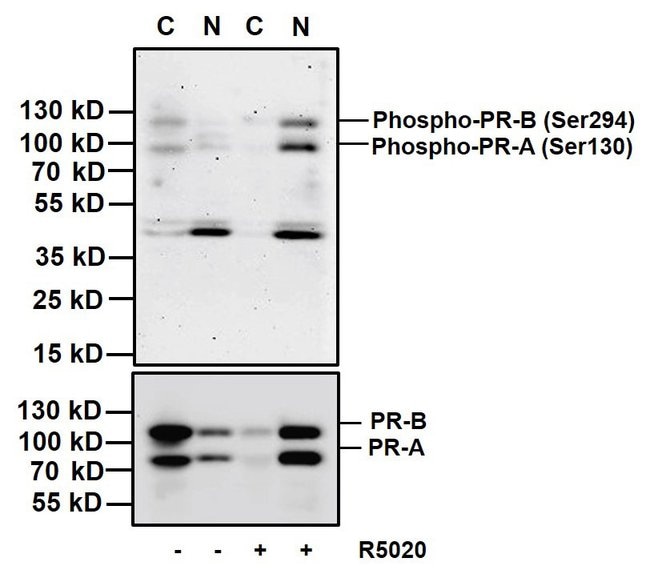
MA1-414 detects phospho-progesterone receptor (pSer294) from human samples. MA1-414 has been successfully used in Western blot, ELISA, immunohistochemistry, immunofluorescence, and immunoprecipitation procedures. By Western blot, this antibody detects ~81 and ~116 kDa proteins representing phospho-progesterone receptor (pSer294) A and B from T47D cell extract. The MA1-414 immunogen is a synthetic peptide corresponding to residues P(288) M A P G R S(p) P L A T T V(300) of human Progesterone Receptor.

The progesterone receptor (PR) is a member of the steroid family of nuclear receptors. The PR mediates the physiological effects of progesterone, which plays a central role in reproductive events associated with the establishment and maintenance of pregnancy. PR is found as a 94 kDa protein (Form A) or a 120 kDa protein (Form B) due to the use of alternative translation initiation sites. PR-B is the transcriptionally active form and is responsible for activating genes for the maintenance of the endometrium, maintenance of pregnancy, and inhibition of ovulation. PR-A is identical to PR-B except for a 165 amino acid deletion at the N-terminus. This deletion exposes a 140 amino acid inhibitory domain (ID) that acts as a repressor of steroid hormone transcriptional activity. In its inactive state, PgR forms a multiprotein complex which includes heat shock proteins and immunophins. Upon binding of progesterone hormone to its receptor, there is a conformational change that allows dimerization and binding of the receptor to progesterone response elements (PRE) sequences, resulting in activated transcription. A Null mutation in the PGR gene leads to pleiotrophic reproductive abnormalities.
TRUSTED_SUSTAINABILITY

Specifications

Antigen Phospho-Progesterone Receptor (Ser294)
Applications ELISA, Immunohistochemistry (Paraffin), Immunoprecipitation, Western Blot, Immunocytochemistry
Classification Monoclonal
Clone 608
Concentration 1 mg/mL
Conjugate Unconjugated
Formulation PBS with 1mg/mL BSA and 0.05% sodium azide
Gene PGR
Gene Accession No. P06401
Gene Alias 9930019P03Rik; BB114106; ENSMUSG00000074510; LOW QUALITY PROTEIN: progesterone receptor; NR3C3; Nuclear receptor subfamily 3 group C member 3; p4 receptor; PGR; pot. alt. progesterone receptor; putative; PR; PR-A; PR-B; Progesterone receptor; progesterone receptor A; progesterone-receptor; putative form B; steroid hormone receptor; testicular progesterone receptor; unnamed protein product
Gene Symbols PGR
Host Species Mouse
Immunogen Synthetic phosphopeptide corresponding to residues P(288) M A P G R S(p) P L A T T V(300) of human Progesterone Receptor.
Purification Method Purified
Quantity 200 μg
Regulatory Status RUO
Primary or Secondary Primary
Gene ID (Entrez) 5241
Target Species Human
Content And Storage -20°C, Avoid Freeze/Thaw Cycles
Product Type Antibody
Form Liquid
Isotype IgG1
Show More Show Less
Product Title
Select an issue

By clicking Submit, you acknowledge that you may be contacted by Fisher Scientific in regards to the feedback you have provided in this form. We will not share your information for any other purposes. All contact information provided shall also be maintained in accordance with our Privacy Policy.