Learn More
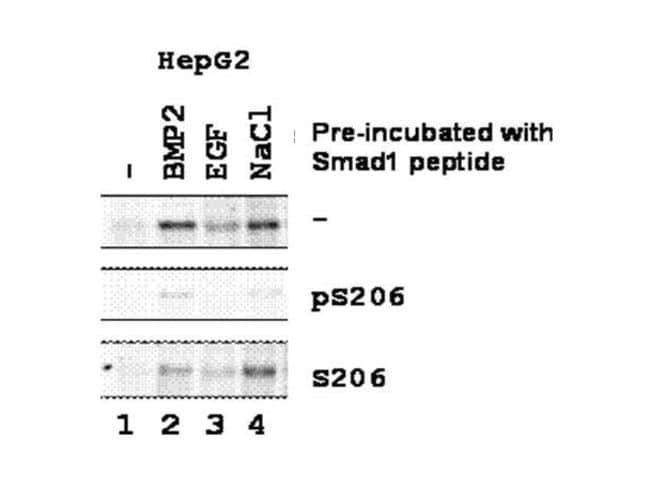
Phospho-SMAD1 (Ser206) Polyclonal Antibody, Rockland™


Description
Store vial at -20°C prior to opening. Aliquot contents and freeze at -20°C or below for extended storage. Avoid cycles of freezing and thawing. Centrifuge product if not completely clear after standing at room temperature. This product is stable for several weeks at 4°C as an undiluted liquid. Dilute only prior to immediate use. This affinity-purified antibody is directed against the phosphorylated form of human SMAD1 protein at the pS206 residue. Reactivity occurs against human SMAD1 pS206 protein and the antibody is specific for the phosphorylated form of the protein. Reactivity with non-phosphorylated human SMAD1 is minimal by ELISA and western blot. A BLAST analysis was used to suggest 100% cross reactivity with SMAD1 from human, Duckbill platypus, Drosophila, mouse, opossum, chimpanzee, bonobo, orangutan, gorilla, macaque, cattle, sheep, pig, rat, horse, salmon, chicken, and dog based on the sequence homology with the immunogen. Reactivity against homologues from other sources is not known.
Specifications
Specifications
| Antigen | Phospho-SMAD1 (Ser206) |
| Applications | ELISA, Western Blot |
| Classification | Polyclonal |
| Concentration | 0.82 mg/mL |
| Conjugate | Unconjugated |
| Formulation | 0.02M potassium phosphate with 0.15M NaCl and 0.01% sodium azide; pH 7.2 |
| Gene | SMAD1 |
| Gene Accession No. | P70340, P97588, Q15797 |
| Gene Alias | AI528653; BSP1; BSP-1; Dwarfin-A; Dwf-A; DWFC; hSMAD1; JV41; JV4-1; JV5-1; MAD (mothers against decapentaplegic, Drosophila) homolog 1; MAD homolog 1; MAD homolog1 (mothers against decapentaplegic, Drosophila); MAD, mothers against decapentaplegic homolog 1; Madh1; MADH5; Madr1; Mad-related protein 1; Mlp1; mMad1; Mothers against decapentaplegic homolog 1; mothers against DPP homolog 1; Mothers-against-DPP-related 1; Mothers-against-DPP-related-1; MusMLP; OTTHUMP00000220456; SMAD; SMAD 1; SMAD family member 1; SMAD, mothers against DPP homolog 1; SMAD1; SMAD5; TGF-beta signaling protein 1; transforming growth factor-beta signaling protein 1; Transforming growth factor-beta-signaling protein 1 |
| Gene Symbols | SMAD1 |
| Show More |
By clicking Submit, you acknowledge that you may be contacted by Fisher Scientific in regards to the feedback you have provided in this form. We will not share your information for any other purposes. All contact information provided shall also be maintained in accordance with our Privacy Policy.