Promotional price valid on web orders only. Your contract pricing may differ. Interested in signing up for a dedicated account number?
Learn More
Learn More
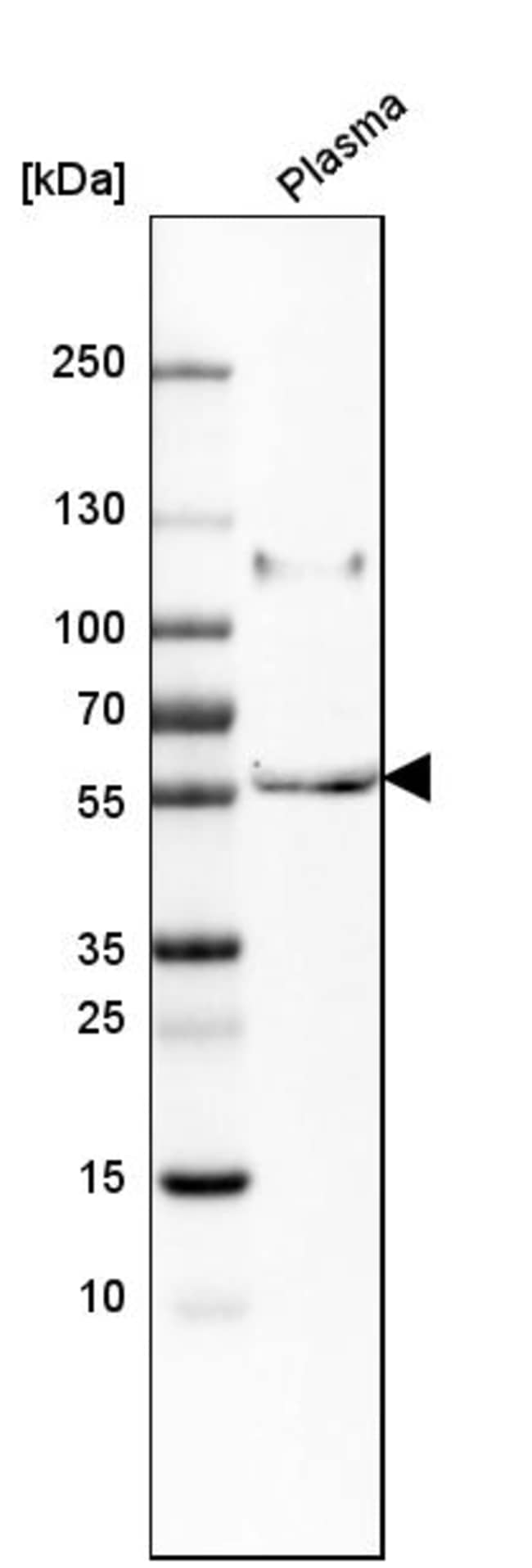
Invitrogen™ PI16 Polyclonal Antibody

Description
Immunogen sequence: CEPIGSPEDA QDLPYLVTEA PSFRATEASD SRKMGTPSSL ATGIPAFLVT EVSGSLATKA LPAVETQAPT SLATKDPPSM ATEAPPCVT Highest antigen sequence indentity to the following orthologs: Rat - 53%, Mouse - 61%.
Peptidase inhibitor 16 (PI16), also known as CRISP-9 or PSPBP, is a member of the cysteine-rich secretory protein (CRISP) family and plays a significant role in various biological processes. This protein consists of 436 amino acids and features three N-linked glycosylation motifs, suggesting its localization to the plasma membrane through a GPI anchor. PI16 has been implicated as a binding protein for prostate secretory protein of 94 amino acids (PSP94), which reflects its potential involvement in reproductive biology. Recent findings highlight PI16's expression in fibroblasts, particularly marking a precursor fibroblast cell state, which is critical in fibroblast lineage development. This expression is heightened in certain pathological conditions, such as neuropathic pain and inflammatory arthritis. In neuropathic pain models such as the spared nerve injury (SNI) model, elevated PI16 levels are noted in fibroblasts within the dorsal root ganglia (DRG) and sciatic nerve, but not in neurons or glia. Interestingly, mice lacking PI16 are protected against neuropathic pain, indicating its role in enhancing pain signaling. Conversely, in rheumatoid arthritis (RA), PI16's overexpression in peripheral blood and synovial fluid correlates with worsened arthritis severity, partly by suppressing the expression of the regulatory T cell marker Foxp3. This complex role of PI16, affecting various signaling pathways and cellular states, underscores its potential as a therapeutic target in pain and inflammatory diseases.

Specifications
Specifications
| Antigen | PI16 |
| Applications | Western Blot |
| Classification | Polyclonal |
| Concentration | 0.4 mg/mL |
| Conjugate | Unconjugated |
| Formulation | PBS with 40% glycerol and 0.02% sodium azide; pH 7.2 |
| Gene | PI16 |
| Gene Accession No. | Q6UXB8 |
| Gene Alias | 1200009H11Rik; CD364; Cripi; CRISP9; CRISP-9; Cysteine-rich protease inhibitor; cysteine-rich secretory protein 9; microseminoprotein, beta-binding protein; MSMBBP; peptidase inhibitor 16; Pi16; PI-16; protease inhibitor 16; PSEC0164; PSP94-binding protein; PSPBP; UNQ289/PRO328 |
| Gene Symbols | PI16 |
| Show More |
Product Title
By clicking Submit, you acknowledge that you may be contacted by Fisher Scientific in regards to the feedback you have provided in this form. We will not share your information for any other purposes. All contact information provided shall also be maintained in accordance with our Privacy Policy.
Spot an opportunity for improvement?