Promotional price valid on web orders only. Your contract pricing may differ. Interested in signing up for a dedicated account number?
Learn More
Learn More
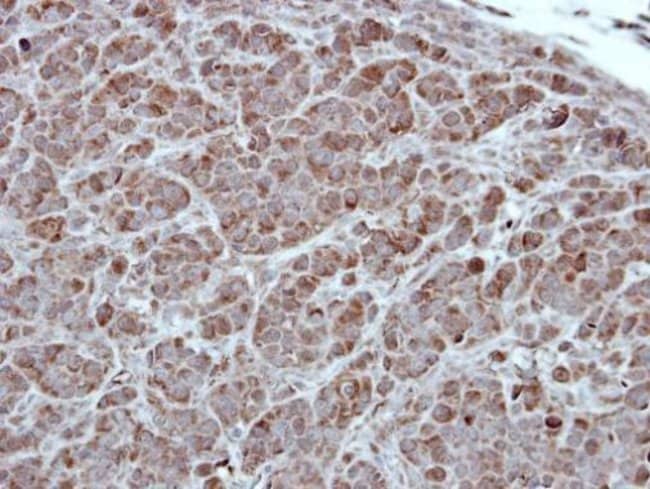
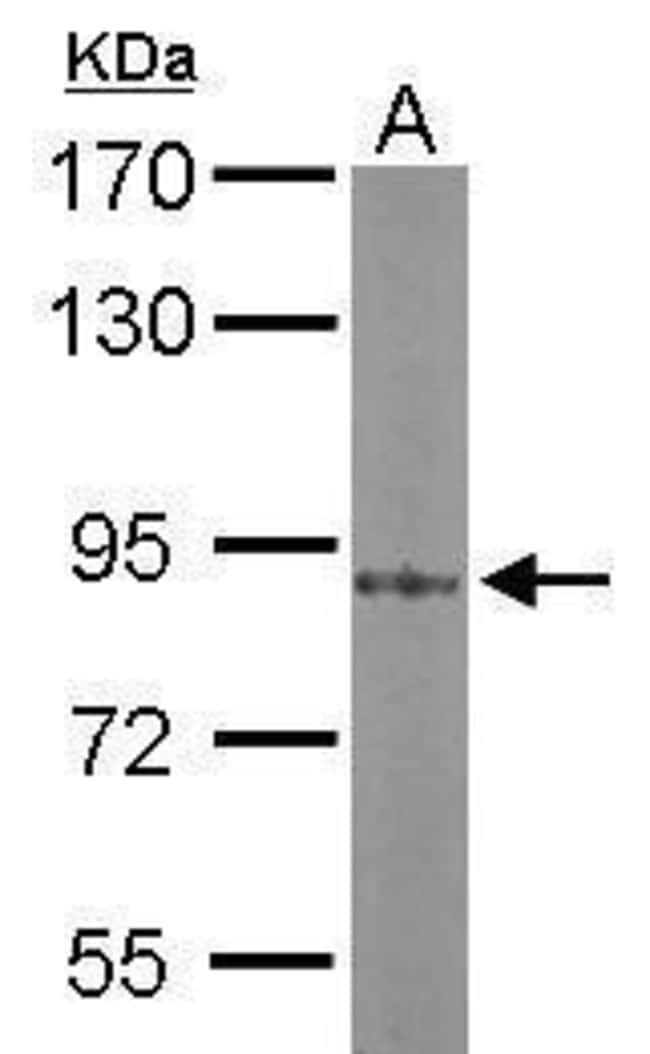
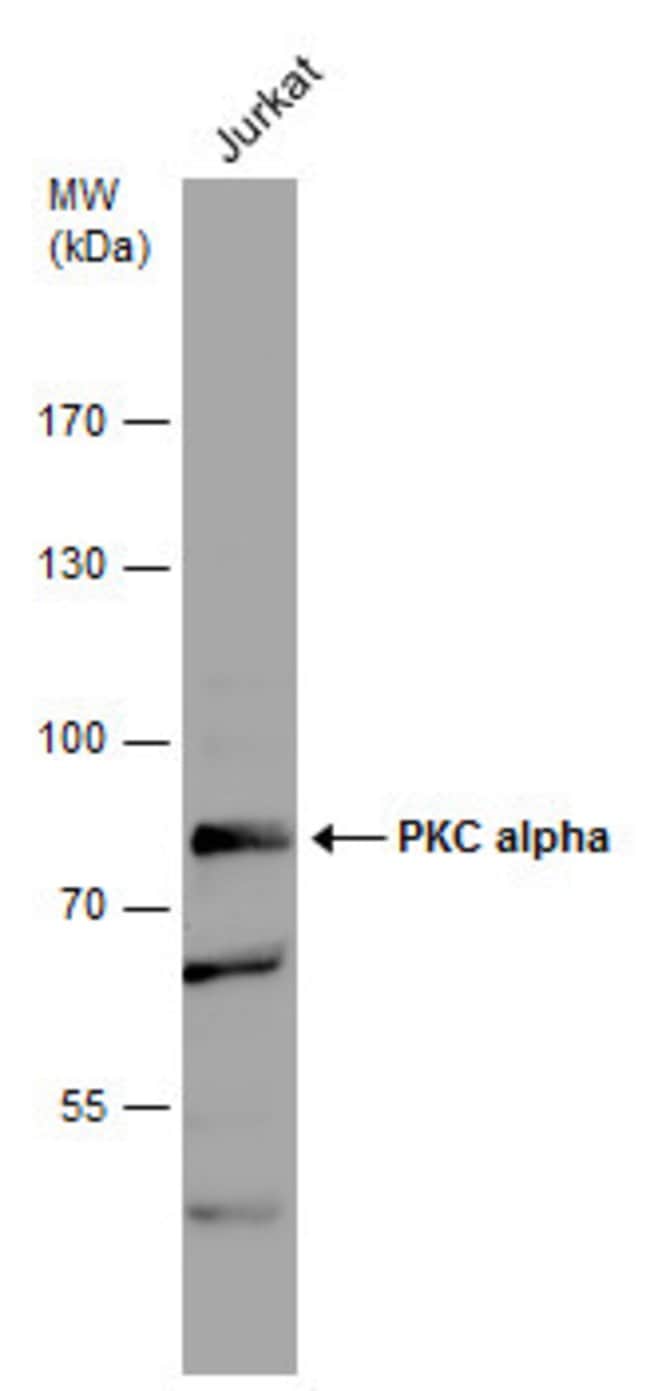
Invitrogen™ PKC alpha Polyclonal Antibody

Description
Recommended positive controls: Jurkat, Mouse brain. Predicted reactivity: Mouse (100%), Zebrafish (90%), Xenopus laevis (94%), Rabbit (100%), Chicken (98%), Rhesus Monkey (100%), Bovine (99%). Store product as a concentrated solution. Centrifuge briefly prior to opening the vial.
The PKC family of serine/threonine kinases, including PRKCA (PKC alpha), is activated intracellularly by signal transduction pathways. In humans, at least 12 different PKC polypeptides have been identified. These isoforms differ in primary structure, tissue distribution, subcellular localization, mode of action in vitro, response to extracellular signals, and substrate specificity. PKC alpha, beta I, beta II, and gamma form the conventional family; their activities are Ca2+- and phospholipid-dependent. Protein kinase C (PKC) can be activated by calcium and the second messenger diacylglycerol. PKC family members phosphorylate a wide variety of protein targets and are known to be involved in diverse cellular signaling pathways. PKC family members also serve as major receptors for phorbol esters, a class of tumor promoters. Each member of the PKC family has a specific expression profile and is believed to play a distinct role in cells. The protein encoded by this gene is one of the PKC family members. This kinase has been reported to play roles in many different cellular processes, such as cell adhesion, cell transformation, cell cycle checkpoint, and cell volume control. Knockout studies in mice suggest that this kinase may be a fundamental regulator of cardiac contractility and Ca(2+) handling in myocytes.

Specifications
Specifications
| Antigen | PKC alpha |
| Applications | Immunohistochemistry (Paraffin), Western Blot |
| Classification | Polyclonal |
| Concentration | 0.74 mg/mL |
| Conjugate | Unconjugated |
| Formulation | 0.1M tris glycine with 10% glycerol and 0.01% thimerosal; pH 7 |
| Gene | PRKCA |
| Gene Accession No. | P17252, P20444 |
| Gene Alias | AAG6; aging-associated gene 6; AI875142; EC 2.7.11.13; FHC; FTH; FTHL6; im:7139045; kinase PKC-alpha; KPCA; MGC104426; PIG15; PKC III; Pkca; PKC-A; PKC-alpha; PKC-III; PKRCA; PLIF; PRKACA; Prkca; prkcaa; protein kinase C; protein kinase C alpha; protein kinase C alpha type; protein kinase C alpha type; protein kinase C, alpha, a; protein kinase C, alpha; protein kinase C, alpha, a; protein kinase c-alpha; si:dkey-8l19.1; Unknown (protein for IMAGE:7139045); unnamed protein product |
| Gene Symbols | PRKCA |
| Show More |
Safety and Handling
WARNING: Cancer - www.P65Warnings.ca.gov
Product Title
By clicking Submit, you acknowledge that you may be contacted by Fisher Scientific in regards to the feedback you have provided in this form. We will not share your information for any other purposes. All contact information provided shall also be maintained in accordance with our Privacy Policy.
Spot an opportunity for improvement?