Promotional price valid on web orders only. Your contract pricing may differ. Interested in signing up for a dedicated account number?
Learn More
Learn More
Invitrogen™ Podoplanin Polyclonal Antibody

Description
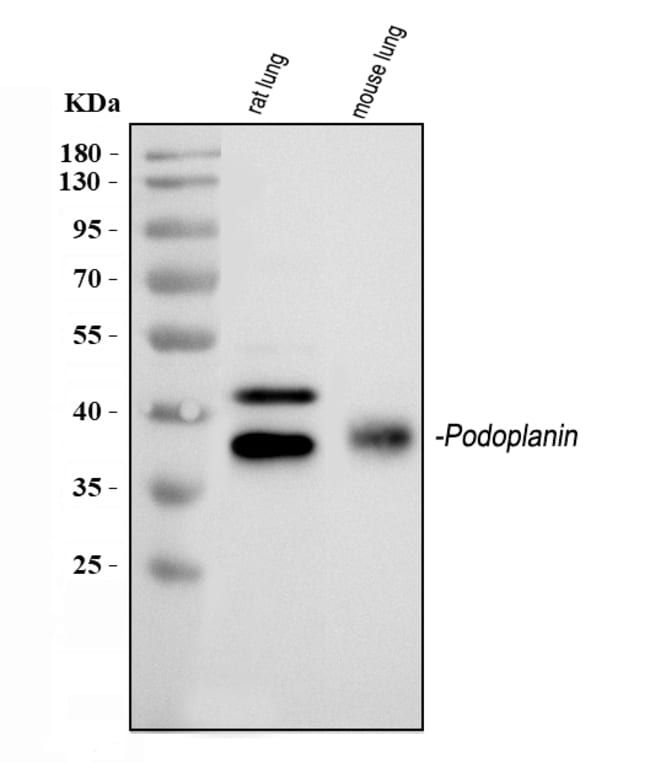
Reconstitute with 0.2 mL of distilled water to yield a concentration of 500 μg/mL. Positive Control - WB: rat lung tissue, mouse lung tissue.
Podoplanin (PDPN, T1A, gp38, Aggrus) is a mucin type-1 glycoprotein with a 40-43 kDa molecular weight. Podoplanin is expressed in many tumors and normal cells, especially lymphatic epithelial cells and follicular DCs. Podoplanin localizes in stromal cells of peripheral lymphoid tissue and thymic epithelial cells. As a regulator of the lymphatic endothelium, podoplanin probably plays a role in maintaining the unique shape of podocytes. Podoplanin appears to serve as a ligand for CLEC-2 and expression is positively correlated with tumors expressing greater invasive and metastatic potential. Podoplanin is directly involved in cell migration, aids metastases formation and tumor cell invasion of tissue. Further, it has also been determined that podoplanin expression is induced through Src activation of Cas and, recently, there are indications of podoplanin presence on Th17 cells. Initial studies below indicate the presence of podoplanin on a small but distinct population of CD4+ cells from human PBMC. Dysfunction of the podoplanin protein has been linked to diseases such as lymphangioma and subglottis neoplasm. Podoplanin has also been proposed as a marker for lung injury due to the physiological function of the protein.

Specifications
Specifications
| Antigen | Podoplanin |
| Applications | Western Blot |
| Classification | Polyclonal |
| Concentration | 500 μg/mL |
| Conjugate | Unconjugated |
| Formulation | PBS with 4mg trehalose and 0.05mg sodium azide |
| Gene | PDPN |
| Gene Accession No. | Q62011, Q64294 |
| Gene Alias | 29kDa cytosolic podoplanin intracellular domain; Aggrus; CTA-520D8.1; E11; E11 antigen epitope; epithelial cell surface transmembrane protein antigen; glycoprotein 36; Glycoprotein 38; glycoprotein, 36-KD; GP36; Gp38; GP40; HT1A-1; hT1alpha-1; hT1alpha-2; lung type I cell membrane associated glycoprotein; lung type-I cell membrane-associated glycoprotein (T1A-2); Ots8; OTS-8; OTTHUMP00000009640; OTTHUMP00000044504; PA2.26; PA2.26 antigen; PDPN; PICD; Podoplanin; PSEC0003; PSEC0025; pulmonary type I alveolar epithelial cell transmembrane differentiation marker; RANDAM-2; RP23-348F1.2; RTI140; RTI40; T1a; T1A2; T1A-2; T1alpha; T1-alpha; TI1A; Transmembrane glycoprotein E11; type I cell 40 kDa protein |
| Gene Symbols | PDPN |
| Show More |
Safety and Handling
WARNING: Cancer - www.P65Warnings.ca.gov
Product Title
By clicking Submit, you acknowledge that you may be contacted by Fisher Scientific in regards to the feedback you have provided in this form. We will not share your information for any other purposes. All contact information provided shall also be maintained in accordance with our Privacy Policy.
Spot an opportunity for improvement?