Promotional price valid on web orders only. Your contract pricing may differ. Interested in signing up for a dedicated account number?
Learn More
Learn More
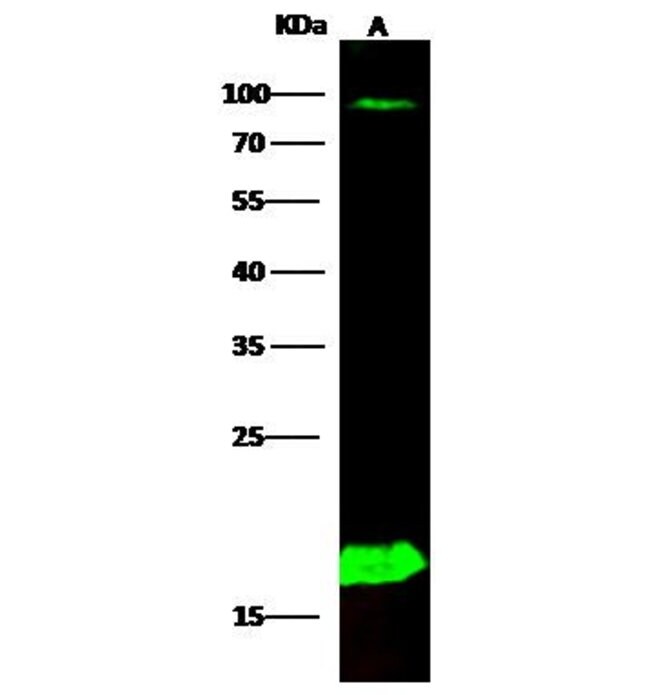
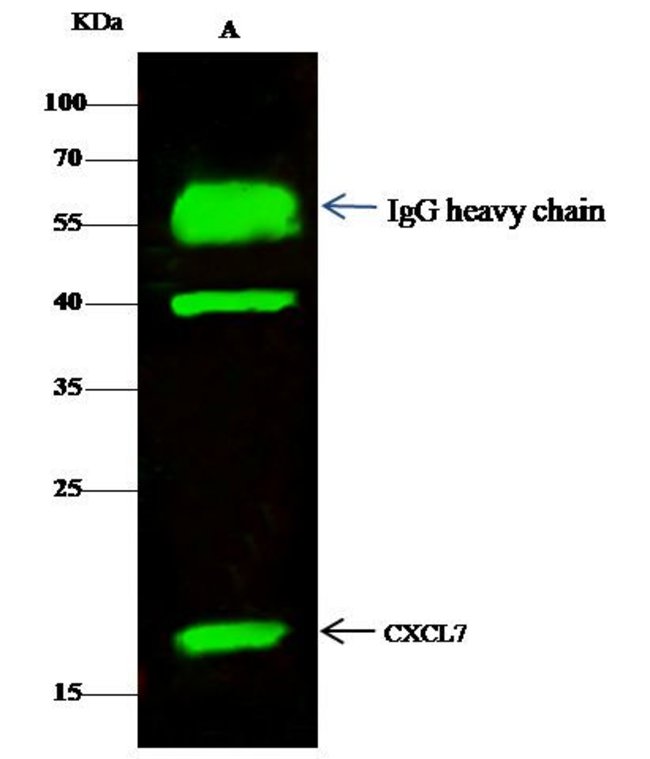
Invitrogen™ PPBP Polyclonal Antibody

Description
This product is preservative free. It is recommended to add sodium azide to avoid contamination (final concentration 0.05%-0.1%). This antibody has specificity for Mouse NAP-2/PPBP/CXCL7.
Members of the a-chemokine subfamily of inducible, secreted, pro-inflammatory cytokines contain a similar motif, in which the first two cysteine residues are separated by a single residue (Cys-X-Cys), and are also chemotactic for neutrophils. The platelet basic protein (PBP), a member of the a-chemokine family, resides in the a-granules of platelets and is released upon their activation. Proteolytic cleavage of the amino terminus of PBP leads to the generation of several peptides, which include mature PBP, connective tissue-activating peptide III (CTAP III, also designated low affinity platelet factor IV (LA-PF4)), b-thromboglobulin (b-TG), and neutrophil-activating peptide 2 (NAP-2). PBP and its N-truncated derivatives mediate inflammation and wound healing. Specifically, NAP-2 activates chemotaxis and degranulation in neutrophils during inflammation. The gene encoding human PBP maps to chromosome 4q12-q13.

Specifications
Specifications
| Antigen | PPBP |
| Applications | ELISA, Immunoprecipitation, Western Blot |
| Classification | Polyclonal |
| Concentration | 1 mg/mL |
| Conjugate | Unconjugated |
| Formulation | PBS with no preservative |
| Gene | PPBP |
| Gene Accession No. | 0 |
| Gene Alias | 2400003M24Rik; AI854500; Beta-TG; Beta-thromboglobulin; b-TG1; chemokine (C-X-C motif) ligand 7; connective tissue-activating peptide III; Connective tissue-activating peptide III(1-81); CTAP3; CTAPIII; CTAP-III; CTAP-III(1-81); CXC chemokine ligand 7; C-X-C motif chemokine 7; CXCL7; LA-PF4; LDGF; Leukocyte-derived growth factor; low-affinity platelet factor IV; Macrophage-derived growth factor; MDGF; NAP-2; NAP-2(1-63); NAP-2(1-66); NAP-2(73); NAP-2(74); NAP-2-L1; neutrophil activating peptide-2; neutrophil-activating peptide 2; Neutrophil-activating peptide 2(1-63); Neutrophil-activating peptide 2(1-66); Neutrophil-activating peptide 2(73); Neutrophil-activating peptide 2(74); neutrophil-activating peptide-2; PBP; Platelet basic protein; PPBP; pro-platelet basic protein; pro-platelet basic protein (chemokine (C-X-C motif) ligand 7); SCYB7; small inducible cytokine B7; small inducible cytokine subfamily B, member 7; small-inducible cytokine B7; TC1; TC-1; TC2; TC-2; TGB; TGB1; THBGB; THBGB1; thrombocidin 1; thrombocidin 2; thromboglobulin, beta-1 |
| Gene Symbols | PPBP |
| Show More |
Product Title
By clicking Submit, you acknowledge that you may be contacted by Fisher Scientific in regards to the feedback you have provided in this form. We will not share your information for any other purposes. All contact information provided shall also be maintained in accordance with our Privacy Policy.
Spot an opportunity for improvement?