Promotional price valid on web orders only. Your contract pricing may differ. Interested in signing up for a dedicated account number?
Learn More

Invitrogen™ PSMA1 Polyclonal Antibody
GREENER_CHOICE

Catalog No. PA1963
Change view
Click to view available options
Quantity:
100 μg
1 product options available for selection
Product selection table with 1 available options. Use arrow keys to navigate and Enter or Space to select.
Catalog No. Quantity
PA1963 100 μg
Use arrow keys to navigate between rows. Press Enter or Space to select a product option. 1 options available.
1 options
Catalog No. PA1963 Supplier Invitrogen™ Supplier No. PA1963
Only null left
Add to Cart
Edge
Add to Cart

Rabbit Polyclonal Antibody

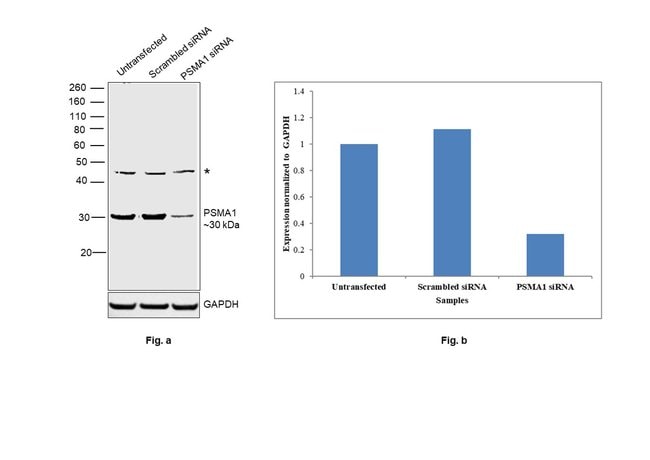
PA1-963 detects proteasome 20S C2 subunit from canine, hamster, human, mouse and rat tissues and cells. PA1-963 has been successfully used in Western blot procedures. By Western blot, this antibody detects a 29 kDa protein representing proteasome 20S C2 subunit from rat brain extract. PA1-963 immunizing peptide corresponds to amino acid residues 249-263 from the C-terminus of human proteasome 20S C2 subunit. This sequence is 93% conserved in the rat and chicken protein and 87% conserved in the mouse protein. PA1-963 immunizing peptide (Cat. # PEP-100) is available for use in neutralization and control experiments.

Proteolytic degradation is critical to the maintenance of appropriate levels of short-lived and regulatory proteins as important and diverse as those involved in cellular metabolism, heat shock and stress response, antigen presentation, modulation of cell surface receptors and ion channels, cell cycle regulation, transcription, and signaling factors. The ubiquitin-proteasome pathway deconstructs most proteins in the eukaryotic cell cytosol and nucleus. Others are degraded via the vacuolar pathway which includes endosomes, lysosomes, and the endoplasmic reticulum. The 26S proteasome is an ATP-dependent, multisubunit (approximately31), barrel-shaped molecular machine with an apparent molecular weight of approximately2. 5 MDa. It consists of a 20S proteolytic core complex which is crowned at one or both ends by 19S regulatory subunit complexes. The 19S regulatory subunits recognize ubiquitinated proteins and play an essential role in unfolding and translocating targets into the lumen of the 20S subunit. An enzymatic cascade is responsible for the attachment of multiple ubiquitin molecules to lysine residues of proteins targeted for degradation. Several genetic diseases are associated with defects in the ubiquitin-proteasome pathway. Some examples of affected proteins include those linked to cystic fibrosis, Angelman's syndrome, and Liddle syndrome.
TRUSTED_SUSTAINABILITY

Specifications

Antigen PSMA1
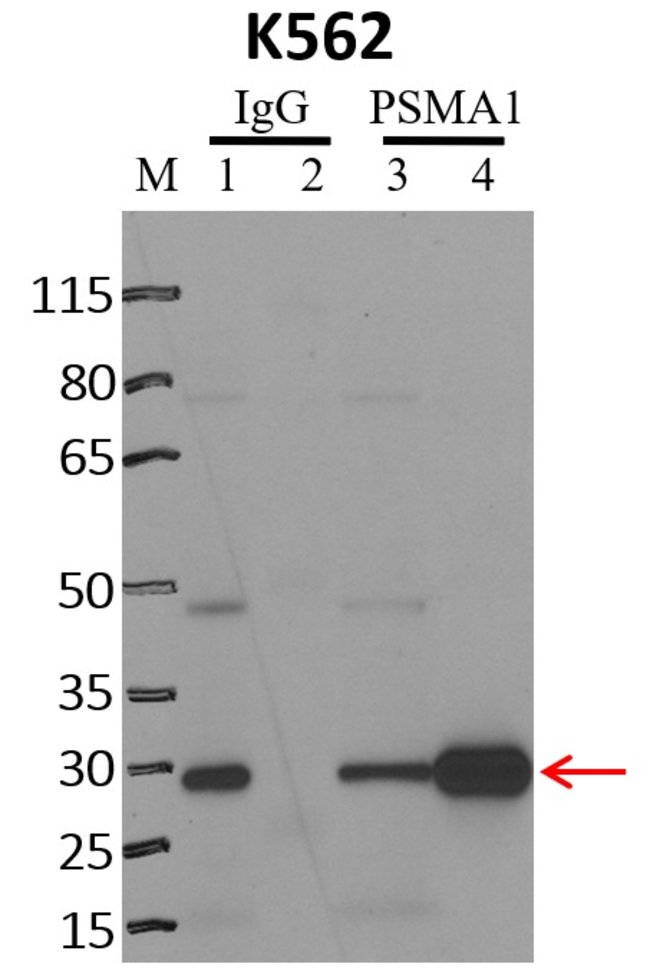
Applications Immunoprecipitation, Western Blot, RNA Immunoprecipitation, Immunocytochemistry
Classification Polyclonal
Concentration 1 mg/mL
Conjugate Unconjugated
Formulation PBS with 1mg/mL BSA and 0.05% sodium azide
Gene PSMA1
Gene Accession No. P18420, P25786, Q9R1P4
Gene Alias 20S proteasome subunit C2; 30 kDa prosomal protein; alpha-type; C2; epididymis secretory protein Li 275; HC2; HEL-S-275; macropain subunit C2; macropain subunit nu; MGC14542; MGC14575; MGC14751; MGC1667; MGC21459; MGC22853; MGC23915; multicatalytic endopeptidase complex subunit C2; NU; PROS30; PROS-30; proteasome (prosome, macropain) subunit, alpha type 1; proteasome (prosome, macropain) subunit, alpha type, 1; proteasome 20S subunit alpha 1; proteasome alpha 1 subunit; proteasome component C2; Proteasome nu chain; proteasome subunit alpha 1; Proteasome subunit alpha type-1; proteasome subunit nu; proteasome subunit, alpha-type, 1; protein P30-33K; PSC2; Psma1; testicular tissue protein Li 150
Gene Symbols PSMA1
Host Species Rabbit
Immunogen Synthetic Peptide: C P(249) A D E P A E K A D E P M E H(263).
Purification Method Antigen affinity chromatography
Quantity 100 μg
Regulatory Status RUO
Primary or Secondary Primary
Gene ID (Entrez) 100773907, 26440, 29668, 476867, 5682
Target Species Human, Mouse, Rat, Canine, Hamster
Content And Storage -20°C, Avoid Freeze/Thaw Cycles
Product Type Antibody
Form Liquid
Isotype IgG
Show More Show Less
Product Title
Select an issue

By clicking Submit, you acknowledge that you may be contacted by Fisher Scientific in regards to the feedback you have provided in this form. We will not share your information for any other purposes. All contact information provided shall also be maintained in accordance with our Privacy Policy.