Promotional price valid on web orders only. Your contract pricing may differ. Interested in signing up for a dedicated account number?
Learn More
Learn More
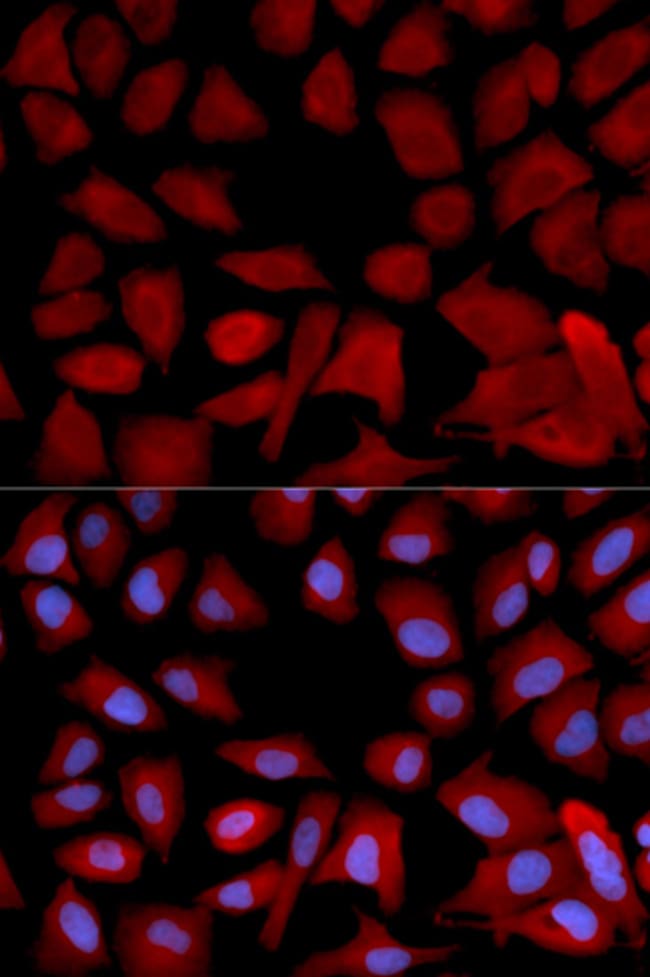
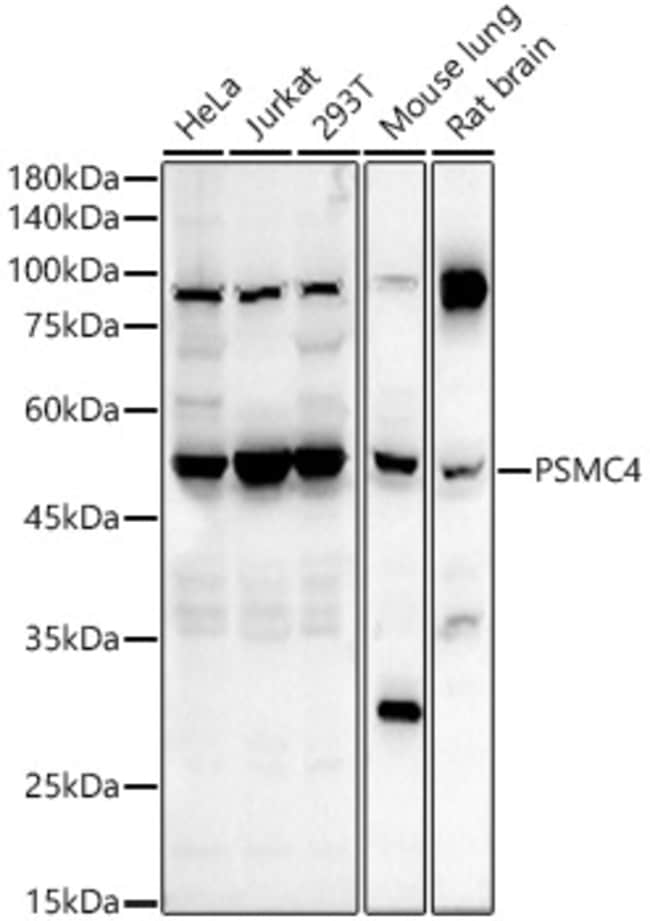
Invitrogen™ PSMC4 Polyclonal Antibody

Description
Immunogen sequence: MEEIGILVEK AQDEIPALSV SRPQTGLSFL GPEPEDLEDL YSRYKKLQQE LEFLEVQEEY IKDEQKNLKK EFLHAQEEVK RIQSIPLVIG QFLEAVDQNT AIVGSTTGSN YYVRILSTID RELLKPNASV ALHKHSNALV DVLPPEADSS IMMLTSDQKP DVMYA; Positive Samples: HepG2, U-251MG, 293T, BT-474, A-549, HeLa, Jurkat, Mouse liver, Mouse heart; Cellular Location: Cytoplasm, Nucleus.
The 26S proteasome is a multicatalytic proteinase complex with a highly ordered structure composed of 2 complexes, a 20S core and a 19S regulator. The 20S core is composed of 4 rings of 28 non-identical subunits; 2 rings are composed of 7 alpha subunits and 2 rings are composed of 7 beta subunits. The 19S regulator is composed of a base, which contains 6 ATPase subunits and 2 non-ATPase subunits, and a lid, which contains up to 10 non-ATPase subunits. Proteasomes are distributed throughout eukaryotic cells at a high concentration and cleave peptides in an ATP/ubiquitin-dependent process in a non-lysosomal pathway. An essential function of a modified proteasome, the immunoproteasome, is the processing of class I MHC peptides. This gene encodes one of the ATPase subunits, a member of the triple-A family of ATPases which have a chaperone-like activity. This subunit has been shown to interact with an orphan member of the nuclear hormone receptor superfamily highly expressed in liver, and with gankyrin, a liver oncoprotein. Two transcript variants encoding different isoforms have been identified.

Specifications
Specifications
| Antigen | PSMC4 |
| Applications | ELISA, Western Blot, Immunocytochemistry |
| Classification | Polyclonal |
| Concentration | 0.31 mg/mL |
| Conjugate | Unconjugated |
| Formulation | PBS with 50% glycerol and 0.05% ProClin 300; pH 7.3 |
| Gene | PSMC4 |
| Gene Accession No. | P43686, P54775, Q63570 |
| Gene Alias | 26S protease regulatory subunit 6B; 26S proteasome AAA-ATPase subunit RPT3; 26S proteasome regulatory subunit 6B; CAR interacing protein 21; CAR interacting protein 21; CIP21; MB67-interacting protein; MGC13687; MGC23214; MGC8570; MIP224; protease 26S subunit 6; proteasome (prosome, macropain) 26S subunit, ATPase, 4; proteasome 26S ATPase subunit 4; proteasome 26S subunit ATPase 4; proteasome 26S subunit, ATPase 4; PSMC4; RPT3; S6; S6 ATPase; Tat-binding protein 7; TBP7; TBP-7 |
| Gene Symbols | PSMC4 |
| Show More |
Product Title
By clicking Submit, you acknowledge that you may be contacted by Fisher Scientific in regards to the feedback you have provided in this form. We will not share your information for any other purposes. All contact information provided shall also be maintained in accordance with our Privacy Policy.
Spot an opportunity for improvement?