Promotional price valid on web orders only. Your contract pricing may differ. Interested in signing up for a dedicated account number?
Learn More
Learn More
Invitrogen™ PTGDS Polyclonal Antibody

Description
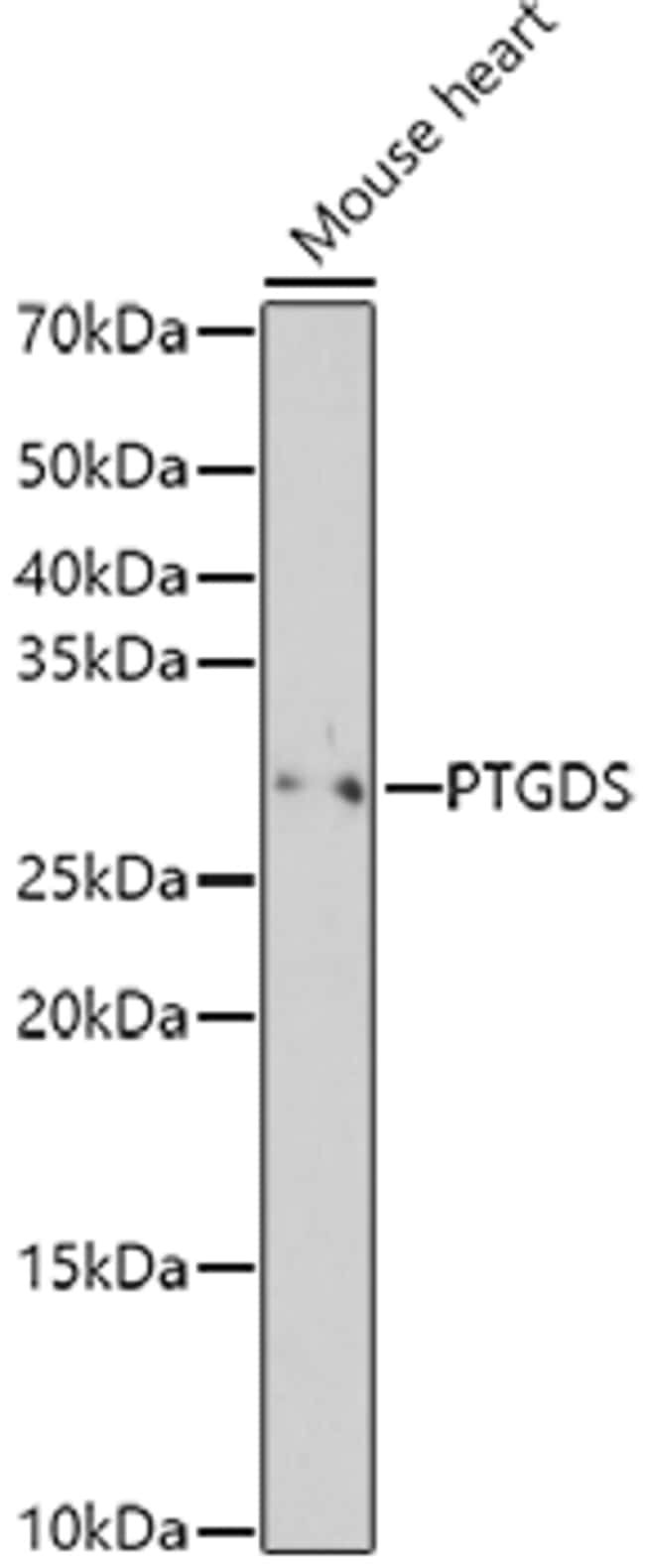
Immunogen sequence: APEAQVSVQP NFQQDKFLGR WFSAGLASNS SWLREKKAAL SMCKSVVAPA TDGGLNLTST FLRKNQCETR TMLLQPAGSL GSYSYRSPHW GSTYSVSVVE TDYDQYALLY SQGSKGPGED FRMATLYSRT QTPRAELKEK FTAFCKAQGF TEDTIVFLPQ TDKCMTEQ; Positive Samples: Mouse heart; Cellular Location: Cytoplasm, Golgi apparatus, Nucleus membrane, Rough endoplasmic reticulum, perinuclear region.
The protein encoded by this gene is a glutathione-independent prostaglandin D synthase that catalyzes the conversion of prostaglandin H2 (PGH2) to postaglandin D2 (PGD2). PGD2 functions as a neuromodulator as well as a trophic factor in the central nervous system. PGD2 is also involved in smooth muscle contraction/relaxation and is a potent inhibitor of platelet aggregation. PTGDS has also been implicated in the development and maintenance of the blood-brain, blood-retina, blood-aqueous humor and blood-testis barrier. Studies with transgenic mice overexpressing this gene suggest that this gene may be also involved in the regulation of non-rapid eye movement (NREM) sleep. It is likely to play important roles in both maturation and maintenance of the central nervous system and male reproductive system. PTGDS is the most abundant protein in the cerebral spinal fluid and recent evidence suggests that PTGDS acts as a Beta-Amyloid chaperone and may have a role in the deposition of Ab plaques in Alzheimer's disease.

Specifications
Specifications
| Antigen | PTGDS |
| Applications | ELISA, Western Blot, Immunocytochemistry |
| Classification | Polyclonal |
| Concentration | 0.19 mg/mL |
| Conjugate | Unconjugated |
| Formulation | PBS with 50% glycerol and 0.02% sodium azide; pH 7.3 |
| Gene | PTGDS |
| Gene Accession No. | O09114, P22057, P41222 |
| Gene Alias | 21kDa; Beta-trace protein; cerebrin-28; Glutathione-independent PGD synthase; glutathione-independent PGD synthetase; lipocalin-type prostaglandin D synthase; lipocalin-type prostaglandin-D synthase; LPGDS; L-PGDS; PDS; PGD2; PGD2 synthase; PGDS; PGDS2; PH2DISO; Prostaglandin D synthase; prostaglandin D2 synthase; prostaglandin D2 synthase (21 kDa, brain); prostaglandin D2 synthase (brain); prostaglandin D2 synthase 21kDa (brain); prostaglandin-D2 synthase; Prostaglandin-H2 D-isomerase; Ptgds; Ptgs3; testis tissue sperm-binding protein Li 63n |
| Gene Symbols | PTGDS |
| Show More |
Product Title
By clicking Submit, you acknowledge that you may be contacted by Fisher Scientific in regards to the feedback you have provided in this form. We will not share your information for any other purposes. All contact information provided shall also be maintained in accordance with our Privacy Policy.
Spot an opportunity for improvement?