Learn More
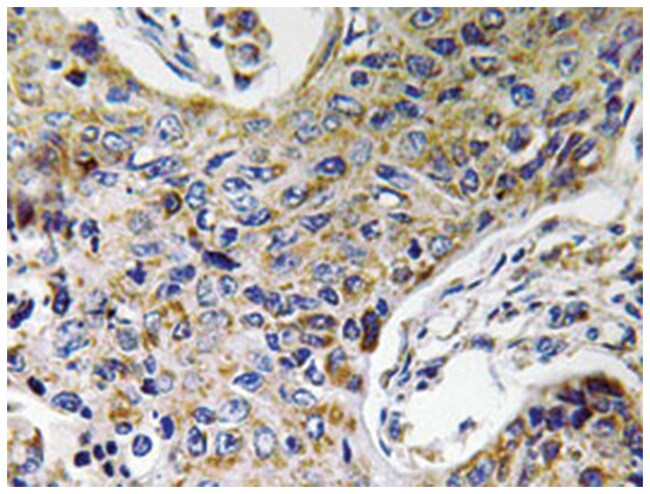
Description
Mitochondrial ATP synthase catalyzes ATP synthesis, utilizing an electrochemical gradient of protons across the inner membrane during oxidative phosphorylation. It is composed of two linked multi-subunit complexes: the soluble catalytic core, F1, and the membrane-spanning component, F0, which comprises the proton channel. The catalytic portion of mitochondrial ATP synthase consists of 5 different subunits (alpha, beta, gamma, delta, and epsilon) assembled with a stoichiometry of 3 alpha, 3 beta, and single representatives of the gamma, delta, and epsilon subunits. The proton channel likely has nine subunits (a, b, c, d, e, f, g, F6 and 8). This gene encodes the f subunit of the F0 complex. Alternatively spliced transcript variants encoding different isoforms have been identified for this gene. This gene has multiple pseudogenes. [provided by RefSeq
Specifications
Specifications
| Antigen | ATP5J2 |
| Applications | Immunohistochemistry (PFA fixed) |
| Classification | Polyclonal |
| Concentration | 1 mg/mL |
| Conjugate | Unconjugated |
| Description | Rabbit polyclonal antibody raised against synthetic peptide of ATP5J2. |
| Dilution | Immunohistochemistry (1:50-1:200) The optimal working dilution should be determined by the end user. |
| Formulation | In PBS, pH 7.2 (0.05% sodium azide) |
| Gene | ATP5J2 |
| Gene Alias | ATP5JL |
| Show More |
For Research Use Only
By clicking Submit, you acknowledge that you may be contacted by Fisher Scientific in regards to the feedback you have provided in this form. We will not share your information for any other purposes. All contact information provided shall also be maintained in accordance with our Privacy Policy.