Learn More
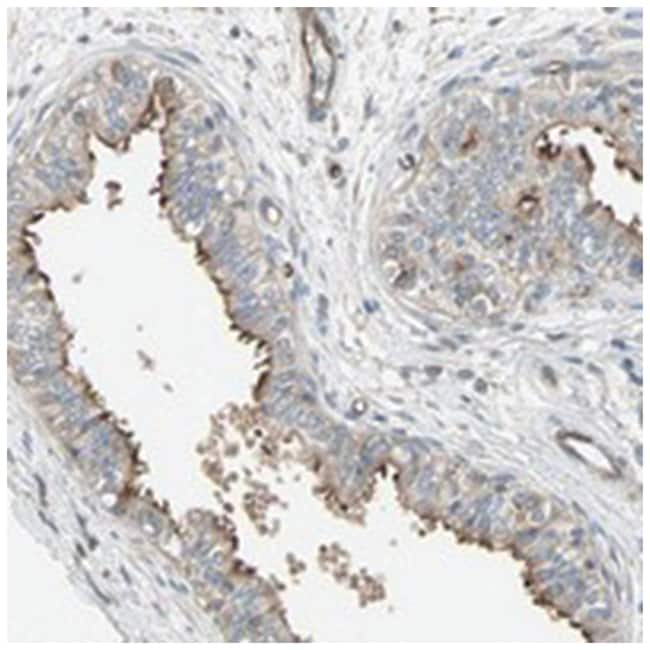
Description
Testicular sperm are morphologically differentiated but are not progressively motile nor able to fertilize an egg. Post-testicular maturation requires exposure of spermatozoa to the microenvironment of the epididymal lumen. Spermatozoa undergo extensive changes in the epididymis, including enzymatic modifications, loss of pre-existing components and addition of new glycoproteins from epididymal secretions. These modifying proteins and enzymes are synthesized by epithelial cells lining the epididymal duct and secreted apically into the lumen, where they come into contact with, and may be absorbed onto, the sperm membranes. The proteins encoded by the genes in this cluster are synthesized and secreted by epididymal epithelial cells. [provided by RefSeq
Specifications
Specifications
| Antigen | FAM12B |
| Applications | Immunohistochemistry (PFA fixed) |
| Classification | Polyclonal |
| Conjugate | Unconjugated |
| Description | Rabbit polyclonal antibody raised against recombinant FAM12B. |
| Dilution | Immunohistochemistry (1:50-1:200) The optimal working dilution should be determined by the end user. |
| Formulation | In PBS, pH 7.5 (40% glycerol, 0.02% sodium azide) |
| Gene | FAM12B |
| Gene Accession No. | P56851 |
| Gene Alias | EP3B/HE3-BETA/HE3B |
| Show More |
For Research Use Only
By clicking Submit, you acknowledge that you may be contacted by Fisher Scientific in regards to the feedback you have provided in this form. We will not share your information for any other purposes. All contact information provided shall also be maintained in accordance with our Privacy Policy.