Learn More
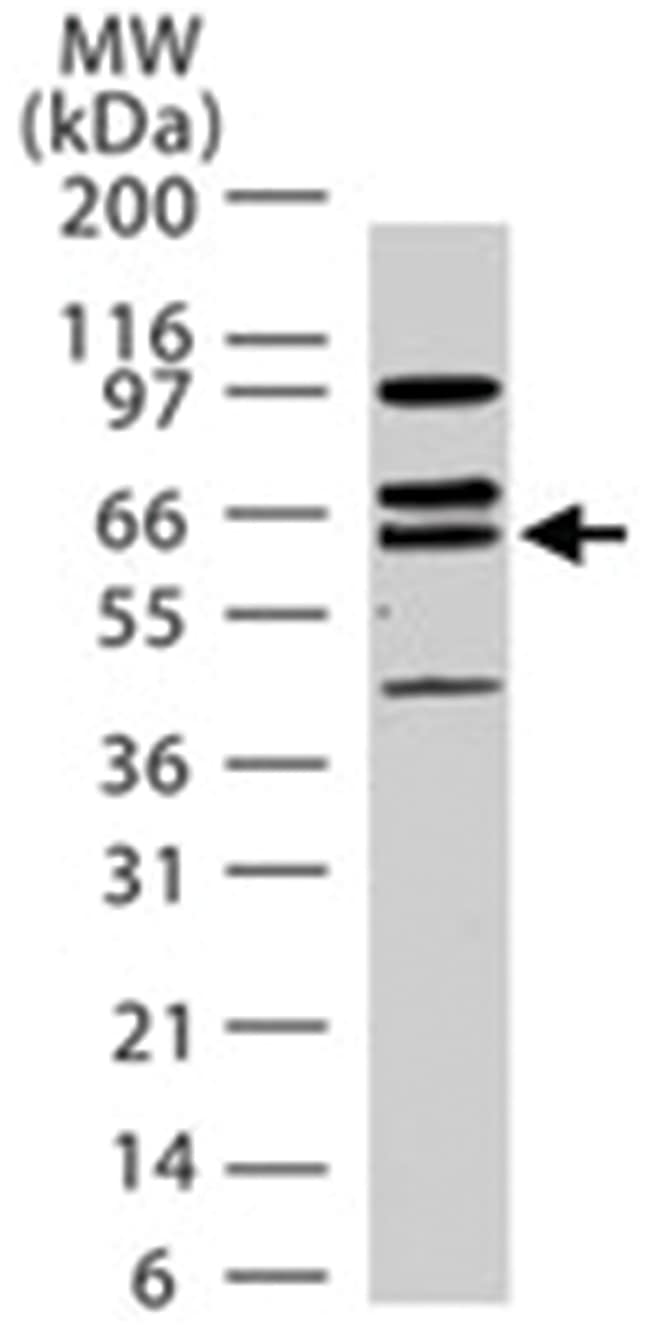
Description
The nuclear lamina consists of a two-dimensional matrix of proteins located next to the inner nuclear membrane. The lamin family of proteins make up the matrix and are highly conserved in evolution. During mitosis, the lamina matrix is reversibly disassembled as the lamin proteins are phosphorylated. Lamin proteins are thought to be involved in nuclear stability, chromatin structure and gene expression. Vertebrate lamins consist of two types, A and B. Through alternate splicing, this gene encodes three type A lamin isoforms. Mutations in this gene lead to several diseases: Emery-Dreifuss muscular dystrophy, familial partial lipodystrophy, limb girdle muscular dystrophy, dilated cardiomyopathy, Charcot-Marie-Tooth disease, and Hutchinson-Gilford progeria syndrome. [provided by RefSeq
Specifications
Specifications
| Antigen | LMNA |
| Applications | Western Blot |
| Classification | Polyclonal |
| Conjugate | Unconjugated |
| Description | Rabbit polyclonal antibody raised against synthetic peptide of LMNA. |
| Dilution | The optimal working dilution should be determined by the end user. |
| Formulation | In PBS (0.05% BSA, 0.05% sodium azide) |
| Gene | LMNA |
| Gene Alias | CDCD1/CDDC/CMD1A/CMT2B1/EMD2/FPL/FPLD/HGPS/IDC/LDP1/LFP/LGMD1B/LMN1/LMNC/PRO1 |
| Gene Symbols | LMNA |
| Show More |
For Research Use Only
By clicking Submit, you acknowledge that you may be contacted by Fisher Scientific in regards to the feedback you have provided in this form. We will not share your information for any other purposes. All contact information provided shall also be maintained in accordance with our Privacy Policy.