Learn More

Description
This gene encodes a member of the tumor necrosis factor (TNF) cytokine family which is a ligand for osteoprotegerin and functions as a key factor for osteoclast differentiation and activation. This protein was shown to be a dentritic cell survival factor and is involved in the regulation of T cell-dependent immune response. T cell activation was reported to induce expression of this gene and lead to an increase of osteoclastogenesis and bone loss. This protein was shown to activate antiapoptotic kinase AKT/PKB through a signaling complex involving SRC kinase and tumor necrosis factor receptor-associated factor (TRAF) 6, which indicated this protein may have a role in the regulation of cell apoptosis. Targeted disruption of the related gene in mice led to severe osteopetrosis and a lack of osteoclasts. The deficient mice exhibited defects in early differentiation of T and B lymphocytes, and failed to form lobulo-alveolar mammary structures during pregnancy. Two alternatively spliced transcript variants have been found. [provided by RefSeq
Specifications
Specifications
| Antigen | TNFSF11 |
| Applications | ELISA, Flow Cytometry, Western Blot |
| Classification | Polyclonal |
| Conjugate | Unconjugated |
| Description | Rabbit polyclonal antibody raised against recombinant TNFSF11. |
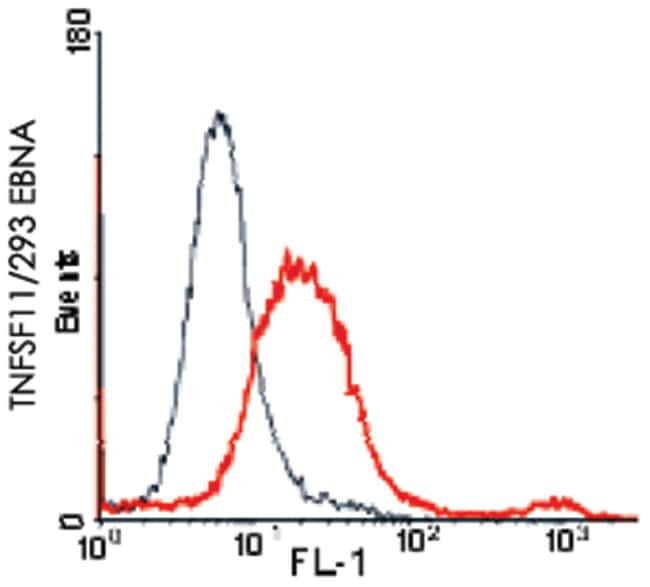
| Dilution | ELISA (1:2000-1:10000) Flow Cytometry (1:500-1:1000) Western Blot (1:2000-1:5000) The optimal working dilution should be determined by the end user. |
| Formulation | In PBS, pH 7.4 |
| Gene | TNFSF11 |
| Gene Alias | CD254/ODF/OPGL/OPTB2/RANKL/TRANCE/hRANKL2/sOdf |
| Gene Symbols | TNFSF11 |
| Show More |
For Research Use Only
By clicking Submit, you acknowledge that you may be contacted by Fisher Scientific in regards to the feedback you have provided in this form. We will not share your information for any other purposes. All contact information provided shall also be maintained in accordance with our Privacy Policy.