Promotional price valid on web orders only. Your contract pricing may differ. Interested in signing up for a dedicated account number?
Learn More

Invitrogen™ RAGE Monoclonal Antibody (5C6C1)
GREENER_CHOICE

Catalog No. PIMA549253
Change view
Click to view available options
Quantity:
100 μg
1 product options available for selection
Product selection table with 1 available options. Use arrow keys to navigate and Enter or Space to select.
Catalog No. Quantity
PIMA549253 100 μg
Use arrow keys to navigate between rows. Press Enter or Space to select a product option. 1 options available.
1 options
Catalog No. PIMA549253 Supplier Invitrogen™ Supplier No. MA549253
Only null left
Add to Cart
Edge
Add to Cart

Mouse Monoclonal Antibody

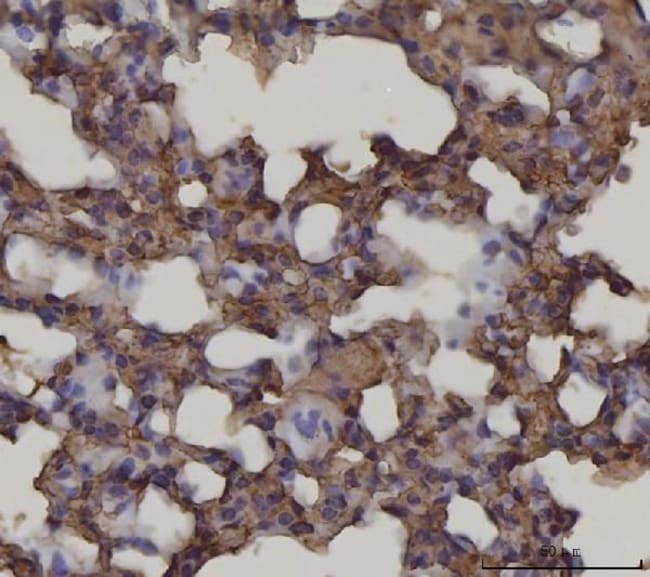
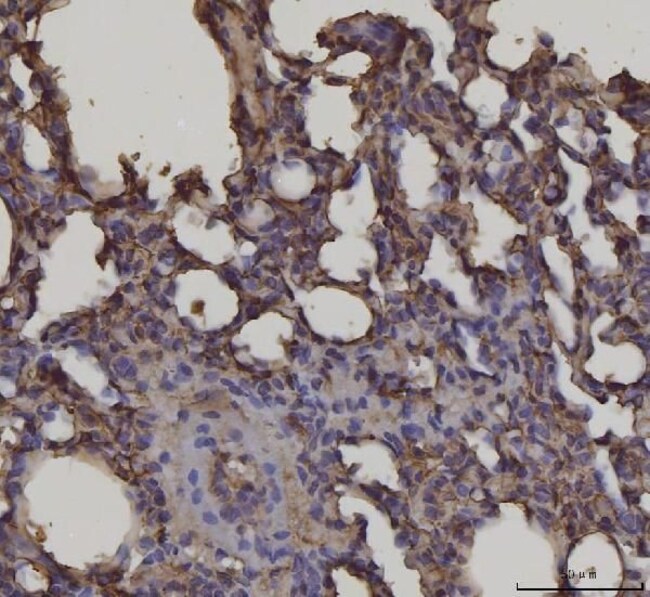
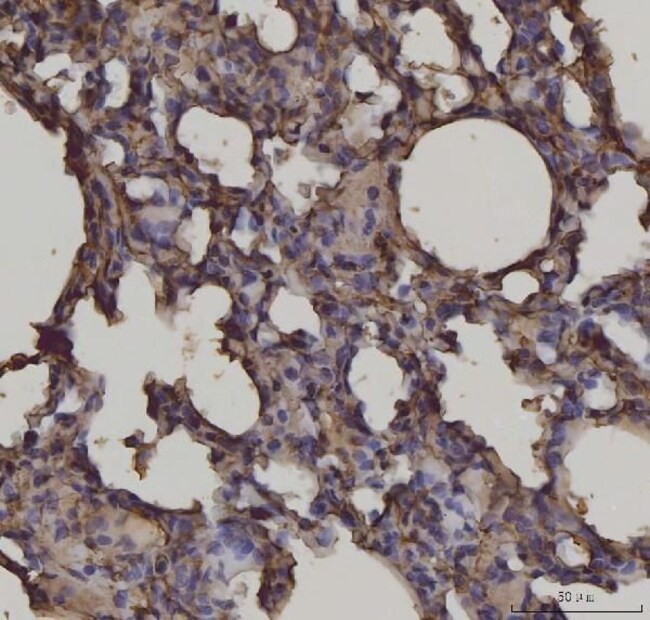
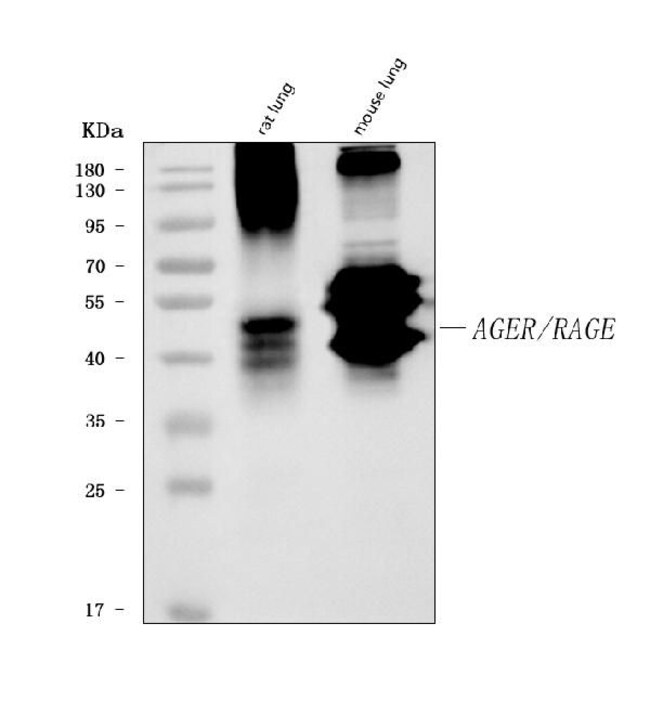
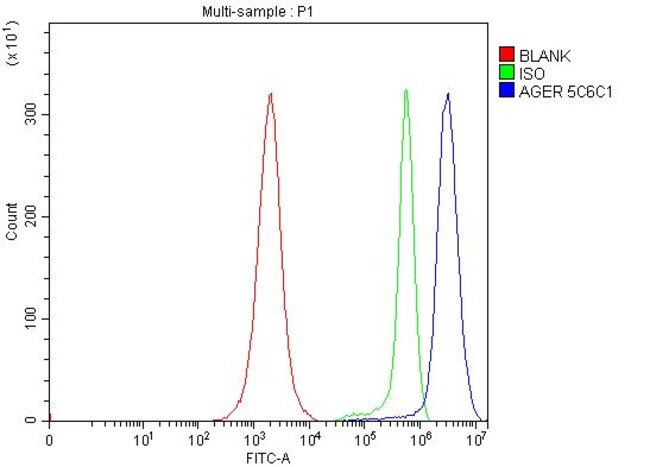
Adding 0.2 mL of distilled water will yield a concentration of 500 μg/mL. Immunogen sequence is different from the related mouse and rat sequences by six amino acids. Positive Control - WB: rat lung tissue, mouse lung tissue. IHC: mouse lung tissue, rat lung tissue, rat lung tissue. Flow: Jurkat cell. Store at -20°C for one year from date of receipt. After reconstitution, at 4°C for one month. It can also be aliquotted and stored frozen at -20°C for six months. Avoid repeated freeze-thaw cycles.

The Receptor for Advanced Glycation End-products (RAGE) is a gene located on human chromosome 6p21.3, encoding a transmembrane receptor belonging to the immunoglobulin superfamily. RAGE is expressed in various tissues, with significant levels in the lungs, and plays a crucial role in cellular signaling and inflammation. As a receptor, RAGE binds multiple ligands, including advanced glycation end-products (AGEs), amyloid-beta peptide, high mobility group box 1 (HMGB1), and S100/calgranulin proteins, facilitating diverse pathological processes like inflammation, cancer progression, and neurodegeneration. The interaction between RAGE and its ligands triggers intracellular signaling pathways such as NF-kB activation, leading to inflammatory responses and oxidative stress. In the context of chronic diseases like diabetes, Alzheimer's, and cardiovascular diseases, RAGE is a critical mediator, linking metabolic disturbance to cellular dysfunction. Therapeutic targeting of RAGE signaling is under investigation, aiming to mitigate its contribution to inflammatory and degenerative diseases.
TRUSTED_SUSTAINABILITY

Specifications

Antigen RAGE
Applications Flow Cytometry, Immunohistochemistry (Paraffin), Western Blot
Classification Monoclonal
Clone 5C6C1
Concentration 500 μg/mL
Conjugate Unconjugated
Formulation PBS with 4mg trehalose and no preservative
Gene AGER
Gene Accession No. Q15109, Q62151, Q63495
Gene Alias advanced glycation end product receptor; advanced glycation end-product receptor; advanced glycation end-products receptor; advanced glycosylation end product-specific receptor; advanced glycosylation end product-specific receptor variant 2; advanced glycosylation end product-specific receptor variant 3; advanced glycosylation end product-specific receptor variant 4; advanced glycosylation end product-specific receptor variant 5; advanced glycosylation end-product specific receptor; Ager; MAPK/MAK/MRK overlapping kinase; MOK; MOK protein kinase; RAGE; RAGE isoform NtRAGE-delta; RAGE isoform sRAGE-delta; RAGE/AGER; RAGE1; RAGE-1; RAGE-4 ORF3; receptor for advanced glycation endproducts; receptor for advanced glycation end-products variant 20; receptor for advanced glycosylation end products; receptor of advanced glycosylation end products of proteins; immunoglobulin superfamily; MHC class II; MHC class III; renal cell carcinoma antigen; renal tumor antigen 1; SCARJ1; sRAGE; STK30
Gene Symbols AGER
Host Species Mouse
Immunogen A synthetic peptide corresponding to a sequence at the N-terminus of human RAGE (91-120aa IQDEGIFRCQAMNRNGKETKSNYRVRVYQI).
Purification Method Antigen affinity chromatography
Quantity 100 μg
Regulatory Status RUO
Primary or Secondary Primary
Gene ID (Entrez) 11596, 177, 81722
Target Species Human, Mouse, Rat
Content And Storage -20°C
Product Type Antibody
Form Lyophilized
Isotype IgG2b
Show More Show Less
Product Title
Select an issue

By clicking Submit, you acknowledge that you may be contacted by Fisher Scientific in regards to the feedback you have provided in this form. We will not share your information for any other purposes. All contact information provided shall also be maintained in accordance with our Privacy Policy.