Learn More
Invitrogen™ RAGE Polyclonal Antibody

Description
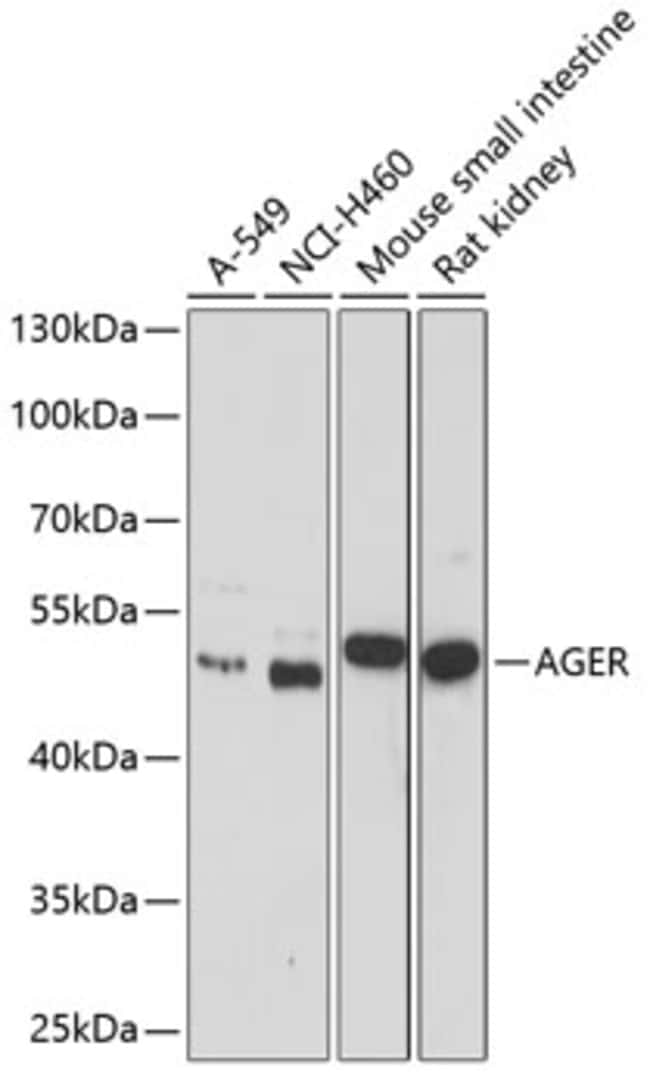
Immunogen sequence: IGEPLVLKCK GAPKKPPQRL EWKLNTGRTE AWKVLSPQGG GPWDSVARVL PNGSLFLPAV GIQDEGIFRC QAMNRNGKET KSNYRVRVYQ IPGKPEIVDS ASELTAGVPN KVGTCVSEGS YPAGTLSWHL DGKPLVPNEK GVSVKEQTRR HPETGLFTLQ SELMVTPARG GDPRPTFSCS FSPGLPRHRA LRTAPIQPRV WEPVPLEEVQ LVVEPEGGAV APGGTVTLTC EVPAQPSPQI HWMKDGVPLP LPPSPVLILP EIGPQDQGTY SCVATHSSHG PQESRAVSIS IIEPGEEGPT A; Positive Samples: A-549, NCI-H460, Mouse small intestine, Rat kidney; Cellular Location: Cell membrane, Single-pass type I membrane protein.

Specifications
Specifications
| Antigen | RAGE |
| Applications | ELISA, Western Blot |
| Classification | Polyclonal |
| Concentration | 0.24 mg/mL |
| Conjugate | Unconjugated |
| Formulation | PBS with 50% glycerol and 0.02% sodium azide; pH 7.3 |
| Gene | AGER |
| Gene Accession No. | Q15109, Q62151, Q63495 |
| Gene Alias | advanced glycation end product receptor; advanced glycation end-product receptor; advanced glycation end-products receptor; advanced glycosylation end product-specific receptor; advanced glycosylation end product-specific receptor variant 2; advanced glycosylation end product-specific receptor variant 3; advanced glycosylation end product-specific receptor variant 4; advanced glycosylation end product-specific receptor variant 5; advanced glycosylation end-product specific receptor; Ager; MAPK/MAK/MRK overlapping kinase; MOK; MOK protein kinase; RAGE; RAGE isoform NtRAGE-delta; RAGE isoform sRAGE-delta; RAGE/AGER; RAGE1; RAGE-1; RAGE-4 ORF3; receptor for advanced glycation endproducts; receptor for advanced glycation end-products variant 20; receptor for advanced glycosylation end products; receptor of advanced glycosylation end products of proteins; immunoglobulin superfamily; MHC class II; MHC class III; renal cell carcinoma antigen; renal tumor antigen 1; SCARJ1; sRAGE; STK30 |
| Gene Symbols | AGER |
| Show More |
Safety and Handling
By clicking Submit, you acknowledge that you may be contacted by Fisher Scientific in regards to the feedback you have provided in this form. We will not share your information for any other purposes. All contact information provided shall also be maintained in accordance with our Privacy Policy.