Promotional price valid on web orders only. Your contract pricing may differ. Interested in signing up for a dedicated account number?
Learn More

Invitrogen™ ROBO1 Polyclonal Antibody
GREENER_CHOICE

Catalog No. PIPA5120344
Change view
Click to view available options
Quantity:
100 μL
1 product options available for selection
Product selection table with 1 available options. Use arrow keys to navigate and Enter or Space to select.
Catalog No. Quantity
PIPA5120344 100 μL
Use arrow keys to navigate between rows. Press Enter or Space to select a product option. 1 options available.
1 options
This item is not returnable. View return policy
Catalog No. PIPA5120344 Supplier Invitrogen™ Supplier No. PA5120344
Add to Cart
Add to Cart
This item is not returnable. View return policy

Rabbit Polyclonal Antibody

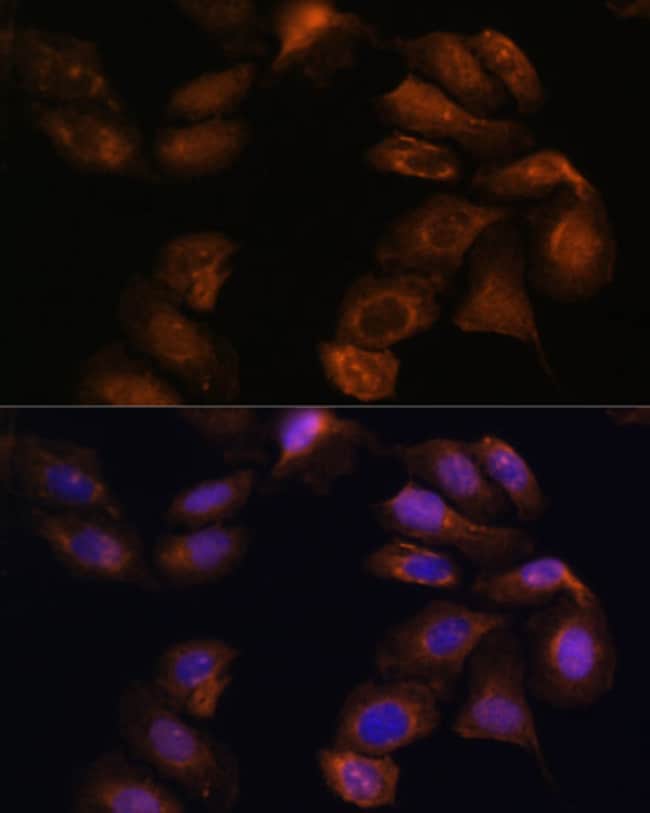
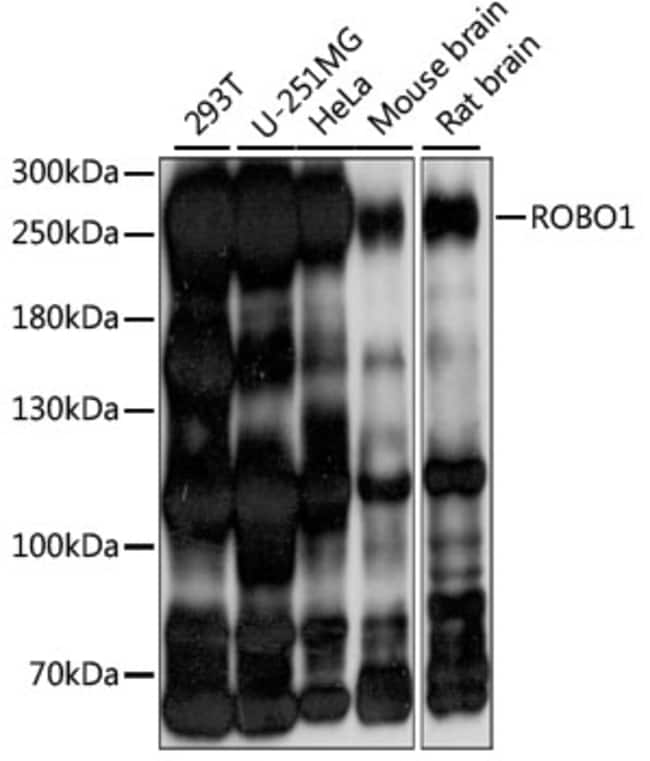
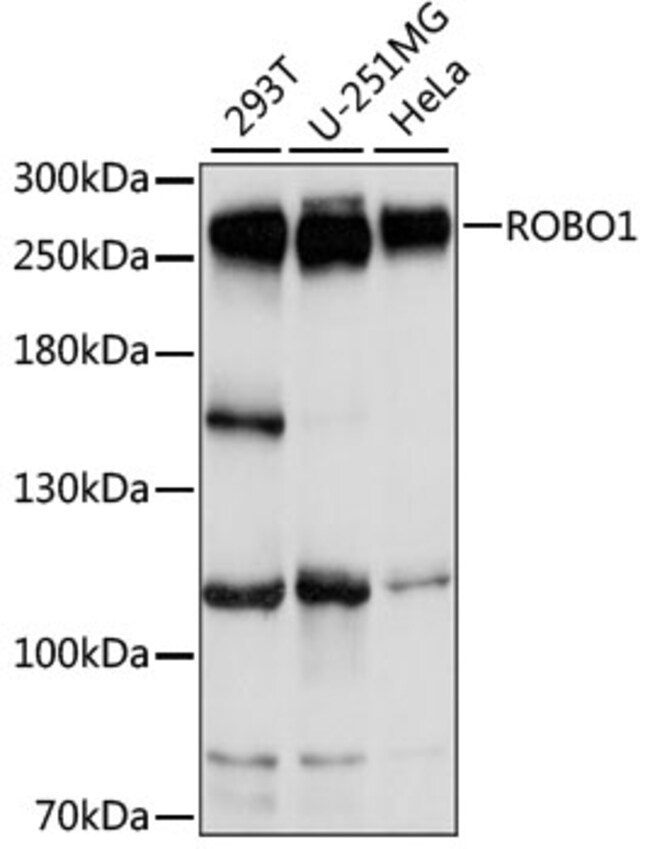
Positive test controls include: 293T, U-251MG, HeLa, 293T, U-251MG, HeLa, Mouse brain, Rat brain. The target is usually found in the following locations: Cell membrane, Cell projection, Single-pass type I membrane protein, axon. Immunogen sequence: AAVMQKTRPA KKLKHQPGHL RRETYTDDLP PPPVPPPAIK SPTAQSKTQL EVRPVVVPKL PSMDARTDRS SDRKGSSYKG REVLDGRQVV DMRTNPGDPR EAQEQQNDGK GRGNKAAKRD LPPAKTHLIQ EDILPYCRPT FPTSNNPRDP SSSSSMSSRG SGSRQREQAN VGRRNIAEMQ VLGGYERGED NNEELEETES.

Specialized cells at the midline, which separates the left and right halves of the CNS, have a number of roles in directing growth cone behavior. In the vertebrate spinal cord, the insect ventral nerve cord and in C. elegans, midline cells produce guidance cues such as nectins and slit, which act as attractants and repellents, respectively. These cells may act as gatekeepers to prevent axons from crossing the midline and to induce a switch in growth cone responsiveness to guidance cues beyond the gateway. One such gatekeeper, Robo, is an axon guidance receptor that defines a novel subfamily of Ig superfamily proteins that are conserved from fruit flies to mammals. Robo acts as a receptor for the repellent Slit and functions in a cell-autonomous fashion. Non-crossing axons express high levels of Robo, whereas crossing axons express low levels of Robo before reaching the midline and high levels after they cross. Robo1 and Robo2 are two human homologs of the Drosophila protein Roundabout. Robo1 is also homologous to the C. elegans gene sax3, whereas Robo2 is homologous to the zebrafish gene astray.
TRUSTED_SUSTAINABILITY

Specifications

Antigen ROBO1
Applications ELISA, Western Blot, Immunocytochemistry
Classification Polyclonal
Concentration 0.47 mg/mL
Conjugate Unconjugated
Formulation PBS with 50% glycerol and 0.01% thimerosal; pH 7.3
Gene ROBO1
Gene Accession No. O55005, O89026, Q9Y6N7
Gene Alias AW494633; AW742721; deleted in U twenty twenty; DUTT1; FLJ21882; Gm310; HGNC:10249; H-Robo-1; MGC131599; MGC133277; ROBO1; roundabout 1; roundabout guidance receptor 1; roundabout homolog 1; roundabout homolog 1 (Drosophila); roundabout, axon guidance receptor, homolog 1; roundabout, axon guidance receptor, homolog 1 (Drosophila); Roundabout1 protein; SAX3
Gene Symbols ROBO1
Host Species Rabbit
Immunogen Recombinant fusion protein containing a sequence corresponding to amino acids 1452-1651 of human ROBO1 (NP_002932.1).
Purification Method Affinity chromatography
Quantity 100 μL
Regulatory Status RUO
Primary or Secondary Primary
Gene ID (Entrez) 19876, 58946, 6091
Target Species Human, Mouse, Rat
Content And Storage -20°C, Avoid Freeze/Thaw Cycles
Product Type Antibody
Form Liquid
Isotype IgG
Show More Show Less
Product Title
Select an issue

By clicking Submit, you acknowledge that you may be contacted by Fisher Scientific in regards to the feedback you have provided in this form. We will not share your information for any other purposes. All contact information provided shall also be maintained in accordance with our Privacy Policy.