Promotional price valid on web orders only. Your contract pricing may differ. Interested in signing up for a dedicated account number?
Learn More
Learn More
Invitrogen™ Sclerostin Polyclonal Antibody

Description
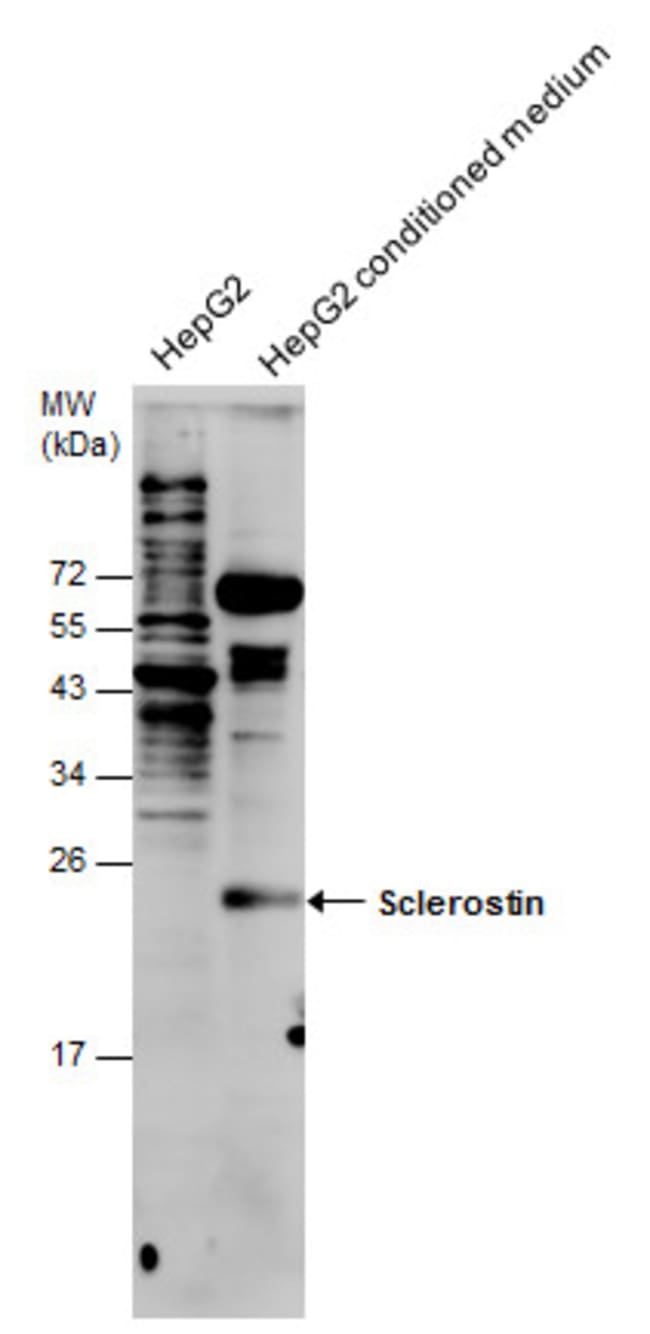
Keep as concentrated solution. Predicted reactivity: Mouse (89%), Rat (92%), Rhesus Monkey (97%), Bovine (94%). Positive Control: HepG2 conditioned medium. Store product as a concentrated solution. Centrifuge briefly prior to opening the vial.
Sclerostin, a glycoprotein predominantly secreted by osteocytes, is a member of the Cerberus/DAN family of putative BMP antagonists that functions as an endogenous regulator of the canonical Wnt signaling pathway and an inhibitory regulator of bone homeostasis. Although expressed nearly exclusively by osteocytes, sclerostin can also be found at significant levels elsewhere, such as bone, bone marrow, cartilage, the kidney, and the liver, and has also been shown to be produced by hypertrophic chondrocytes and cementocytes. Like DKK family members DKK-1 and DKK-4, sclerostin plays an important regulatory role in the Wnt/beta-catenin signaling pathway by forming inhibitory complexes with LDL Receptor-related proteins 5 and 6 (LRP5 and LRP6), which are essential components of the Wnt/beta-catenin signaling system. LRP5 and LRP6 are single-pass transmembrane proteins that appear to act as co-receptors for Wnt ligands involved in the Wnt/beta-catenin signaling cascade. Sclerostin has also been shown to interact directly with LRP4 via its extracellular domain to facilitate inhibition of Wnt signaling, and can catabolically promote osteoclast activity by increasing osteocyte expression of RANKL. Sclerostin's critical involvement in the regulation of bone formation and resorption is emphasized by two bone dysplasia disorders, sclerosteosis and van Buchem disease (VBD), caused by rare autosomal recessive mutations that result in progressive bone overgrowth and hypermineralization due to markedly decreased sclerostin levels.

Specifications
Specifications
| Antigen | Sclerostin |
| Applications | Western Blot |
| Classification | Polyclonal |
| Concentration | 2.73 mg/mL |
| Conjugate | Unconjugated |
| Formulation | PBS with 20% glycerol and 0.025% ProClin 300; pH 7 |
| Gene | SOST |
| Gene Accession No. | Q9BQB4 |
| Gene Alias | 5430411E23Rik; CDD; DAND6; sclerosteosis; sclerostin; SOST; SOST1; UNQ2976/PRO7455/PRO7476; VBCH |
| Gene Symbols | SOST |
| Show More |
Product Title
By clicking Submit, you acknowledge that you may be contacted by Fisher Scientific in regards to the feedback you have provided in this form. We will not share your information for any other purposes. All contact information provided shall also be maintained in accordance with our Privacy Policy.
Spot an opportunity for improvement?