Promotional price valid on web orders only. Your contract pricing may differ. Interested in signing up for a dedicated account number?
Learn More
Learn More
Invitrogen™ SCN9A Polyclonal Antibody

Description
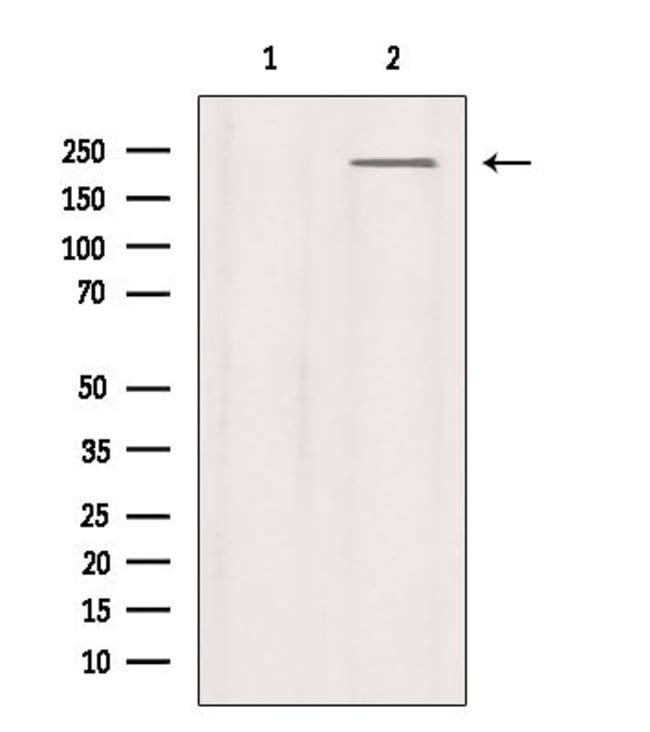
Antibody detects endogenous levels of total Nav1.7.
Epithelial sodium channels are amiloride-sensitive members of the Degenerin/epithelial sodium channel (Deg/ENaC) superfamily of ion channels. Members of this superfamily of ion channels share organizational similarity in that they all possess two short intracellular amino and carboxyl termini, two short membrane spanning segments, and a large extracellular loop with a conserved cysteine-rich region. There are three homologous isoforms of the ENaC (alpha, beta, and gamma) protein. ENaC in the kidney, lung, and colon plays an essential role in trans-epithelial sodium and fluid balance. ENaC also mediates aldosterone-dependent sodium reabsorption in the distal nephron of the kidney, thus regulating blood pressure. ENaC is thought to be regulated, in part, through association with the cystic fibrosis transmembrane conductance regulator (CFTR) chloride ion channel. Gain-of-function mutations in beta- or gamma-ENaC can cause severe arterial hypertension (Liddels syndrome) and loss-of-function mutations in alpha- or beta-ENaC causes pseudohypoaldosteronism (PHA-1).

Specifications
Specifications
| Antigen | SCN9A |
| Applications | Western Blot |
| Classification | Polyclonal |
| Concentration | 1 mg/mL |
| Conjugate | Unconjugated |
| Formulation | PBS with 50% glycerol and 0.02% sodium azide; pH 7.4 |
| Gene | SCN9A |
| Gene Accession No. | Q15858, Q62205 |
| Gene Alias | ETHA; FEB3B; GEFSP7; hNaN; hNE Na; hNE-Na; HSAN2D; KIAA1356; Kiaa4197; MED; mKIAA4197; NAC1; NAC2; NAC3; Nav1.1; Nav1.2; Nav1.3; Nav1.4; Nav1.5; Nav1.6; Nav1.7; Nav1.8; Nav1.9; NE; NE NA; NENA; NE-NA; neuroendocrine sodium channel; Peripheral sodium channel 1; PN1; SCN1; SCN10A; SCN11A; SCN12A; SCN1A; Scn2a; SCN2A1; SCN2A2; SCN3A; SCN4A; SCN5A; SCN8A; Scn9a; SFNP; SNS2; sodium channel 25; sodium channel protein type 9 subunit alpha; Sodium channel protein type IX subunit alpha; sodium channel, voltage gated, type IX alpha subunit; sodium channel, voltage-gated, type 9, alpha polypeptide; sodium channel, voltage-gated, type IX, alpha; sodium channel, voltage-gated, type IX, alpha polypeptide; sodium channel, voltage-gated, type IX, alpha subunit; sodium voltage-gated channel alpha subunit 9; voltage-gated sodium channel alpha subunit Nav1.7; voltage-gated sodium channel subunit alpha Nav1.7 |
| Gene Symbols | SCN9A |
| Show More |
Product Title
By clicking Submit, you acknowledge that you may be contacted by Fisher Scientific in regards to the feedback you have provided in this form. We will not share your information for any other purposes. All contact information provided shall also be maintained in accordance with our Privacy Policy.
Spot an opportunity for improvement?