Promotional price valid on web orders only. Your contract pricing may differ. Interested in signing up for a dedicated account number?
Learn More
Learn More
Invitrogen™ SCNN1B Monoclonal Antibody (16E4), PerCP

Description
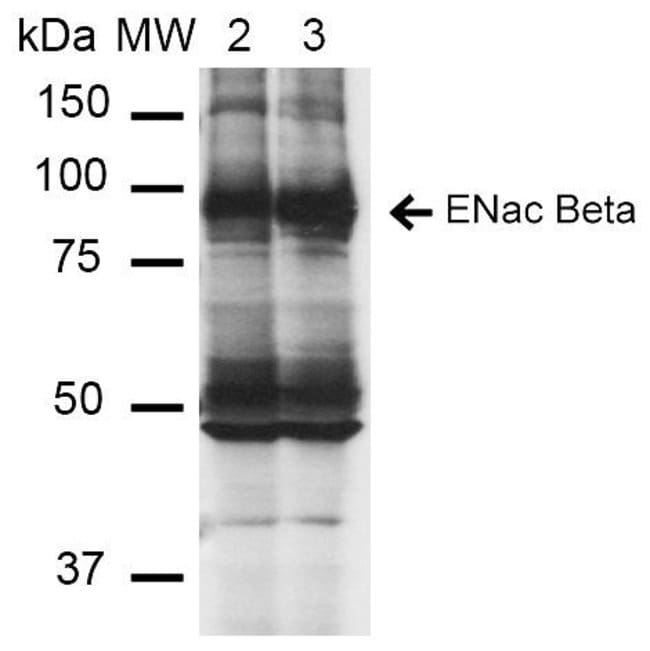
A 1:1,000 dilution of MA5-45357 was sufficient for detection of ENaC beta in 15 μg of Mouse whole kidney lysate by ECL immunoblot analysis using goat anti-mouse IgG:HRP as the secondary antibody. Detects approximately 87kDa.
Sodium permeable non-voltage-sensitive ion channel inhibited by the diuretic amiloride. Mediates the electrodiffusion of the luminal sodium (and water, which follows osmotically) through the apical membrane of epithelial cells. Controls the reabsorption of sodium in kidney, colon, lung and sweat glands. Also plays a role in taste perception. Heterotetramer of two alpha, one beta and one gamma subunit. A delta subunit can replace the alpha subunit. Interacts with the WW domains of NEDD4, NEDD4L, WWP1 and WWP2. Defects in SCNN1B are a cause of autosomal recessive pseudohypoaldosteronism type 1 (PHA1) [MIM:264350]. PHA1 is a rare salt wasting disease resulting from target organ unresponsiveness to mineralocorticoids. There are 2 forms of PHA1: the autosomal recessive form that is severe, and the dominant form which is more milder and due to defects in mineralocorticoid receptor. Autosomal recessive PHA1 is characterized by an often fulminant presentation in the neonatal period with dehydration, hyponatraemia, hyperkalaemia, metabolic acidosis, failure to thrive and weight loss. Defects in SCNN1B are a cause of Liddle syndrome. It is an autosomal dominant disorder characterized by pseudoaldosteronism and hypertension associated with hypokalemic alkalosis. The disease is caused by constitutive activation of the renal epithelial sodium channel.

Specifications
Specifications
| Antigen | SCNN1B |
| Applications | Western Blot |
| Classification | Monoclonal |
| Clone | 16E4 |
| Concentration | 1 mg/mL |
| Conjugate | PerCP |
| Formulation | 2.48mM MES, 95.64mM phosphate with 0.5M EDTA and no preservative; pH 7.4 |
| Gene | SCNN1B |
| Gene Accession No. | Q9WU38 |
| Gene Alias | Amiloride-sensitive sodium channel subunit beta; amiloride-sensitive sodium channel subunit beta 1; amiloride-sensitive sodium channel subunit beta-like protein; BESC1; Beta ENaC; beta-ENaC; Beta-NaCH; betaxENaC; ENaC beta; ENaCb; enacbeta; epithelial Na(+) channel subunit beta; epithelial sodium channel beta-2 subunit; epithelial sodium channel beta-3 subunit; epithelial sodium channel, nonvoltage-gated 1, beta; nasal epithelial sodium channel beta subunit; nonvoltage-gated sodium channel 1 subunit beta; RNENACB; SCNEB; SCNN 1B; SCNN1B; scnn1b.L; scnn1b-a; scnn1b-b; sodium channel epithelial 1 beta subunit; sodium channel, non voltage gated 1 beta subunit; sodium channel, non voltage gated 1 beta subunit L homeolog; sodium channel, nonvoltage-gated 1 beta; sodium channel, nonvoltage-gated 1, beta; sodium channel, non-voltage-gated 1, beta subunit; sodium channel, nonvoltage-gated, type I, beta; XELAEV_18045378mg |
| Show More |
Safety and Handling
WARNING: Cancer - www.P65Warnings.ca.gov
Product Title
By clicking Submit, you acknowledge that you may be contacted by Fisher Scientific in regards to the feedback you have provided in this form. We will not share your information for any other purposes. All contact information provided shall also be maintained in accordance with our Privacy Policy.
Spot an opportunity for improvement?