Promotional price valid on web orders only. Your contract pricing may differ. Interested in signing up for a dedicated account number?
Learn More

Invitrogen™ SNRPN Monoclonal Antibody (6F12)
GREENER_CHOICE

Catalog No. PIMA549219
Change view
Click to view available options
Quantity:
100 μg
1 product options available for selection
Product selection table with 1 available options. Use arrow keys to navigate and Enter or Space to select.
Catalog No. Quantity
PIMA549219 100 μg
Use arrow keys to navigate between rows. Press Enter or Space to select a product option. 1 options available.
1 options
Catalog No. PIMA549219 Supplier Invitrogen™ Supplier No. MA549219
Only null left
Add to Cart
Add to Cart

Mouse Monoclonal Antibody

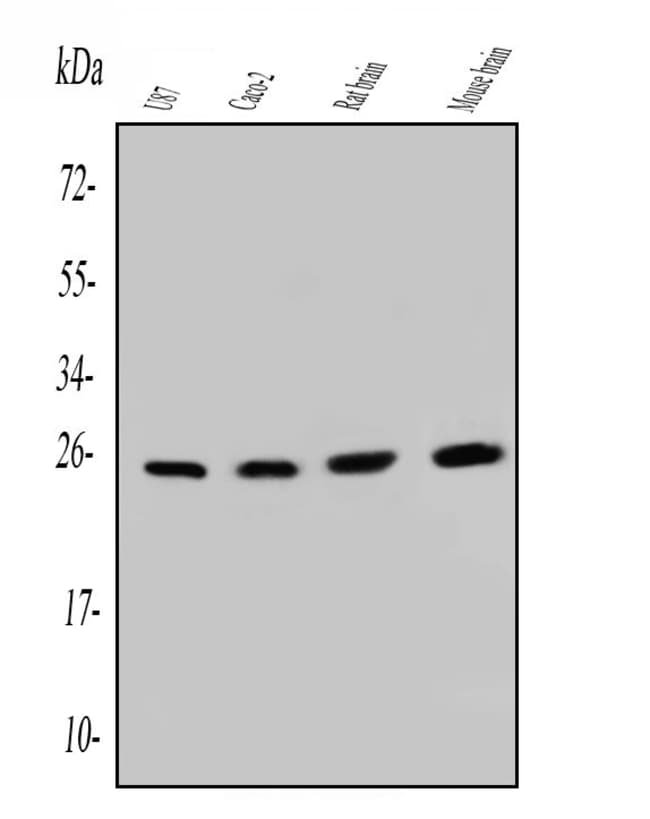
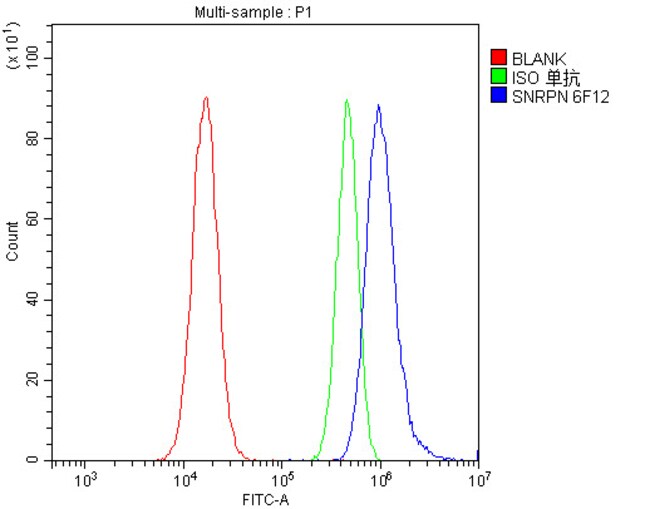
Adding 0.2 mL of distilled water will yield a concentration of 500 μg/mL. Immunogen sequence is identical to the related mouse and rat sequences. Positive Control - WB: human U87 whole cell, human Caco-2 whole cell, rat brain tissue, mouse brain tissue. Flow: A549 cell. Store at -20°C for one year from date of receipt. After reconstitution, at 4°C for one month. It can also be aliquotted and stored frozen at -20°C for six months. Avoid repeated freeze-thaw cycles.

The protein encoded by this gene is one polypeptide of a small nuclear ribonucleoprotein complex and belongs to the snRNP SMB/SMN family. The protein plays a role in pre-mRNA processing, possibly tissue-specific alternative splicing events. Although individual snRNPs are believed to recognize specific nucleic acid sequences through RNA-RNA base pairing, the specific role of this family member is unknown. The protein arises from a bicistronic transcript that also encodes a protein identified as the SNRPN upstream reading frame (SNURF). Multiple transcription initiation sites have been identified and extensive alternative splicing occurs in the 5' untranslated region. Additional splice variants have been described but sequences for the complete transcripts have not been determined. The 5' UTR of this gene has been identified as an imprinting center. Alternative splicing or deletion caused by a translocation event in this paternally-expressed region is responsible for Angelman syndrome or Prader-Willi syndrome due to parental imprint switch failure.
TRUSTED_SUSTAINABILITY

Specifications

Antigen SNRPN
Applications Flow Cytometry, Western Blot
Classification Monoclonal
Clone 6F12
Concentration 500 μg/mL
Conjugate Unconjugated
Formulation PBS with 4mg trehalose and 0.05mg sodium azide
Gene SNRPN
Gene Accession No. P63162, P63163, P63164
Gene Alias 2410045I01Rik; DKFZp686C0927; DKFZp686M12165; DKFZp761I1912; DKFZp762N022; FE 294; FE 294 psi; FE294; FE294 gene for snRNP-associated polypeptide N; FE294 psi; FE294 psi pseudogene; FLJ33569; FLJ36996; FLJ39265; HCERN3; MGC29886; Peg4; PWCR; Pwcr1; RT-LI; Sm protein D; sm protein N; small nuclear ribonucleoparticle-associated protein (snRNP) mRNA clone Sm51; small nuclear ribonucleoparticle-associated protein (snRNP) mRNA, clone Sm51; small nuclear ribonucleoprotein N; small nuclear ribonucleoprotein polypeptide N; small nuclear ribonucleoprotein-associated protein N; Sm-D; Smn; sm-N; snRNP-N; Snrpn; SNRPN upstream reading frame; SNURF; SNURF-SNRPN; tissue-specific splicing protein; tissue-specific-splicing protein
Gene Symbols SNRPN
Host Species Mouse
Immunogen A synthetic peptide corresponding to a sequence at the N-terminus of human SNRPN (11-39aa QHIDYRMRCILQDGRIFIGTFKAFDKHMN).
Purification Method Antigen affinity chromatography
Quantity 100 μg
Regulatory Status RUO
Primary or Secondary Primary
Gene ID (Entrez) 20646, 6638, 81781
Target Species Human, Mouse, Rat
Content And Storage -20°C
Product Type Antibody
Form Lyophilized
Isotype IgG2b
Show More Show Less
Product Title
Select an issue

By clicking Submit, you acknowledge that you may be contacted by Fisher Scientific in regards to the feedback you have provided in this form. We will not share your information for any other purposes. All contact information provided shall also be maintained in accordance with our Privacy Policy.