Promotional price valid on web orders only. Your contract pricing may differ. Interested in signing up for a dedicated account number?
Learn More

Invitrogen™ SNX6 Polyclonal Antibody
GREENER_CHOICE

Catalog No. PIPA587586
Change view
Click to view available options
Quantity:
100 μL
1 product options available for selection
Product selection table with 1 available options. Use arrow keys to navigate and Enter or Space to select.
Catalog No. Quantity
PIPA587586 100 μL
Use arrow keys to navigate between rows. Press Enter or Space to select a product option. 1 options available.
1 options
Catalog No. PIPA587586 Supplier Invitrogen™ Supplier No. PA587586
Add to Cart
Add to Cart

Rabbit Polyclonal Antibody

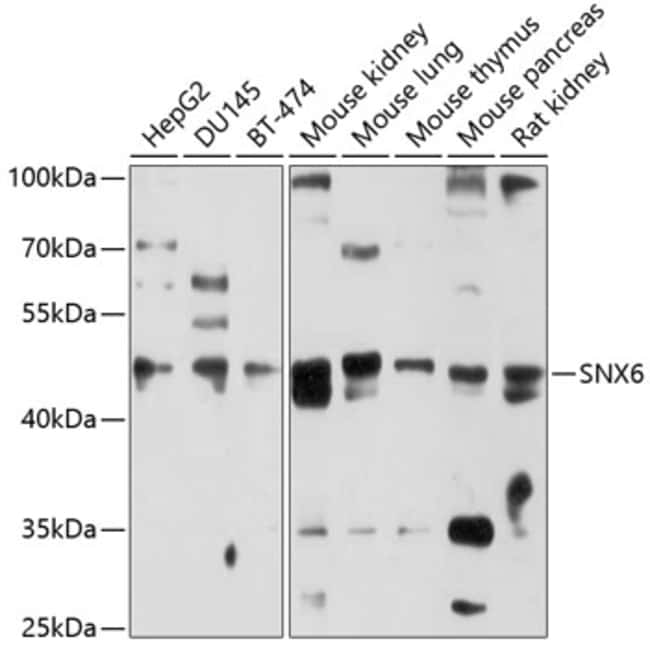
Immunogen sequence: MTKEEFTKMK QELEAEYLAI FKKTVAMHEV FLCRVAAHPI LRRDLNFHVF LEYNQDLSVR GKNKKEKLED FFKNMVKSAD GVIVSGVKDV DDFFEHERTF LLEYHNRVKD ASAKSDRMTR SHKSAADDYN RIGSSLYALG TQDSTDICKF FLKVSELFDK TRKIEARVSA DEDLKLSDLL KYYLRESQAA KDLLYRRSRS LVDYENANKA LDKARAKNKD VLQAETSQQL CCQKFEKISE SAKQELIDFK TRRVAAFRKN LVELAELELK HAKGNLQLLQ NCLAVLNGDT; Positive Samples: HepG2, DU145, BT-474, Mouse kidney, Mouse lung, Mouse thymus, Mouse pancreas, Rat kidney; Cellular Location: Cytoplasm, Cytoplasmic side, Cytoplasmic vesicle, Early endosome, Early endosome membrane, Nucleus, Peripheral membrane protein.

SNX6 interacts with members of the transforming growth factor-beta family of receptor serine-threonine kinases. These receptors belong to two classes: type II receptors that bind ligand, and type I receptors that are subsequently recruited to transduce the signal. Of the type II receptors, SNX6 was found to interact strongly with ActRIIB and more moderately with wild type and kinase-defective mutants of TbetaRII. Of the type I receptors, SNX6 was found to interact only with inactivated TbetaRI. SNXs 1-4 also interacted with the transforming growth factor-beta receptor family, showing different receptor preferences. Conversely, SNX6 behaved similarly to the other SNX proteins in its interactions with receptor tyrosine kinases. Strong heteromeric interactions were also seen among SNX1, -2, -4, and -6, suggesting the formation in vivo of oligomeric complexes. These findings are the first evidence for the association of the SNX family of molecules with receptor serine-threonine kinases.
TRUSTED_SUSTAINABILITY

Specifications

Antigen SNX6
Applications ELISA, Western Blot
Classification Polyclonal
Concentration 0.78 mg/mL
Conjugate Unconjugated
Formulation PBS with 50% glycerol and 0.02% sodium azide; pH 7.3
Gene SNX6
Gene Accession No. Q6P8X1, Q9UNH7
Gene Alias 2010006G21Rik; 2610032J07Rik; 2810425K19Rik; AU018928; C85963; MSTP010; SNX6; sorting nexin 6; sorting nexin-6; Sorting nexin-6, N-terminally processed; TFAF2; TRAF4-associated factor 2; tumor necrosis factor receptor-associated factor 4(TRAF4)-associated factor 2
Gene Symbols SNX6
Host Species Rabbit
Immunogen Recombinant fusion protein containing a sequence corresponding to amino acids 1-290 of human SNX6 (NP_0670723).
Purification Method Affinity Chromatography
Quantity 100 μL
Regulatory Status RUO
Primary or Secondary Primary
Gene ID (Entrez) 362738, 58533, 72183
Target Species Human, Mouse, Rat
Content And Storage -20°C, Avoid Freeze/Thaw Cycles
Product Type Antibody
Form Liquid
Isotype IgG
Show More Show Less
Product Title
Select an issue

By clicking Submit, you acknowledge that you may be contacted by Fisher Scientific in regards to the feedback you have provided in this form. We will not share your information for any other purposes. All contact information provided shall also be maintained in accordance with our Privacy Policy.