Promotional price valid on web orders only. Your contract pricing may differ. Interested in signing up for a dedicated account number?
Learn More
Learn More

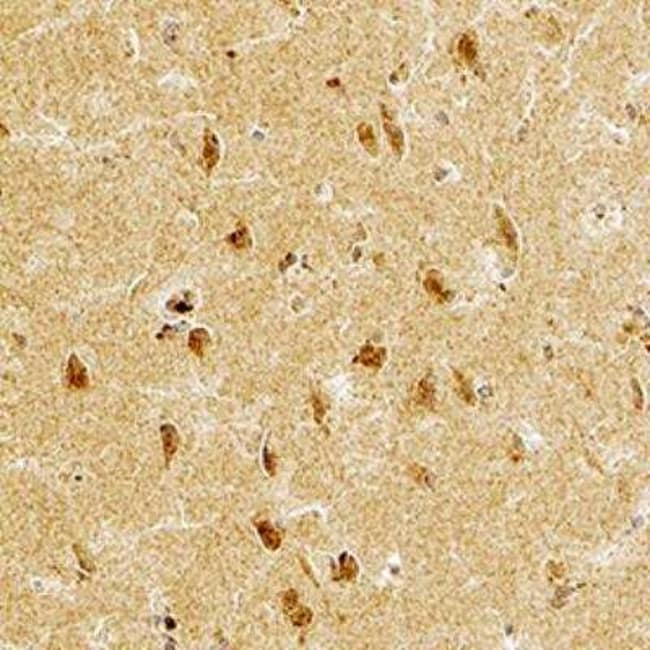
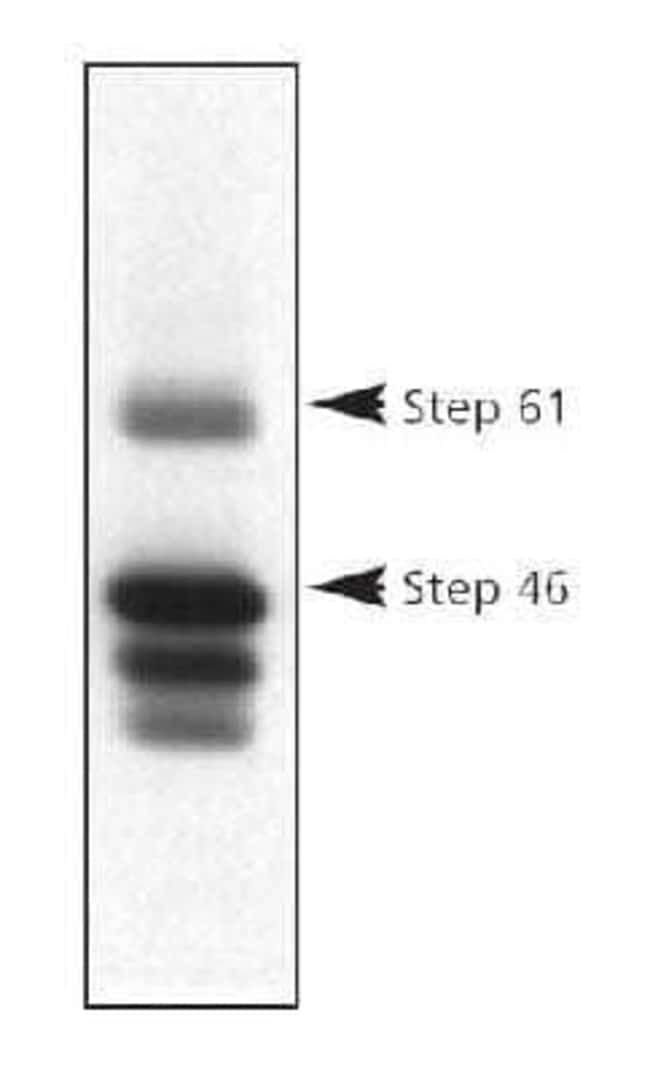
Invitrogen™ STEP Monoclonal Antibody (23E5)

Description
Suggested positive control: rat brain. Immunogen sequence: MCTPGCNEEG FGYLVSPR.
Reversible phosphorylation of tyrosine residues is a key regulatory mechanism for numerous cellular events such as proliferation, differentiation, gene expression and migration. Abnormalities in tyrosine phosphorylation play a role in the pathogenesis of numerous inherited or acquired human diseases from cancer to immune deficiencies. There are at least 107 genes coding for PTPs (protein tyrosine phosphatases) in the human genome. All known PTPs contain a highly conserved 12 amino acid catalytic domain and are further distinguished on the basis of additional structural motifs. The receptor-like PTPs exhibit an extracellular domain, a single transmembrane and one or two intracellular phosphatase domains. The nonreceptor cytoplasmic PTPs contain a single phosphatase domain and additional amino acid sequences that are homologous to motifs found in other classes of proteins. Protein tyrosine phosphatases PTPN5 (STEP), PTPRR and PTPN7 comprise a family of phosphatases that specifically inactivate MAPKs (mitogen-activated protein kinases). There are multiple forms of STEP in the adult rat brain which show differential enrichment in brain regions implicated in aspects of cognitive, affective, and motor behaviors. Some of the STEP isoforms are generated through alternative splicing of a single STEP gene and each has unique intracellular targets and functions.

Specifications
Specifications
| Antigen | STEP |
| Applications | Immunohistochemistry (Frozen), Immunohistochemistry (Paraffin), Immunoprecipitation, Western Blot, Immunocytochemistry |
| Classification | Monoclonal |
| Clone | 23E5 |
| Concentration | Conc. Not Determined |
| Conjugate | Unconjugated |
| Formulation | Ascites with 0.09% sodium azide |
| Gene | PTPN5 |
| Gene Accession No. | P35234, P54829, P54830 |
| Gene Alias | FLJ14427; Neural-specific protein-tyrosine phosphatase; protein tyrosine phosphatase, non-receptor type 5; protein tyrosine phosphatase, non-receptor type 5 (striatum-enriched); protein-tyrosine phosphatase striatum-enriched; protein-tyrosine-phosphatase non-receptor 5; PTN5; PTP STEP; PTPN 5; PTPN5; PTPSTEP; STEP; STEP61; striatal-enriched protein tyrosine phosphatase; striatum-enriched protein-tyrosine phosphatase; Tyrosine-protein phosphatase non-receptor type 5 |
| Show More |
Product Title
By clicking Submit, you acknowledge that you may be contacted by Fisher Scientific in regards to the feedback you have provided in this form. We will not share your information for any other purposes. All contact information provided shall also be maintained in accordance with our Privacy Policy.
Spot an opportunity for improvement?