Promotional price valid on web orders only. Your contract pricing may differ. Interested in signing up for a dedicated account number?
Learn More
Learn More
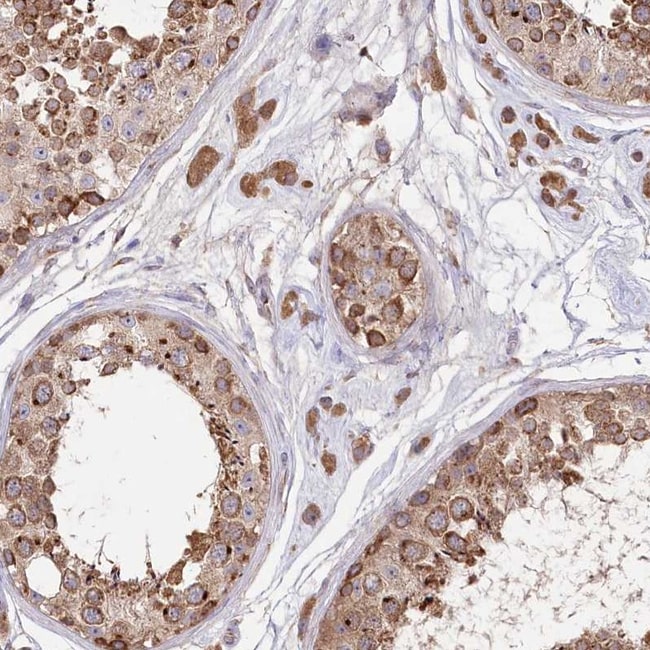
Invitrogen™ STT3B Polyclonal Antibody

Description
Immunogen sequence: KAPDNRETLD HKPRVTNIFP KQKYLSKKTT KRKRGYIK Highest antigen sequence identity to the following orthologs: Mouse - 92%, Rat - 95%.
Catalytic subunit of the oligosaccharyl transferase (OST) complex that catalyzes the initial transfer of a defined glycan (Glc(3)Man(9)GlcNAc(2) in eukaryotes) from the lipid carrier dolichol-pyrophosphate to an asparagine residue within an Asn-X-Ser/Thr consensus motif in nascent polypeptide chains, the first step in protein N-glycosylation. N-glycosylation occurs cotranslationally and the complex associates with the Sec61 complex at the channel-forming translocon complex that mediates protein translocation across the endoplasmic reticulum (ER). All subunits are required for a maximal enzyme activity. This subunit contains the active site and the acceptor peptide and donor lipid-linked oligosaccharide (LLO) binding pockets. STT3B is present in a small subset of OST complexes and mediates both cotranslational and post-translational N-glycosylation of target proteins: STT3B-containing complexes are required for efficient post-translational glycosylation and while they are less competent than STT3A-containing complexes for cotranslational glycosylation, they have the ability to mediate glycosylation of some nascent sites that are not accessible for STT3A. STT3B-containing complexes also act post-translationally and mediate modification of skipped glycosylation sites in unfolded proteins. Plays a role in ER-associated degradation (ERAD) pathway that mediates ubiquitin-dependent degradation of misfolded endoplasmic reticulum proteins by mediating N-glycosylation of unfolded proteins, which are then recognized by the ERAD pathway and targeted for degradation. Mediates glycosylation of the disease variant AMYL-TTR 'Asp-38' of TTR at 'Asn-118', leading to its degradation.

Specifications
Specifications
| Antigen | STT3B |
| Applications | Immunohistochemistry (Paraffin) |
| Classification | Polyclonal |
| Concentration | 0.1 mg/mL |
| Conjugate | Unconjugated |
| Formulation | PBS with 40% glycerol and 0.02% sodium azide; pH 7.2 |
| Gene | STT3B |
| Gene Accession No. | Q8TCJ2 |
| Gene Alias | 1300006C19Rik; B6dom1 antigen; CDG1X; dolichyl-diphosphooligosaccharide protein glycotransferase; dolichyl-diphosphooligosaccharide--protein glycosyltransferase subunit STT3B; homolog of yeast STT3; oligosaccharyl transferase subunit STT3B; RGD1311563; Simp; Source of immunodominant MHC-associated peptides; source of immunodominant MHC-associated peptides homolog; STT3, subunit of the oligosaccharyltransferase complex, homolog B; STT3, subunit of the oligosaccharyltransferase complex, homolog B (S. cerevisiae); STT3B; STT3-B; STT3B, catalytic subunit of the oligosaccharyltransferase complex; STT3B, subunit of the oligosaccharyltransferase complex (catalytic) |
| Gene Symbols | STT3B |
| Show More |
Safety and Handling
WARNING: Cancer - www.P65Warnings.ca.gov
Product Title
By clicking Submit, you acknowledge that you may be contacted by Fisher Scientific in regards to the feedback you have provided in this form. We will not share your information for any other purposes. All contact information provided shall also be maintained in accordance with our Privacy Policy.
Spot an opportunity for improvement?