Learn More
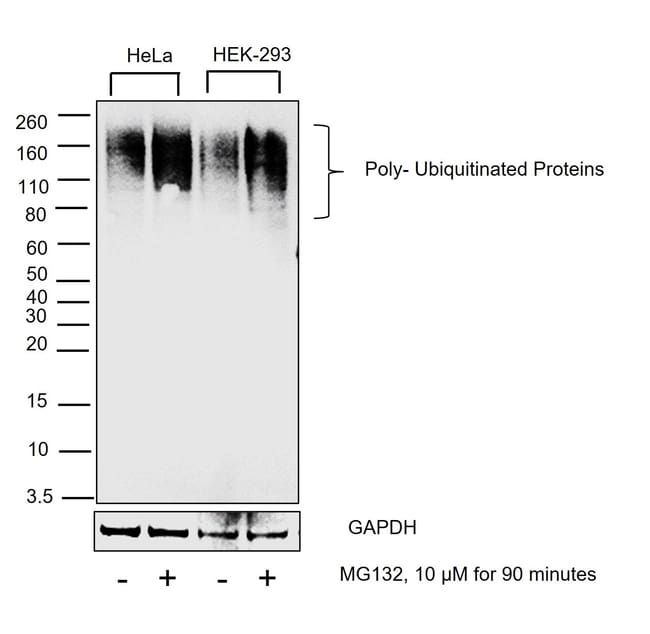
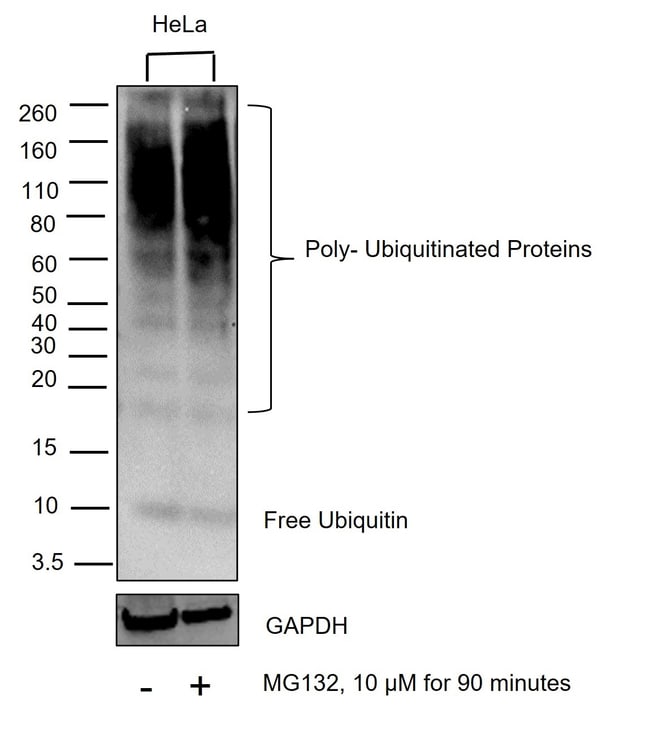

Invitrogen™ Ubiquitin Monoclonal Antibody (eBioP4D1 (P4D1)), eBioscience™, Invitrogen™

Description
Description: The monoclonal antibody eBioP4D1 (p4D1) recognizes ubiquitin, a small 8Ka protein. Ubiquitin units are linked to proteins via a ubiquitination process, thereby signaling the protein for degradation by the 26S proteosome. The process of ubiquitination plays a role in differentiation, cell cycle progression, apoptosis and disease progression. For example, neuronal inclusions called Lewis bodies from Parkinson patients are rich in ubiquitin. Applications Reported: This eBioP4D1 (P4D1) antibody has been reported for use in immunoprecipitation, immunoblotting (WB), and immunohistochemical staining. Applications Tested: This eBioP4D1 (P4D1) antibody has been tested by immunblotting of treated cell lines. This can be used at less than or equal to 2 μg/mL. It is recommended that the antibody be carefully titrated for optimal performance in the assay of interest. Purity: Greater than 90%, as determined by SDS-PAGE. Aggregation: Less than 10%, as determined by HPLC. Filtration: 0.2 μm post-manufacturing filtered.

Specifications
Specifications
| Antigen | Ubiquitin |
| Applications | Immunohistochemistry, Immunoprecipitation, Western Blot |
| Classification | Monoclonal |
| Clone | eBioP4D1 (P4D1) |
| Concentration | 0.5 mg/mL |
| Conjugate | Unconjugated |
| Formulation | PBS with 0.09% sodium azide; pH 7.2 |
| Gene | UBB |
| Gene Accession No. | P0CG47, P0CG48, P0CG49, P0CG50, P0CG51, P24051, P62979, P62982, P62983, P62984, P62986, P62987, Q63429, Q6ZWY3, Q71UM5 |
| Gene Alias | 0610006J14Rik; 1810034D23Rik; 2700054O04Rik; 40S ribosomal protein S27a; 40S ribosomal protein S27-like; 40S ribosomal protein S27-like protein; AI194771; AL033289; CEP80; CG5271; CG5271-PA; Chap1; Dmel\CG5271; Dmel_CG5271; Dub80; epididymis luminal protein 112; epididymis secretory protein Li 50; HEL112; HEL-S-50; hm:zeh0386; HMG20; hPLIC-2; HRIHFB2157; HUBCEP52; ik:tdsubc_1f2; l(2)04820; l(2)31Ei; LOC100912032; LOC101747587; male female sterile 31; mfs(2)31; mfs(2)48; mfs48; OTTHUMP00000200786; OTTHUMP00000201692; PLIC-2; polyubiquitin; polyubiquitin B; polyubiquitin C; poly-ubiquitin precursor; polyubiquitin-B; Polyubiquitin-C; polyubiquitin-C-like; RE44350p; ribosomal protein S27; ribosomal protein S27 like; ribosomal protein S27A; ribosomal protein S27a L homeolog; ribosomal protein S27a S homeolog; ribosomal protein S27-like; ribosomal protein S27-like protein; RPL40; RpS27; Rps27a; rps27a.L; rps27a.S; RpS27A-PA; RPS27L; S27A; similar to polyubiquitin; similar to ubiquitin-S27a fusion protein; Small ribosomal subunit protein eS27-like; Small ribosomal subunit protein eS31; tdsubc_1f2; TI-225; UB3-D; Uba52; UBA80; UBB; Ubb2; UBC; UBCEP1; UBCEP80; Ubi-f80; Ubi-m; Ubiq; Ubiquilin 2; ubiquitin; ubiquitin (34 AA) (1 is 2nd base in codon); ubiquitin and ribosomal protein S27a; ubiquitin B; ubiquitin C; ubiquitin carboxyl extension protein 80; ubiquitin copy 4; ubiquitin fusion 80; ubiquitin polyprotein (heat shock related); ubiquitin/ribosomal protein; ubiquitin-40S ribosomal protein S27a; ubiquitin-40S ribosomal protein S27a-like; ubiquitin-CEP80; ubiquitin-hybrid protein precursor; Ubiquitin-monomeric; Ubiquitin-related; Ubiquitin-related 1; Ubiquitin-related 2; ubiquitin-S27a fusion protein; Unknown (protein for MGC:127652); unnamed protein product; XELAEV_18028796mg; xx:tdsubc_1f2; zgc:66168; zgc:66168 protein |
| Show More |
Safety and Handling
By clicking Submit, you acknowledge that you may be contacted by Fisher Scientific in regards to the feedback you have provided in this form. We will not share your information for any other purposes. All contact information provided shall also be maintained in accordance with our Privacy Policy.