Learn More


Invitrogen™ Ubiquitin Recombinant Rabbit Monoclonal Antibody (10H4L21)
Description
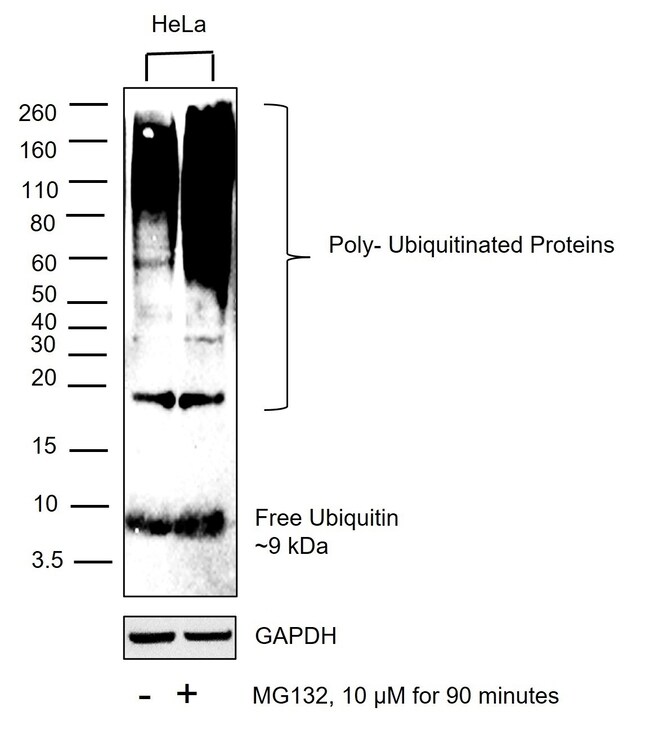
701339 was successfully used to detect the ubiquitination of GLUT1 in transfected in HeLa cells. This antibody is predicted to react with bovine, chimpanzee, equine, non-human primate, rabbit, ovine and porcine based on sequence homology. Intact IgG appears on a non-reducing gel as ~150 kDa band and upon reduction generating a ~25 kDa light chain band and a ~50 kDa heavy chain. Recombinant rabbit monoclonal antibodies are produced using in vitro expression systems. The expression systems are developed by cloning in the specific antibody DNA sequences from immunoreactive rabbits. Then, individual clones are screened to select the best candidates for production. The advantages of using recombinant rabbit monoclonal antibodies include: better specificity and sensitivity, lot-to-lot consistency, animal origin-free formulations, and broader immunoreactivity to diverse targets due to larger rabbit immune repertoire.

Specifications
Specifications
| Antigen | Ubiquitin |
| Applications | ChIP Assay, Western Blot, Immunocytochemistry |
| Classification | Recombinant Monoclonal |
| Clone | 10H4L21 |
| Concentration | 0.5 mg/mL |
| Conjugate | Unconjugated |
| Formulation | PBS with 0.09% sodium azide |
| Gene | UBB |
| Gene Accession No. | P0CG47, P0CG48, P62979, P62987, Q71UM5 |
| Gene Alias | 0610006J14Rik; 1810034D23Rik; 2700054O04Rik; 40S ribosomal protein S27a; 40S ribosomal protein S27-like; 40S ribosomal protein S27-like protein; AI194771; AL033289; CEP80; CG5271; CG5271-PA; Chap1; Dmel\CG5271; Dmel_CG5271; Dub80; epididymis luminal protein 112; epididymis secretory protein Li 50; HEL112; HEL-S-50; hm:zeh0386; HMG20; hPLIC-2; HRIHFB2157; HUBCEP52; ik:tdsubc_1f2; l(2)04820; l(2)31Ei; LOC100912032; LOC101747587; male female sterile 31; mfs(2)31; mfs(2)48; mfs48; OTTHUMP00000200786; OTTHUMP00000201692; PLIC-2; polyubiquitin; polyubiquitin B; polyubiquitin C; poly-ubiquitin precursor; polyubiquitin-B; Polyubiquitin-C; polyubiquitin-C-like; RE44350p; ribosomal protein S27; ribosomal protein S27 like; ribosomal protein S27A; ribosomal protein S27a L homeolog; ribosomal protein S27a S homeolog; ribosomal protein S27-like; ribosomal protein S27-like protein; RPL40; RpS27; Rps27a; rps27a.L; rps27a.S; RpS27A-PA; RPS27L; S27A; similar to polyubiquitin; similar to ubiquitin-S27a fusion protein; Small ribosomal subunit protein eS27-like; Small ribosomal subunit protein eS31; tdsubc_1f2; TI-225; UB3-D; Uba52; UBA80; UBB; Ubb2; UBC; UBCEP1; UBCEP80; Ubi-f80; Ubi-m; Ubiq; Ubiquilin 2; ubiquitin; ubiquitin (34 AA) (1 is 2nd base in codon); ubiquitin and ribosomal protein S27a; ubiquitin B; ubiquitin C; ubiquitin carboxyl extension protein 80; ubiquitin copy 4; ubiquitin fusion 80; ubiquitin polyprotein (heat shock related); ubiquitin/ribosomal protein; ubiquitin-40S ribosomal protein S27a; ubiquitin-40S ribosomal protein S27a-like; ubiquitin-CEP80; ubiquitin-hybrid protein precursor; Ubiquitin-monomeric; Ubiquitin-related; Ubiquitin-related 1; Ubiquitin-related 2; ubiquitin-S27a fusion protein; Unknown (protein for MGC:127652); unnamed protein product; XELAEV_18028796mg; xx:tdsubc_1f2; zgc:66168; zgc:66168 protein |
| Show More |
Safety and Handling
By clicking Submit, you acknowledge that you may be contacted by Fisher Scientific in regards to the feedback you have provided in this form. We will not share your information for any other purposes. All contact information provided shall also be maintained in accordance with our Privacy Policy.