Promotional price valid on web orders only. Your contract pricing may differ. Interested in signing up for a dedicated account number?
Learn More

Invitrogen™ UGT2B10 Polyclonal Antibody
GREENER_CHOICE

Catalog No. PIPA596723
Change view
Click to view available options
Quantity:
100 μL
1 product options available for selection
Product selection table with 1 available options. Use arrow keys to navigate and Enter or Space to select.
Catalog No. Quantity
PIPA596723 100 μL
Use arrow keys to navigate between rows. Press Enter or Space to select a product option. 1 options available.
1 options
Catalog No. PIPA596723 Supplier Invitrogen™ Supplier No. PA596723
Add to Cart
Add to Cart

Rabbit Polyclonal Antibody

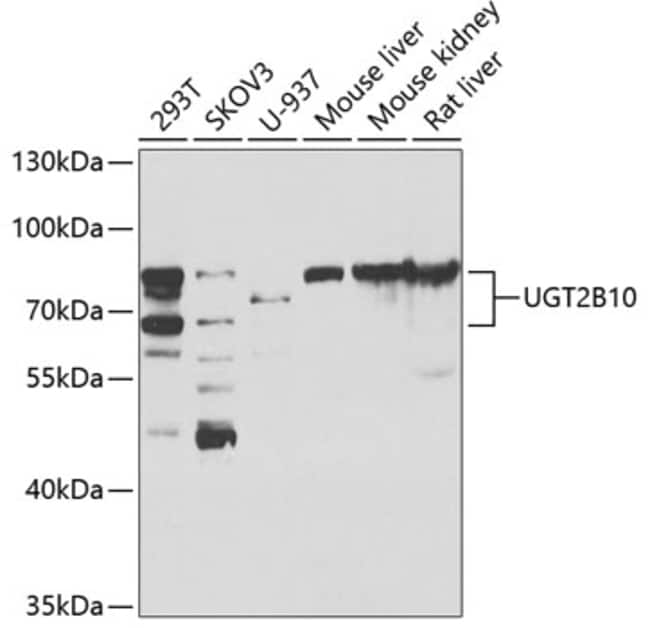
Immunogen sequence: GSCGKVLVWA AEYSLWMNMK TILKELVQRG HEVTVLASSA SILFDPNDSS TLKLEVYPTS LTKTEFENII MQLVKRLSEI QKDTFWLPFS QEQEILWAIN DIIRNFCKDV VSNKKLMKKL QESRFDIVFA DAYLPCGELL AELFNIPFVY SHSFSPGYSF ERHSGGFIFP PSYVPVVMSK LSDQMTFMER VKNMLYVLYF DFWFQIFNMK KWDQFYSEVL GRPTTLSETM RKADIWLMRN SWNFKFPHPF LPNVDFVGGL H; Positive Samples: 293T, SKOV3, U-937, Mouse liver, Mouse kidney, Rat liver; Cellular Location: Endoplasmic reticulum membrane, Microsome membrane, Single-pass membrane protein.

DNA containing double-strand breaks (DSB) created by the CRISPR/Cas9 system can be repaired by either the non-homologous end-joining (NHEJ) or the homology-directed repair (HDR) pathway. The NHEJ repair pathway introduces non-specific insertions or deletions at the cleavage site, whereas the HDR pathway allows for precise gene editing at the DSB site. Target-specific HDR Plasmids provide a DNA repair template for a DSB and, when co-transfected with CRISPR/Cas9 KO Plasmids, enable the insertion of specific selection markers where Cas9-induced DNA cleavage has occurred. The HDR plasmid can incorporate a Red Fluorescent Protein (RFP) gene to visually confirm transfection and an antibiotic resistance gene (puromycin) for selection of cells containing a successful CRISPR/Cas9 doublestrand break. The puromycin resistance and RFP encoding genes are flanked by two LoxP sites that are recognized by the Cre Vector, which can be used to later remove these selection markers from the genomic DNA.
TRUSTED_SUSTAINABILITY

Specifications

Antigen UGT2B10
Applications ELISA, Western Blot
Classification Polyclonal
Concentration 0.32 mg/mL
Conjugate Unconjugated
Formulation PBS with 50% glycerol and 0.02% sodium azide; pH 7.3
Gene UGT2B10
Gene Accession No. P36537
Gene Alias UDP glucuronosyltransferase 2 family, polypeptide B10; UDP glucuronosyltransferase 2 family, polypeptide B34; UDP glucuronosyltransferase family 2 member B10; UDP glycosyltransferase 2 family, polypeptide B10; UDP-glucuronosyltransferase 2B10; UDPGT 2B10; UDPGT2B10; Ugt2b10; Ugt2b34
Gene Symbols UGT2B10
Host Species Rabbit
Immunogen Recombinant fusion protein containing a sequence corresponding to amino acids 20-280 of human UGT2B10 (NP_0010661).
Purification Method Affinity chromatography
Quantity 100 μL
Regulatory Status RUO
Primary or Secondary Primary
Gene ID (Entrez) 305264, 7365
Target Species Human, Mouse, Rat
Content And Storage -20°C, Avoid Freeze/Thaw Cycles
Product Type Antibody
Form Liquid
Isotype IgG
Show More Show Less
WARNING: Cancer - www.P65Warnings.ca.gov
Product Title
Select an issue

By clicking Submit, you acknowledge that you may be contacted by Fisher Scientific in regards to the feedback you have provided in this form. We will not share your information for any other purposes. All contact information provided shall also be maintained in accordance with our Privacy Policy.