Learn More
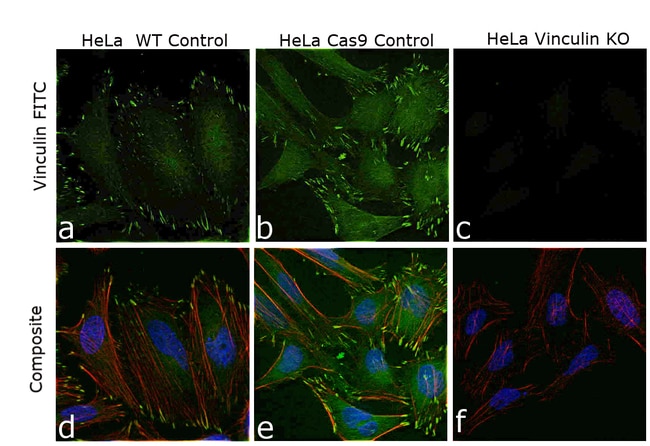

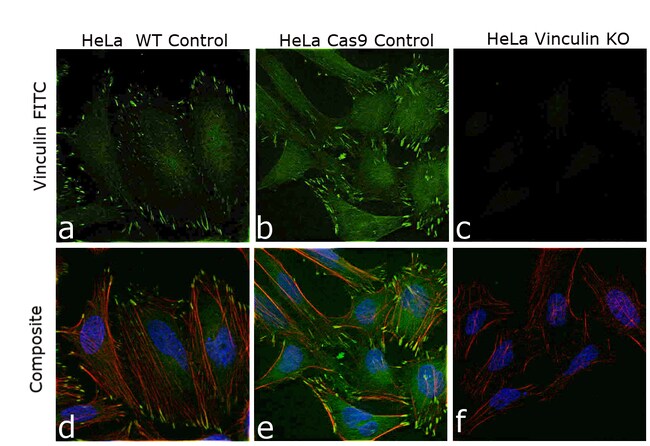
Invitrogen™ Vinculin Monoclonal Antibody (7F9), Alexa Fluor™ 488, eBioscience™, Invitrogen™


Description
Description: The monoclonal antibody 7F9 (VIIF9) recognizes human, mouse, rat, and avian vinculin and its alternatively spliced isoform, metavinculin. Vinculin is a cytoskeletal protein associated with cell-cell and cell-matrix junctions. Vinculin is involved in the anchoring of F-actin to the membrane and the regulation of E-cadherin expression. Vinculin binds to talin, paxillin, and alpha-actinin. Disregulation of vinculin alters cell adhesion, migration, and growth, which promotes cancer invasion and metastasis. Applications Reported: This 7F9 antibody has been reported for use in immunohistochemical staining of frozen tissue sections, immunohistochemical staining of formalin-fixed paraffin embedded tissue sections, microscopy, and immunocytochemistry. Applications Tested: This 7F9 antibody has been tested by immunocytochemistry of formaldehyde-fixed and permeabilized cells and can be used at less than or equal to 20 μg/mL. It is recommended that the antibody be carefully titrated for optimal performance in the assay of interest. Excitation: 488 nm; Emission: 519 nm; Laser: Blue Laser. Filtration: 0.2 μm post-manufacturing filtered.

Specifications
Specifications
| Antigen | Vinculin |
| Applications | Immunohistochemistry (Frozen), Immunohistochemistry (Paraffin), Immunocytochemistry |
| Classification | Monoclonal |
| Clone | 7F9 |
| Concentration | 0.5 mg/mL |
| Conjugate | Alexa Fluor 488 |
| Formulation | PBS with 0.09% sodium azide; pH 7.2 |
| Gene | VCL |
| Gene Accession No. | P18206, P85972, Q64727 |
| Gene Alias | 9430097D22; AA571387; AI462105; AW545629; CMD1W; CMH15; epididymis luminal protein 114; HEL114; metavinculin; meta-vinculin; metavinculin {ECO:0000250; MV; MVCL; RP11-178G16.3; UniProtKB:P18206}; unnamed protein product; Vcl; vcl {ECO:0000250; VIN; vinc; vinc 1; VINC1; Vinculin; vinculin {ECO:0000250 |
| Show More |
For Research Use Only.
By clicking Submit, you acknowledge that you may be contacted by Fisher Scientific in regards to the feedback you have provided in this form. We will not share your information for any other purposes. All contact information provided shall also be maintained in accordance with our Privacy Policy.