Promotional price valid on web orders only. Your contract pricing may differ. Interested in signing up for a dedicated account number?
Learn More

Wnt1 Monoclonal Antibody (13F9), Rockland™
SDP

Catalog No. 501990556
Encompass
Encompass_Preferred
Change view
Click to view available options
Quantity:
100 μg
25 μL
2 product options available for selection
Product selection table with 2 available options. Use arrow keys to navigate and Enter or Space to select.
Catalog No. Quantity
50-199-0556 25 μL
50-199-0555 100 μg
Use arrow keys to navigate between rows. Press Enter or Space to select a product option. 2 options available.
2 options
Catalog No. 50-199-0556 Supplier Rockland Immunochemicals Supplier No. 200301A37S
Add to Cart
Add to Cart

Mouse Monoclonal Antibody

Store vial at -20°C prior to opening. Aliquot contents and freeze at -20°C or below for extended storage. Avoid cycles of freezing and thawing. Centrifuge product if not completely clear after standing at room temperature. This product is stable for several weeks at 4°C as an undiluted liquid. Dilute only prior to immediate use. This antibody reacts with human and mouse Wnt1 protein. A BLAST analysis was used to suggest cross-reactivity with Wnt1 from mouse, human, rat, bovine, dog, macaque, opossum and rat based on a 100% homology with the immunizing sequence. Partial cross-reactivity is expected against chicken Wnt1 based on a 91% sequence homology. Cross-reactivity with Wnt1 from other sources has not been determined.

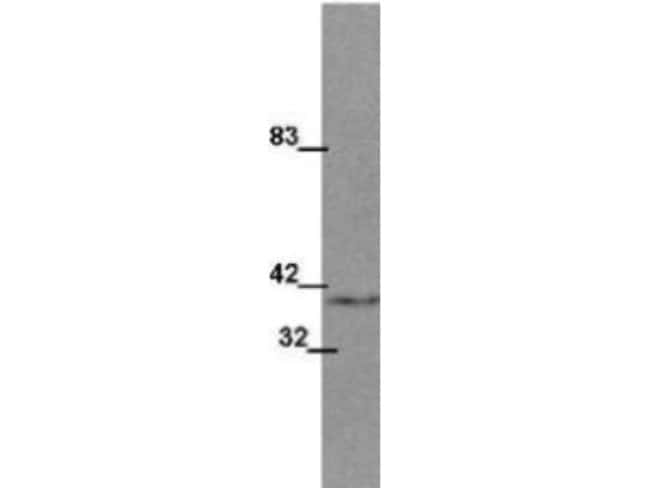
Wnt proteins constitute a family of secreted glyocoproteins that activate signal transduction pathways to mediate tissue homeostasis, cell fate, cell proliferation, and self-renewal. The canonical signaling pathway is initiated upon Wnt binding to a Frizzled family receptor and an LRP5/LRP6 coreceptor, which leads to activation of the beta-catenin cascade. Non-canonical Wnt signals are activated by binding to a Frizzled family receptor and ROR2 coreceptor. Extensive research has shown that deregulation of these pathways or its components can lead to cancer. Human Wnt-1 is encoded as a 370 amino acid precursor that, upon secretion, is cleaved into a 343 amino acid (42 kDa) mature form. At the amino acid level, mature human Wnt-1 is approximately 99% identical to mature mouse Wnt-1. Depending on the tissue, Wnt-1 can activate the canonical and non-canonical signaling pathways. Studies have demonstrated its involvement in a variety of functions, including embryonic development and carcinogenesis. Wnt-1 signaling can also induce the phosphorylation and subsequent degradation of c-Myb.

Specifications

Antigen Wnt1
Applications ELISA, Immunoprecipitation, Western Blot
Classification Monoclonal
Clone 13F9
Concentration 1 mg/mL
Conjugate Unconjugated
Formulation 0.02M potassium phosphate with 0.15M NaCl and 0.01% sodium azide; pH 7.2
Gene WNT1
Gene Accession No. P04628
Gene Alias BMND16; INT1; Int-1; OI15; Proto-oncogene Int-1; Proto-oncogene Int-1 homolog; proto-oncogene protein Wnt-1; Proto-oncogene Wnt-1; sw; swaying; wingless-related MMTV integration site 1; Wingless-type MMTV integration site 1 homolog; Wingless-type MMTV integration site 1, homolog; wingless-type MMTV integration site family member 1; wingless-type MMTV integration site family, member 1; wingless-type MMTV integration site family, member 1 (oncogene INT1); Wnt family member 1; WNT1; Wnt-1
Gene Symbols WNT1
Host Species Mouse
Immunogen Synthetic peptide corresponding to an internal region of human Wnt1 protein.
Quantity 25 μL
Regulatory Status RUO
Primary or Secondary Primary
Gene ID (Entrez) 7471
Target Species Human
Content And Storage -20°C, Avoid Freeze/Thaw Cycles
Product Type Antibody
Form Liquid
Isotype IgG1 κ
Show More Show Less
Product Title
Select an issue

By clicking Submit, you acknowledge that you may be contacted by Fisher Scientific in regards to the feedback you have provided in this form. We will not share your information for any other purposes. All contact information provided shall also be maintained in accordance with our Privacy Policy.