
Universal Pipette Tips
Disposable pipette tips designed to fit single and multichannel pipettes from most manufacturers; offer acceptable performance compared to pipette specific tips and can be used with a variety of pipette models.
Single-use universal pipette tips are designed for compatibility with most mechanical and electronic single and multichannel pipettors.
Universal pipette tips are available in a range of types, sizes, colors, styles, and packaging configurations and may be designed for specific purposes or tasks.
- Capacity or volume based on the pipettor size
- Filters to reduce contamination and cross-contamination
- Color
- Sterility or autoclavability
- Tip style: beveled, tapered, wide bore, round, flat, or gel-loading
- Length: short or extended
- Purity: metal-free or DNase-, RNase-, ATP-, Bioburden-, PCR inhibitor-, endotoxin-, or pyrogen-free for genomic and biologic applications
- Surface treatments to reduce retention
- Packaging options to help facilitate re-stocking or eliminate waste


ABclonal Technology SEC11A Rabbit pAb

This gene encodes a member of the peptidase S26B family. The encoded protein is an 18kDa subunit of the signal peptidase complex and has been linked to cell migration and invasion, gastric cancer and lymph node metastasis. Alternative splicing results in multiple transcript variants. A related pseudogene has been identified on chromosome 8.


ABclonal Technology XPO6 Rabbit pAb
The protein encoded by this gene is a member of the importin-beta family. Members of this family are regulated by the GTPase Ran to mediate transport of cargo across the nuclear envelope. This protein has been shown to mediate nuclear export of profilin-actin complexes. A pseudogene of this gene is located on the long arm of chromosome 14. Alternative splicing results in multiple transcript variants that encode different protein isoforms.

ABclonal Technology Src Rabbit pAb
This gene is highly similar to the v-src gene of Rous sarcoma virus. This proto-oncogene may play a role in the regulation of embryonic development and cell growth. The protein encoded by this gene is a tyrosine-protein kinase whose activity can be inhibited by phosphorylation by c-SRC kinase. Mutations in this gene could be involved in the malignant progression of colon cancer. Two transcript variants encoding the same protein have been found for this gene.

ABclonal Technology HNRPLL Rabbit pAb
HNRNPLL is a master regulator of activation-induced alternative splicing in T cells. In particular, it alters splicing of CD45 (PTPRC, MIM 151460), a tyrosine phosphatase essential for T-cell development and activation (Oberdoerffer et al., 2008 [PubMed 18669861]).

ABclonal Technology TPH2 Rabbit pAb
This gene encodes a member of the pterin-dependent aromatic acid hydroxylase family. The encoded protein catalyzes the first and rate limiting step in the biosynthesis of serotonin, an important hormone and neurotransmitter. Mutations in this gene may be associated with psychiatric diseases such as bipolar affective disorder and major depression.

ABclonal Technology PLD2 Rabbit pAb
The protein encoded by this gene catalyzes the hydrolysis of phosphatidylcholine to phosphatidic acid and choline. The activity of the encoded enzyme is enhanced by phosphatidylinositol 4,5-bisphosphate and ADP-ribosylation factor-1. This protein localizes to the peripheral membrane and may be involved in cytoskeletal organization, cell cycle control, transcriptional regulation, and/or regulated secretion. Two transcript variants encoding different isoforms have been found for this gene.

ABclonal Technology CARD8 Rabbit pAb
The protein encoded by this gene belongs to the caspase recruitment domain (CARD)-containing family of proteins, which are involved in pathways leading to activation of caspases or nuclear factor kappa-B (NFKB). This protein may be a component of the inflammasome, a protein complex that plays a role in the activation of proinflammatory caspases. It is thought that this protein acts as an adaptor molecule that negatively regulates NFKB activation, CASP1-dependent IL1B secretion, and apoptosis. Polymorphisms in this gene may be associated with a susceptibility to rheumatoid arthritis. Alternatively spliced transcript variants have been described for this gene.

ABclonal Technology 14-3-3 sigma Rabbit pAb
This gene encodes a cell cycle checkpoint protein. The encoded protein binds to translation and initiation factors and functions as a regulator of mitotic translation. In response to DNA damage this protein plays a role in preventing DNA errors during mitosis.

ABclonal Technology STRIP1 Rabbit pAb
This gene encodes a member of the striatin-interacting phosphatase and kinase complex, which is involved in localization of the Golgi body. The encoded protein participates in cytosketelal organization. Alternative splicing results in multiple transcript variants.

ABclonal Technology ART1 Rabbit pAb
ADP-ribosyltransferase catalyzes the ADP-ribosylation of arginine residues in proteins. Mono-ADP-ribosylation is a posttranslational modification of proteins that is interfered with by a variety of bacterial toxins including cholera, pertussis, and heat-labile enterotoxins of E. coli. The amino acid sequence consists of predominantly hydrophobic N- and C-terminal regions, which is characteristic of glycosylphosphatidylinositol (GPI)-anchored proteins. This gene was previously designated ART2.

ABclonal Technology Gsdma Rabbit pAb
Predicted to enable phosphatidylinositol-4,5-bisphosphate binding activity, phosphatidylinositol-4-phosphate binding activity, and phosphatidylserine binding activity. Predicted to be involved in apoptotic process, defense response to bacterium, and pyroptosis. Predicted to act upstream of or within programmed cell death. Located in cytoplasm. Is expressed in esophagus epithelium, stomach, stomach cardiac region, stomach glandular region, and stomach glandular region mucosa. Orthologous to human GSDMA (gasdermin A).

ABclonal Technology RPL36AL Rabbit pAb
Cytoplasmic ribosomes, organelles that catalyze protein synthesis, consist of a small 40S subunit and a large 60S subunit. Together these subunits are composed of 4 RNA species and approximately 80 structurally distinct proteins. This gene encodes a ribosomal protein that is a component of the 60S subunit. The protein, which shares sequence similarity with yeast ribosomal protein L44, belongs to the L44E (L36AE) family of ribosomal proteins. This gene and the human gene officially named ribosomal protein L36a (RPL36A) encode nearly identical proteins, however, they are distinct genes. Although the name of this gene has been referred to as ribosomal protein L36a (RPL36A), its official name is ribosomal protein L36a-like (RPL36AL). As is typical for genes encoding ribosomal proteins, there are multiple processed pseudogenes of this gene dispersed through the genome.

ABclonal Technology ARPC2 Rabbit pAb
This gene encodes one of seven subunits of the human Arp2/3 protein complex. The Arp2/3 protein complex has been implicated in the control of actin polymerization in cells and has been conserved through evolution. The exact role of the protein encoded by this gene, the p34 subunit, has yet to be determined. Two alternatively spliced variants have been characterized to date. Additional alternatively spliced variants have been described but their full length nature has not been determined.
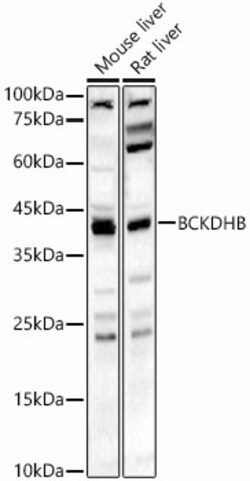
ABclonal Technology BCKDHB Rabbit pAb
This gene encodes the E1 beta subunit of branched-chain keto acid dehydrogenase, which is a multienzyme complex associated with the inner membrane of mitochondria. This enzyme complex functions in the catabolism of branched-chain amino acids. Mutations in this gene have been associated with maple syrup urine disease (MSUD), type 1B, a disease characterized by a maple syrup odor to the urine in addition to mental and physical retardation and feeding problems. Alternative splicing at this locus results in multiple transcript variants.

ABclonal Technology NTAN1 Rabbit pAb
The protein encoded by this gene functions in a step-wise process of protein degradation through the N-end rule pathway. This protein acts as a tertiary destabilizing enzyme that deamidates N-terminal L-Asn residues on proteins to produce N-terminal L-Asp. L-Asp substrates are subsequently conjugated to L-Arg, which is recognized by specific E3 ubiquitin ligases and targeted to the proteasome. Pseudogenes of this gene are located on the long arms of chromosomes 8, 10 and 12. Alternative splicing results in multiple transcript variants that encode different protein isoforms.