
Universal Pipette Tips
Disposable pipette tips designed to fit single and multichannel pipettes from most manufacturers; offer acceptable performance compared to pipette specific tips and can be used with a variety of pipette models.
Single-use universal pipette tips are designed for compatibility with most mechanical and electronic single and multichannel pipettors.
Universal pipette tips are available in a range of types, sizes, colors, styles, and packaging configurations and may be designed for specific purposes or tasks.
- Capacity or volume based on the pipettor size
- Filters to reduce contamination and cross-contamination
- Color
- Sterility or autoclavability
- Tip style: beveled, tapered, wide bore, round, flat, or gel-loading
- Length: short or extended
- Purity: metal-free or DNase-, RNase-, ATP-, Bioburden-, PCR inhibitor-, endotoxin-, or pyrogen-free for genomic and biologic applications
- Surface treatments to reduce retention
- Packaging options to help facilitate re-stocking or eliminate waste


ABclonal Technology PLD2 Rabbit pAb

The protein encoded by this gene catalyzes the hydrolysis of phosphatidylcholine to phosphatidic acid and choline. The activity of the encoded enzyme is enhanced by phosphatidylinositol 4,5-bisphosphate and ADP-ribosylation factor-1. This protein localizes to the peripheral membrane and may be involved in cytoskeletal organization, cell cycle control, transcriptional regulation, and/or regulated secretion. Two transcript variants encoding different isoforms have been found for this gene.


ABclonal Technology BPIFB2 Rabbit pAb
This gene encodes a member of the lipid transfer/lipopolysaccharide binding protein (LT/LBP) gene family. It is highly expressed in hypertrophic tonsils. This gene and three other members of the LT/LBP gene family form a cluster on the long arm of chromosome 20.

ABclonal Technology SRA1 Rabbit pAb
Both long non-coding and protein-coding RNAs are transcribed from this gene, and they represent alternatively spliced transcript variants. This gene was initially defined as a non-coding RNA, which is a coactivator for several nuclear receptors (NRs) and is associated with breast cancer. It has now been found that this gene is involved in the regulation of many NR and non-NR activities, including metabolism, adipogenesis and chromatin organization. The long non-coding RNA transcripts interact with a variety of proteins, including the protein encoded by this gene. The encoded protein acts as a transcriptional repressor by binding to the non-coding RNA.

ABclonal Technology 14-3-3 sigma Rabbit pAb
This gene encodes a cell cycle checkpoint protein. The encoded protein binds to translation and initiation factors and functions as a regulator of mitotic translation. In response to DNA damage this protein plays a role in preventing DNA errors during mitosis.

ABclonal Technology Gsdma Rabbit pAb
Predicted to enable phosphatidylinositol-4,5-bisphosphate binding activity, phosphatidylinositol-4-phosphate binding activity, and phosphatidylserine binding activity. Predicted to be involved in apoptotic process, defense response to bacterium, and pyroptosis. Predicted to act upstream of or within programmed cell death. Located in cytoplasm. Is expressed in esophagus epithelium, stomach, stomach cardiac region, stomach glandular region, and stomach glandular region mucosa. Orthologous to human GSDMA (gasdermin A).
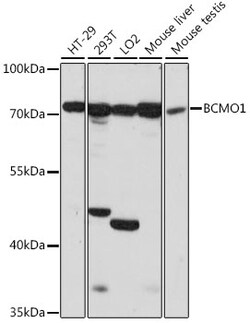
ABclonal Technology BCMO1 Rabbit pAb
Vitamin A metabolism is important for vital processes such as vision, embryonic development, cell differentiation, and membrane and skin protection. The protein encoded by this gene is a key enzyme in beta-carotene metabolism to vitamin A. It catalyzes the oxidative cleavage of beta,beta-carotene into two retinal molecules.

ABclonal Technology ARPC2 Rabbit pAb
This gene encodes one of seven subunits of the human Arp2/3 protein complex. The Arp2/3 protein complex has been implicated in the control of actin polymerization in cells and has been conserved through evolution. The exact role of the protein encoded by this gene, the p34 subunit, has yet to be determined. Two alternatively spliced variants have been characterized to date. Additional alternatively spliced variants have been described but their full length nature has not been determined.

ABclonal Technology NTAN1 Rabbit pAb
The protein encoded by this gene functions in a step-wise process of protein degradation through the N-end rule pathway. This protein acts as a tertiary destabilizing enzyme that deamidates N-terminal L-Asn residues on proteins to produce N-terminal L-Asp. L-Asp substrates are subsequently conjugated to L-Arg, which is recognized by specific E3 ubiquitin ligases and targeted to the proteasome. Pseudogenes of this gene are located on the long arms of chromosomes 8, 10 and 12. Alternative splicing results in multiple transcript variants that encode different protein isoforms.

ABclonal Technology INCENP Rabbit pAb
In mammalian cells, centromere-interacting proteins are classified into two groups: constitutive and passenger proteins. Constitutive proteins, which bind centromere proteins, include CENPA, CENPB, CENPC1, and CENPD. Passenger proteins localize to the centromere during specific cell cycle stages and include CENPE, MCAK, KID, cytoplasmic dynein, CliPs, and CENPF/mitosin. Inner centromere proteins (INCENPs), early members of the passenger protein group, are broadly distributed along chromosomes in early mitosis but concentrate at centromeres during mid-metaphase. By telophase, they localize to the midbody in the intercellular bridge and are discarded after cytokinesis.
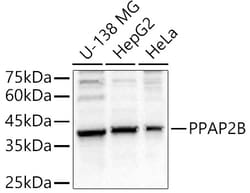
ABclonal Technology PPAP2B Rabbit pAb
The protein encoded by this gene is a member of the phosphatidic acid phosphatase (PAP) family. PAPs convert phosphatidic acid to diacylglycerol, and function in de novo synthesis of glycerolipids as well as in receptor-activated signal transduction mediated by phospholipase D. This protein is a membrane glycoprotein localized at the cell plasma membrane. It has been shown to actively hydrolyze extracellular lysophosphatidic acid and short-chain phosphatidic acid. The expression of this gene is found to be enhanced by epidermal growth factor in Hela cells.

ABclonal Technology FER1L5 Rabbit pAb
Predicted to enable calcium ion binding activity and calcium-dependent phospholipid binding activity. Predicted to be involved in several processes, including myeloid cell activation involved in immune response, negative regulation of phagocytosis, and plasma membrane organization. Predicted to be located in plasma membrane. Predicted to be integral component of membrane. Predicted to be active in T-tubule and cytoplasmic vesicle.
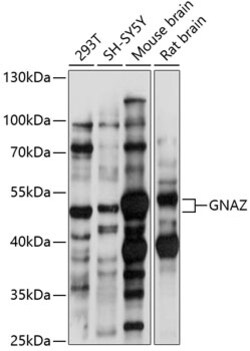
ABclonal Technology GNAZ Rabbit pAb
The protein encoded by this gene is a member of a G protein subfamily that mediates signal transduction in pertussis toxin-insensitive systms. This encoded protein may play a role in maintaining the ionic balance of perilymphatic and endolymphatic cochlear fluids.
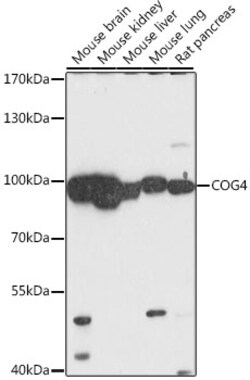
ABclonal Technology COG4 Rabbit pAb
The protein encoded by this gene is a component of an oligomeric protein complex involved in the structure and function of the Golgi apparatus. Defects in this gene may be a cause of congenital disorder of glycosylation type IIj. Two transcript variants encoding different isoforms have been found for this gene.

ABclonal Technology PON2 Rabbit pAb
This gene encodes a member of the paraoxonase gene family, which includes three known members located adjacent to each other on the long arm of chromosome 7. The encoded protein is ubiquitously expressed in human tissues, membrane-bound, and may act as a cellular antioxidant, protecting cells from oxidative stress. Hydrolytic activity against acylhomoserine lactones, important bacterial quorum-sensing mediators, suggests the encoded protein may also play a role in defense responses to pathogenic bacteria. Mutations in this gene may be associated with vascular disease and a number of quantitative phenotypes related to diabetes. Alternatively spliced transcript variants encoding different isoforms have been described.

ABclonal Technology NGEF Rabbit pAb
Enables guanyl-nucleotide exchange factor activity. Predicted to be involved in several processes, including activation of GTPase activity, ephrin receptor signaling pathway, and negative regulation of dendritic spine morphogenesis. Predicted to be located in cytosol. Predicted to be active in glutamatergic synapse.