
Universal Pipette Tips
Disposable pipette tips designed to fit single and multichannel pipettes from most manufacturers; offer acceptable performance compared to pipette specific tips and can be used with a variety of pipette models.
Single-use universal pipette tips are designed for compatibility with most mechanical and electronic single and multichannel pipettors.
Universal pipette tips are available in a range of types, sizes, colors, styles, and packaging configurations and may be designed for specific purposes or tasks.
- Capacity or volume based on the pipettor size
- Filters to reduce contamination and cross-contamination
- Color
- Sterility or autoclavability
- Tip style: beveled, tapered, wide bore, round, flat, or gel-loading
- Length: short or extended
- Purity: metal-free or DNase-, RNase-, ATP-, Bioburden-, PCR inhibitor-, endotoxin-, or pyrogen-free for genomic and biologic applications
- Surface treatments to reduce retention
- Packaging options to help facilitate re-stocking or eliminate waste

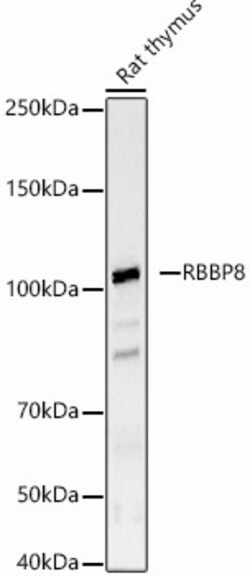
ABclonal Technology RBBP8 Rabbit pAb

The protein encoded by this gene is a ubiquitously expressed nuclear protein. It is found among several proteins that bind directly to retinoblastoma protein, which regulates cell proliferation. This protein complexes with transcriptional co-repressor CTBP. It is also associated with BRCA1 and is thought to modulate the functions of BRCA1 in transcriptional regulation, DNA repair, and/or cell cycle checkpoint control. It is suggested that this gene may itself be a tumor suppressor acting in the same pathway as BRCA1. Three transcript variants encoding two different isoforms have been found for this gene. More transcript variants exist, but their full-length natures have not been determined.

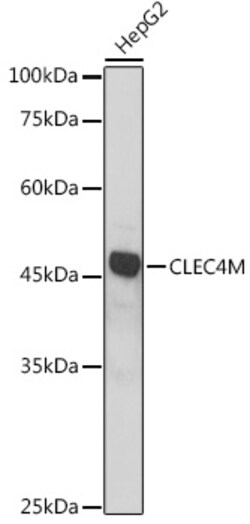
ABclonal Technology CLEC4M Rabbit pAb
This gene encodes a C-type lectin involved in cell adhesion and pathogen recognition. It recognizes a range of pathogens, including tuberculosis mycobacteria, Ebola, HIV-1, influenza A, West Nile virus, and SARS-CoV. The protein has four domains: a C-terminal carbohydrate recognition domain, a flexible neck domain, a transmembrane region, and an N-terminal cytoplasmic domain for internalization. This gene is related to CD209 (DC-SIGN) but differs in viral recognition and expression. It is highly expressed in endothelial cells of the liver, lymph node, and placenta. Polymorphisms in the neck domain are linked to resistance to SARS infection.
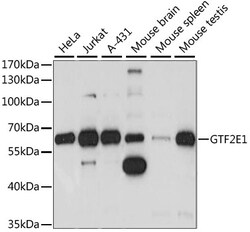
ABclonal Technology GTF2E1 Rabbit pAb
Enables RNA polymerase II general transcription initiation factor activity. Involved in transcription by RNA polymerase II. Located in cytosol and nucleoplasm. Part of transcription factor TFIID complex and transcription preinitiation complex.
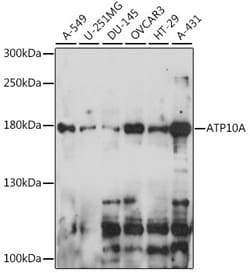
ABclonal Technology ATP10A Rabbit pAb
The protein encoded by this gene belongs to the family of P-type cation transport ATPases, and to the subfamily of aminophospholipid-transporting ATPases. The aminophospholipid translocases transport phosphatidylserine and phosphatidylethanolamine from one side of a bilayer to another. This gene is maternally expressed. It maps within the most common interval of deletion responsible for Angelman syndrome, also known as happy puppet syndrome.

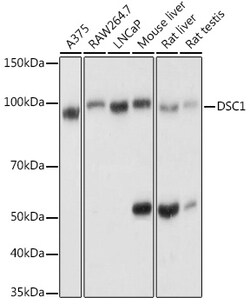
ABclonal Technology DSC1 Rabbit pAb
The protein encoded by this gene is a calcium-dependent glycoprotein that is a member of the desmocollin subfamily of the cadherin superfamily. These desmosomal family members, along with the desmogleins, are found primarily in epithelial cells where they constitute the adhesive proteins of the desmosome cell-cell junction and are required for cell adhesion and desmosome formation. A subtype of IgA pemphigus, a life-threatening autoimmune disease, is characterized by the presence of autoantibodies that target the encoded protein. The desmosomal family members are arranged in two clusters on chromosome 18. Alternative splicing of this gene results in multiple transcript variants. At least one of these variants encodes a preproprotein that is proteolytically processed to generate the mature protein.
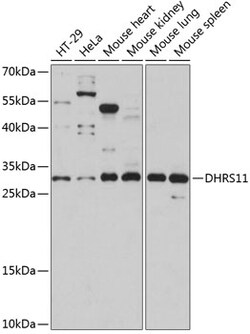
ABclonal Technology DHRS11 Rabbit pAb
Enables 17-beta-hydroxysteroid dehydrogenase (NADP+) activity, 17-beta-ketosteroid reductase activity, and 3-keto sterol reductase activity. Involved in steroid biosynthetic process. Predicted to be located in extracellular region.
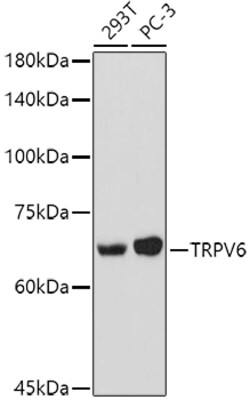
ABclonal Technology TRPV6 Rabbit pAb
This gene encodes a member of a family of multipass membrane proteins that functions as calcium channels. The encoded protein contains N-terminal ankyrin repeats, which are required for channel assembly and regulation. Translation initiation for this protein occurs at a non-AUG start codon that is decoded as methionine. This gene is situated next to a closely related gene for transient receptor potential cation channel subfamily V member 5 (TRPV5). This locus has experienced positive selection in non-African populations, resulting in several non-synonymous codon differences among individuals of different genetic backgrounds.

Genesee Scientific Corporation Olympus 300 µl Barrier Tips, Filtered Barrier Tip, Low-Binding Resin Technology, Universal Fit, 300 µl
The Olympus 300 µl Barrier Tips are premium filtered pipette tips designed for high-precision liquid handling, featuring low-binding resin technology for maximal sample recovery and contaminant-free certification. Their unique aerosol barrier prevents pipettor contamination, making them ideal for sensitive assays. Universally compatible with most research-grade pipettors, they come in an SBS-format rack for easy identification and ergonomic use.

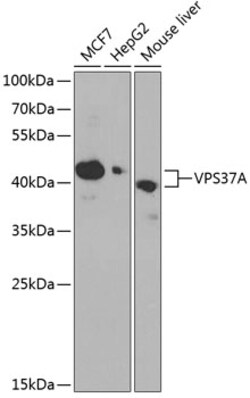
ABclonal Technology VPS37A Rabbit pAb
This gene belongs to the VPS37 family, and encodes a component of the ESCRT-I (endosomal sorting complex required for transport I) protein complex, required for the sorting of ubiquitinated transmembrane proteins into internal vesicles of multivesicular bodies. Expression of this gene is downregulated in hepatocellular carcinoma, and mutations in this gene are associated with autosomal recessive spastic paraplegia-53. A related pseudogene has been identified on chromosome 5. Alternatively spliced transcript variants have been found for this gene.

ABclonal Technology CYTH4 Rabbit pAb
This gene encodes a member of the PSCD family of proteins, which have an N-terminal coiled-coil motif, a central Sec7 domain, and a C-terminal pleckstrin homology (PH) domain. The coiled-coil motif is involved in homodimerization, the Sec7 domain contains guanine-nucleotide exchange protein (GEP) activity, and the PH domain interacts with phospholipids and is responsible for association of PSCDs with membranes. Members of this family function as GEPs for ADP-ribosylation factors (ARFs), which are guanine nucleotide-binding proteins involved in vesicular trafficking pathways. This protein exhibits GEP activity in vitro with ARF1 and ARF5, but is inactive with ARF6. Alternatively spliced transcript variants have been found for this gene.

ABclonal Technology CALCA Rabbit pAb
This gene encodes the peptide hormones calcitonin, calcitonin gene-related peptide and katacalcin by tissue-specific alternative RNA splicing of the gene transcripts and cleavage of inactive precursor proteins. Calcitonin is involved in calcium regulation and acts to regulate phosphorus metabolism. Calcitonin gene-related peptide functions as a vasodilator and as an antimicrobial peptide while katacalcin is a calcium-lowering peptide. Multiple transcript variants encoding different isoforms have been found for this gene.

ABclonal Technology OR1A1 Rabbit pAb
Olfactory receptors interact with odorant molecules in the nose, to initiate a neuronal response that triggers the perception of a smell. The olfactory receptor proteins are members of a large family of G-protein-coupled receptors (GPCR) arising from single coding-exon genes. Olfactory receptors share a 7-transmembrane domain structure with many neurotransmitter and hormone receptors and are responsible for the recognition and G protein-mediated transduction of odorant signals. The olfactory receptor gene family is the largest in the genome. The nomenclature assigned to the olfactory receptor genes and proteins for this organism is independent of other organisms.

ABclonal Technology COQ9 Rabbit pAb
This locus represents a mitochondrial ubiquinone biosynthesis gene. The encoded protein is likely necessary for biosynthesis of coenzyme Q10, as mutations at this locus have been associated with autosomal-recessive neonatal-onset primary coenzyme Q10 deficiency.

ABclonal Technology TRIP4 Rabbit pAb
This gene encodes a subunit of the tetrameric nuclear activating signal cointegrator 1 (ASC-1) complex, which associates with transcriptional coactivators, nuclear receptors and basal transcription factors to facilitate nuclear receptors-mediated transcription. This protein is localized in the nucleus and contains an E1A-type zinc finger domain, which mediates interaction with transcriptional coactivators and ligand-bound nuclear receptors, such as thyroid hormone receptor and retinoid X receptor alpha, but not glucocorticoid receptor. Mutations in this gene are associated with spinal muscular atrophy with congenital bone fractures-1 (SMABF1).