
Gel Electrophoresis Reagents and Buffers



Biotium Primary Antibody Rabbit IgG Fc N2507.RFC CF660R 1/EA
Alpaca Anti-Rabbit IgG (Fc) rVHH (N2507 RFC) is a recombinant Alpaca VHH antibody that recognizes the Fc fragment of rabbit IgG and is validated for immunofluorescence Far-red fluorescent photostable CF660R dye has Ex/Em at 663/682 nm Unit size 500 uL at 0 1 mg/mL


Biotium Primary Antibody Human IgG Fc N2508.HFC CF740 1/EA
Anti-Human IgG (Fc) rVHH (N2508 HFC) is a recombinant Alpaca VHH antibody that recognizes the Fc domain of human IgG and is validated for IF and flow Near-IR photostable CF740 dye has Ex/Em at 742/767 nm Unit size 500 uL at 0 1 mg/mL

Biotium Primary Antibody Rabbit IgG Fc N2507.RFC CF680R 1/EA
Alpaca Anti-Rabbit IgG (Fc) rVHH (N2507 RFC) is a recombinant Alpaca VHH antibody that recognizes the Fc fragment of rabbit IgG and is validated for immunofluorescence Far-red/near-IR photostable CF680R dye has Ex/Em at 680/701 nm Unit size 500 uL at 0 1 mg/mL
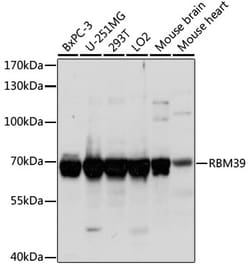
ABclonal Technology RBM39 Rabbit pAb

This gene encodes a member of the U2AF65 family of proteins. The encoded protein is found in the nucleus, where it co-localizes with core spliceosomal proteins. It has been shown to play a role in both steroid hormone receptor-mediated transcription and alternative splicing, and it is also a transcriptional coregulator of the viral oncoprotein v-Rel. Multiple transcript variants have been observed for this gene. A related pseudogene has been identified on chromosome X.
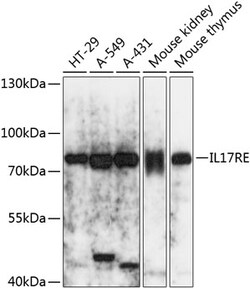
ABclonal Technology IL17RE Rabbit pAb
This gene encodes a transmembrane protein that functions as the receptor for interleukin-17C. The encoded protein signals to downstream components of the mitogen activated protein kinase (MAPK) pathway. Activity of this protein is important in the immune response to bacterial pathogens. Alternatively spliced transcript variants have been described for this gene.
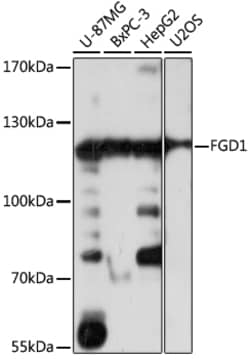
ABclonal Technology FGD1 Rabbit pAb
This gene encodes a protein that contains Dbl (DH) and pleckstrin (PH) homology domains and is similar to the Rho family of small GTP-binding proteins. The encoded protein specifically binds to the Rho family GTPase Cdc42Hs and can stimulate the GDP-GTP exchange of the isoprenylated form of Cdc42Hs. It also stimulates the mitogen activated protein kinase cascade leading to c-Jun kinase SAPK/JNK1 activation. Defects in this gene are the cause of the faciogenital dysplasia in Aarskog-Scott syndrome and a syndromatic form of X-linked cognitive disability.
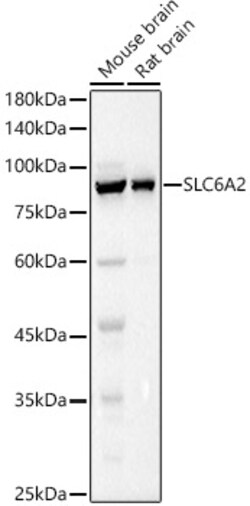
ABclonal Technology SLC6A2 Rabbit pAb
This gene encodes a member of the sodiumneurotransmitter symporter family. This member is a multi-pass membrane protein, which is responsible for reuptake of norepinephrine into presynaptic nerve terminals and is a regulator of norepinephrine homeostasis. Mutations in this gene cause orthostatic intolerance, a syndrome characterized by lightheadedness, fatigue, altered mentation and syncope. Alternatively spliced transcript variants encoding different isoforms have been identified in this gene.
![ABclonal Technology [KO Validated] CHCHD2 Rabbit pAb](https://assets.fishersci.com/TFS-Assets/CCG/product-images/5000111033.jpg-250.jpg)
ABclonal Technology [KO Validated] CHCHD2 Rabbit pAb
The protein encoded by this gene belongs to the eukaryotic CX(9)C family, characterized by four cysteine residues forming disulfide linkages that create a CHCH fold. In response to stress, it moves from the mitochondrial intermembrane space to the nucleus, where it binds to a conserved oxygen-responsive element in the promoter of cytochrome oxidase 4I2, a subunit of the electron transport chain. Along with recombination signal sequence-binding protein J, this protein activates the element at low oxygen levels. It also acts as a negative regulator of mitochondria-mediated apoptosis; under apoptotic stress, its mitochondrial levels decrease, allowing BCL2-associated X protein to activate the caspase cascade. Pseudogenes of this gene exist on multiple chromosomes, and alternative splicing produces multiple transcript variants.

S2 Media 15x100mm Chameleon™ COLOREX™ StrepACG, 10/pack
Chameleon™ COLOREX™ StrepACG is a selective and differential, chromogenic culture medium used for the qualitative direct detection and presumptive identification of Streptococcus pyogenes (Group A Streptococcus, GAS), Group C, and Group G streptococci. Test specimens include throat swabs. Concomitant cultures should be performed to recover organisms for further microbiological testing or epidemiological typing. Further identification or epidemiological typing should be performed on suspect colonies.• Product meets CLSI performance criteria.• Chameleon™ COLOREX™ StrepACG should be used by trained professionals within a laboratory setting. • For in vitro diagnostic (IVD) use.• Product is not intended for use in the diagnosis or treatment of disease or other human conditions.
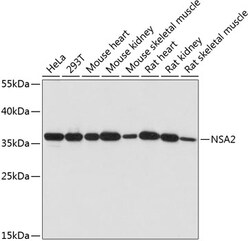
ABclonal Technology NSA2 Rabbit pAb
This gene encodes a nucleolar protein involved in cell cycle regulation and proliferation. This gene was identified based on sequence similarity to a highly conserved Saccharomyces cerevisiae gene encoding a pre-ribosomal protein, which is involved in large ribosomal subunit biogenesis. The encoded protein is found at elevated levels in diabetic nephropathy. Alternative splicing results in multiple transcript variants. Several related pseudogenes have been identified.
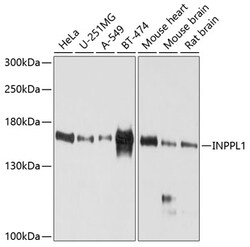
ABclonal Technology INPPL1 Rabbit pAb
The protein encoded by this gene is an SH2-containing 5-inositol phosphatase that is involved in the regulation of insulin function. The encoded protein also plays a role in the regulation of epidermal growth factor receptor turnover and actin remodelling. Additionally, this gene supports metastatic growth in breast cancer and is a valuable biomarker for breast cancer.
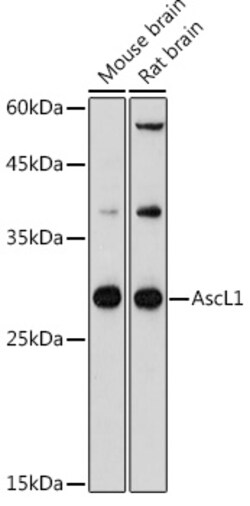
ABclonal Technology AscL1 Rabbit pAb
This gene encodes a member of the basic helix-loop-helix (BHLH) family of transcription factors. The protein activates transcription by binding to the E box (5-CANNTG-3). Dimerization with other BHLH proteins is required for efficient DNA binding. This protein plays a role in the neuronal commitment and differentiation and in the generation of olfactory and autonomic neurons. Mutations in this gene may contribute to the congenital central hypoventilation syndrome (CCHS) phenotype in rare cases.
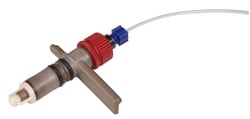
Perkin Elmer US LLC Organics High Sensitivity Plastic Nebulizer Tantalum Needle Assembly for PinAAcle 900
The high sensitivity plastic nebulizer provides exceptional sensitivity, precision and corrosion resistance and can be used to aspirate almost all solutions, even those solutions containing a high percentage of acids.
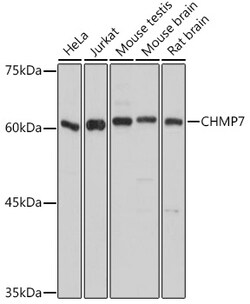
ABclonal Technology CHMP7 Rabbit pAb
Involved in several processes, including late endosome to vacuole transport, midbody abscission, and mitotic nuclear division. Located in cytosol, nuclear envelope, and nucleoplasm. Part of ESCRT III complex. Colocalizes with chromatin.
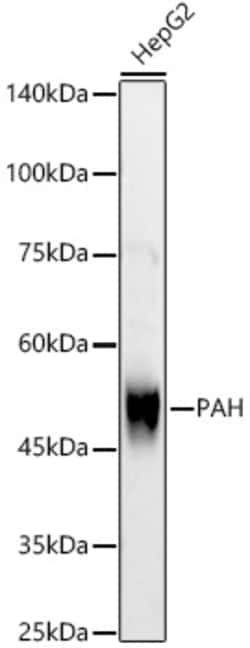
ABclonal Technology PAH Rabbit pAb
This gene encodes a member of the biopterin-dependent aromatic amino acid hydroxylase protein family. The encoded phenylalanine hydroxylase enzyme hydroxylates phenylalanine to tyrosine and is the rate-limiting step in phenylalanine catabolism. Deficiency of this enzyme activity results in the autosomal recessive disorder phenylketonuria.