
Protein Molecular Weight Markers


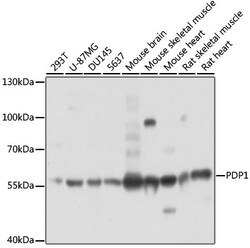
ABclonal Technology PDP1 Rabbit pAb

Pyruvate dehydrogenase (E1) is part of the pyruvate dehydrogenase complex (E1, E2, E3), with E1 activity regulated by phosphorylation and dephosphorylation. Pyruvate dehydrogenase kinases inactivate E1 by phosphorylating serine residues, while pyruvate dehydrogenase phosphatases activate E1 by dephosphorylation. The phosphatase is a heterodimer with catalytic and regulatory subunits. The catalytic subunit encoded by this gene is predominantly expressed in skeletal muscle and belongs to the protein phosphatase 2C (PP2C) superfamily. Located in the mitochondrial matrix, this enzyme, along with pyruvate dehydrogenase and kinases, regulates pyruvate metabolism. Mutations in this gene lead to pyruvate dehydrogenase phosphatase deficiency. Multiple alternatively spliced isoforms have been identified.

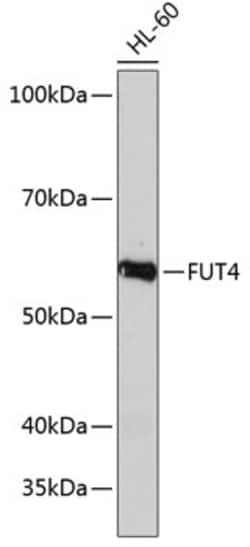
ABclonal Technology FUT4 Rabbit pAb
The product of this gene transfers fucose to N-acetyllactosamine polysaccharides to generate fucosylated carbohydrate structures. It catalyzes the synthesis of the non-sialylated antigen, Lewis x (CD15).
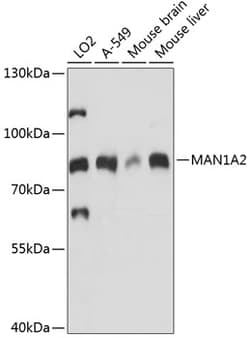
ABclonal Technology MAN1A2 Rabbit pAb
Alpha-mannosidases function at different stages of N-glycan maturation in mammalian cells. See MAN2A1 (MIM 154582) for general information.
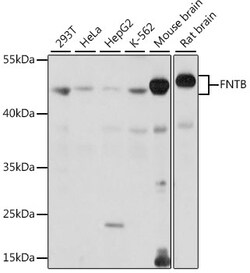
ABclonal Technology FNTB Rabbit pAb
Enables zinc ion binding activity. Contributes to protein farnesyltransferase activity. Involved in protein farnesylation. Part of microtubule associated complex and protein farnesyltransferase complex.


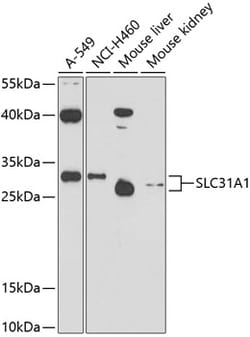
ABclonal Technology SLC31A1 Rabbit pAb
The protein encoded by this gene is a high-affinity copper transporter found in the cell membrane. The encoded protein functions as a homotrimer to effect the uptake of dietary copper.
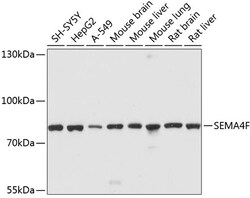
ABclonal Technology SEMA4F Rabbit pAb
This gene encodes a transmembrane class IV semaphorin family protein, which plays a role in neural development. This gene may be involved in neurogenesis in prostate cancer, the development of neurofibromas, and breast cancer tumorigenesis. Alternative splicing results in multiple transcript variants.
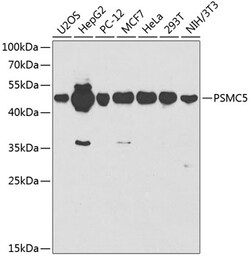
ABclonal Technology PSMC5 Rabbit pAb
The 26S proteasome is a multicatalytic proteinase complex consisting of a 20S core and a 19S regulator. The 20S core has 4 rings made of 28 subunits, while the 19S regulator includes a base with ATPase subunits and a lid with non-ATPase subunits. Proteasomes, located throughout eukaryotic cells, cleave peptides in an ATP/ubiquitin-dependent process. The immunoproteasome processes class I MHC peptides. This gene encodes an ATPase subunit, part of the triple-A family of ATPases with chaperone-like activity. Beyond proteasome function, it may also participate in transcriptional regulation, interacting with thyroid hormone and retinoid X receptors. Two isoforms of this gene are produced by alternative splicing.

S2 Media 15x100mm Chameleon™ COLOREX™ Campylobacter, 10/pack
Chameleon™ COLOREX™ Campylobacter is a selective and differential, chromogenic culture medium used for the qualitative direct detection and presumptive identification of thermotolerant Campylobacter. Test specimens include rectal swabs and stools. Chameleon™ COLOREX™ Campylobacter can also be used in the detection of Campylobacter in the analyses of food products for human consumption, animal feed, and in environmental samples in accordance with the ISO 10272-1. Further identification, susceptibility testing, and epidemiological typing should be performed on suspect colonies.• Product meets CLSI and ISO performance criteria.• Chameleon™ COLOREX™ Campylobacter should be used by trained professionals within a laboratory setting. • For in vitro diagnostic (IVD) use.• Product is not intended for use in the diagnosis or treatment of disease or other human conditions.

Rockland Immunochemicals OspA Control Protein 100 µg
Outer-Surface Protein A (OspA) a lipoprotein from Borrelia burgdorferi encoded on its Plasmid lp54 is a major component of the spirochete's extracellular matrix. OspA probably serves as a lipid-anchor. The spirochetes migrate from the tick midgut during feeding to its salivary glands and are thus transmitted to the mammal host. This transition may be facilitated by changes in expression of some B. burgdorferi genes. Upon transmission of the spirochete from the Ixodes tick to mammalian host the transcript level of OspA can change. B. burgdorferi can attach to diverse tissues within the vertebrate host and the tick vector suggesting that physiological factors other than pH and temperature may play roles in modulating B. burgdorferi gene expression.
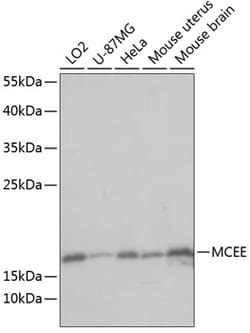
ABclonal Technology MCEE Rabbit pAb
The product of this gene catalyzes the interconversion of D- and L-methylmalonyl-CoA during the degradation of branched chain amino acids. odd chain-length fatty acids, and other metabolites. Mutations in this gene result in methylmalonyl-CoA epimerase deficiency, which is presented as mild to moderate methylmalonic aciduria.