
Protein Molecular Weight Markers

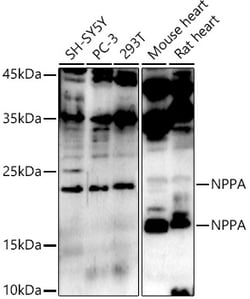
ABclonal Technology NPPA Rabbit pAb

The protein encoded by this gene belongs to the natriuretic peptide family. Natriuretic peptides are implicated in the control of extracellular fluid volume and electrolyte homeostasis. This protein is synthesized as a large precursor (containing a signal peptide), which is processed to release a peptide from the N-terminus with similarity to vasoactive peptide, cardiodilatin, and another peptide from the C-terminus with natriuretic-diuretic activity. Mutations in this gene have been associated with atrial fibrillation familial type 6. This gene is located adjacent to another member of the natriuretic family of peptides on chromosome 1.

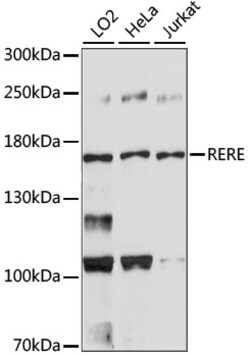
ABclonal Technology RERE Rabbit pAb
This gene encodes a member of the atrophin family of arginine-glutamic acid (RE) dipeptide repeat-containing proteins. The encoded protein co-localizes with a transcription factor in the nucleus, and its overexpression triggers apoptosis. A similar protein in mouse associates with histone deacetylase and is thought to function as a transcriptional co-repressor during embryonic development. Multiple transcript variants encoding different isoforms have been found for this gene.
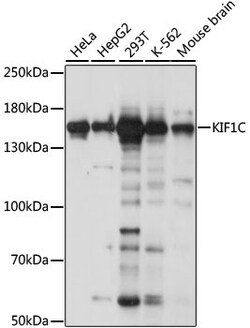
ABclonal Technology KIF1C Rabbit pAb
The protein encoded by this gene is a member of the kinesin-like protein family. The family members are microtubule-dependent molecular motors that transport organelles within cells and move chromosomes during cell division. Mutations in this gene are a cause of spastic ataxia 2, autosomal recessive.
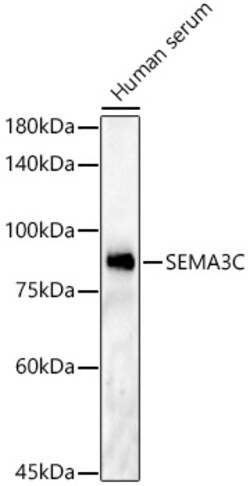
ABclonal Technology SEMA3C Rabbit pAb
This gene encodes a secreted glycoprotein that belongs to the semaphorin class 3 family of neuronal guidance cues. The encoded protein contains an N-terminal sema domain, integrin and immunoglobulin-like domains, and a C-terminal basic domain. Homodimerization and proteolytic cleavage of the C-terminal propeptide are necessary for the function of the encoded protein. It binds a neuropilin co-receptor before forming a heterotrimeric complex with an associated plexin. An increase in the expression of this gene correlates with an increase in cancer cell invasion and adhesion. Naturally occurring mutations in this gene are associated with Hirschsprung disease.
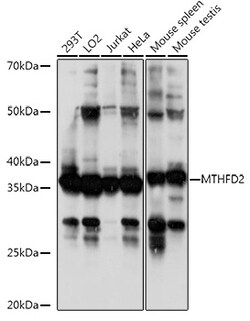
ABclonal Technology MTHFD2 Rabbit pAb
This gene encodes a nuclear-encoded mitochondrial bifunctional enzyme with methylenetetrahydrofolate dehydrogenase and methenyltetrahydrofolate cyclohydrolase activities. The enzyme functions as a homodimer and is unique in its absolute requirement for magnesium and inorganic phosphate. Formation of the enzyme-magnesium complex allows binding of NAD. Alternative splicing results in two different transcripts, one protein-coding and the other not protein-coding. This gene has a pseudogene on chromosome 7.
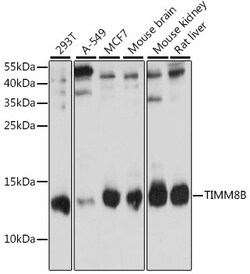
ABclonal Technology TIMM8B Rabbit pAb
This gene encodes a member of a well-conserved family of proteins with similarity to yeast Tim mitochondrial import proteins. This gene is encoded by a nuclear gene and is transported into the intermembrane space of the mitochondrion. When formed into complexes, these proteins guide membrane-spanning proteins across the mitochondrial intermembrane space before they are added into the mitochondrial inner membrane. This gene is adjacent to succinate dehydrogenase, subunit D (SDHD), in which mutations have been found in affected members of families with hereditary paraganglioma.
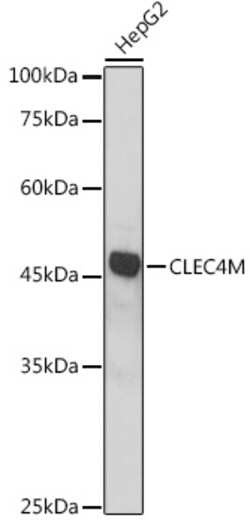
ABclonal Technology CLEC4M Rabbit pAb
This gene encodes a C-type lectin involved in cell adhesion and pathogen recognition. It recognizes a range of pathogens, including tuberculosis mycobacteria, Ebola, HIV-1, influenza A, West Nile virus, and SARS-CoV. The protein has four domains: a C-terminal carbohydrate recognition domain, a flexible neck domain, a transmembrane region, and an N-terminal cytoplasmic domain for internalization. This gene is related to CD209 (DC-SIGN) but differs in viral recognition and expression. It is highly expressed in endothelial cells of the liver, lymph node, and placenta. Polymorphisms in the neck domain are linked to resistance to SARS infection.
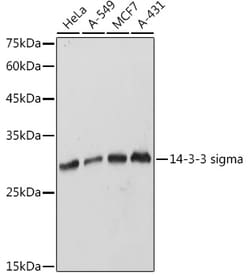
ABclonal Technology 14-3-3 sigma Rabbit pAb
This gene encodes a cell cycle checkpoint protein. The encoded protein binds to translation and initiation factors and functions as a regulator of mitotic translation. In response to DNA damage this protein plays a role in preventing DNA errors during mitosis.
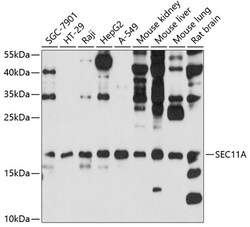
ABclonal Technology SEC11A Rabbit pAb
This gene encodes a member of the peptidase S26B family. The encoded protein is an 18kDa subunit of the signal peptidase complex and has been linked to cell migration and invasion, gastric cancer and lymph node metastasis. Alternative splicing results in multiple transcript variants. A related pseudogene has been identified on chromosome 8.
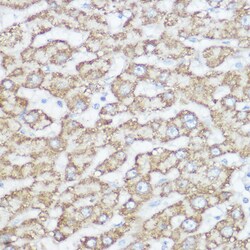
ABclonal Technology NDUFA4 Rabbit pAb
The protein encoded by this gene belongs to the complex I 9kDa subunit family. Mammalian complex I of mitochondrial respiratory chain is composed of 45 different subunits. This protein has NADH dehydrogenase activity and oxidoreductase activity. It transfers electrons from NADH to the respiratory chain. The immediate electron acceptor for the enzyme is believed to be ubiquinone.
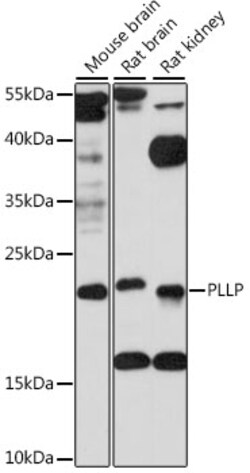
ABclonal Technology PLLP Rabbit pAb
Predicted to be a structural constituent of myelin sheath. Predicted to be involved in myelination. Predicted to be located in compact myelin and membrane raft. Predicted to be integral component of membrane. Biomarker of schizophrenia.
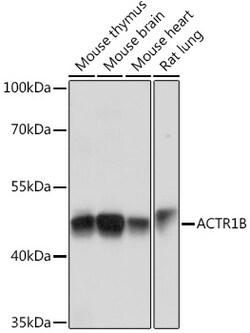
ABclonal Technology ACTR1B Rabbit pAb
This gene encodes a 42.3 kD subunit of dynactin, a macromolecular complex consisting of 10 subunits ranging in size from 22 to 150 kD. Dynactin binds to both microtubules and cytoplasmic dynein and is involved in a diverse array of cellular functions, including ER-to-Golgi transport, the centripetal movement of lysosomes and endosomes, spindle formation, chromosome movement, nuclear positioning, and axonogenesis. This subunit, like ACTR1A, is an actin-related protein. These two proteins, which are of equal length and share 90% amino acid identity, are present in a constant ratio of approximately 115 in the dynactin complex.
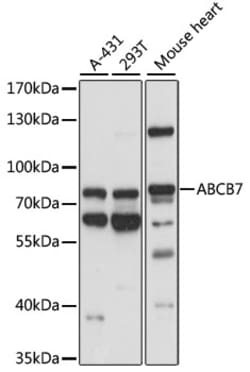
ABclonal Technology ABCB7 Rabbit pAb
The membrane-associated protein encoded by this gene is a member of the superfamily of ATP-binding cassette (ABC) transporters. ABC proteins transport various molecules across extra- and intra-cellular membranes. ABC genes are divided into seven distinct subfamilies (ABC1, MDR/TAP, MRP, ALD, OABP, GCN20, White). This protein is a member of the MDR/TAP subfamily. Members of the MDR/TAP subfamily are involved in multidrug resistance as well as antigen presentation. This gene encodes a half-transporter involved in the transport of heme from the mitochondria to the cytosol. With iron/sulfur cluster precursors as its substrates, this protein may play a role in metal homeostasis. Mutations in this gene have been associated with mitochondrial iron accumulation and isodicentric (X)(q13) and sideroblastic anemia. Alternatively spliced transcript variants encoding multiple isoforms have been observed for this gene.
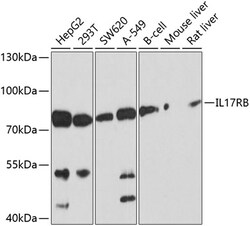
ABclonal Technology IL17RB Rabbit pAb
The protein encoded by this gene is a cytokine receptor. This receptor specifically binds to IL17B and IL17E, but does not bind to IL17 and IL17C. This receptor has been shown to mediate the activation of NF-kappaB and the production of IL8 induced by IL17E. The expression of the rat counterpart of this gene was found to be significantly up-regulated during intestinal inflammation, which suggested the immunoregulatory activity of this receptor.
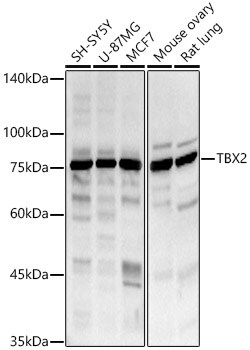
ABclonal Technology TBX2 Rabbit pAb
This gene is a member of a phylogenetically conserved family of genes that share a common DNA-binding domain, the T-box. T-box genes encode transcription factors involved in the regulation of developmental processes. This gene product is the human homolog of mouse Tbx2, and shares strong sequence similarity with Drosophila omb protein. Expression studies indicate that this gene may have a potential role in tumorigenesis as an immortalizing agent. Transcript heterogeneity due to alternative polyadenylation has been noted for this gene.