
Protein Molecular Weight Markers

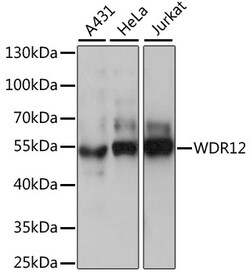
ABclonal Technology WDR12 Rabbit pAb

This gene encodes a member of the WD repeat protein family. WD repeats are minimally conserved regions of approximately 40 amino acids typically bracketed by gly-his and trp-asp (GH-WD), which may facilitate formation of heterotrimeric or multiprotein complexes. Members of this family are involved in a variety of cellular processes, including cell cycle progression, signal transduction, apoptosis, and gene regulation. This protein is highly similar to the mouse WD repeat domain 12 protein at the amino acid level. The protein encoded by this gene is a component of a nucleolar protein complex that affects maturation of the large ribosomal subunit.

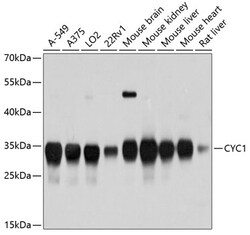
ABclonal Technology CYC1 Rabbit pAb
This gene encodes a subunit of the cytochrome bc1 complex, which plays an important role in the mitochondrial respiratory chain by transferring electrons from the Rieske iron-sulfur protein to cytochrome c. Mutations in this gene may cause mitochondrial complex III deficiency, nuclear type 6.

Echelon Biosciences Research Labs Select-HA HiLadder
Select-HA HiLadder is a hyaluronic acid (HA) preparation of uniform and narrow size distribution prepared by in vitro synthesis using recombinant Pasteurella multocida hyaluronan synthase. Each Select-HA Ladder™ contains 5 Select-HA™ molecular mass markers. This item is non returnable


S2 Media 15x100mm Chameleon™ COLOREX™ C3GR (RUO), 10/pack
Chameleon™ COLOREX™ C3GR (RUO) is a selective and differential, chromogenic culture medium used for the qualitative direct detection of gastrointestinal colonization with 3rd generation cephalosporin-resistant Enterobacteria (C3GR-E). Test specimens include rectal swabs and stools. For Research Use Only (RUO). Not for use in diagnostic procedures unless Laboratory Developed Test (LDT) validation with the product has been completed. Further identification, susceptibility testing, and epidemiological typing should be performed on suspect colonies.• Product meets CLSI performance criteria.• Chameleon™ COLOREX™ C3GR should be used by trained professionals within a laboratory setting. • For in vitro diagnostic (IVD) use.• Product is not intended for use in the diagnosis or treatment of disease or other human conditions.
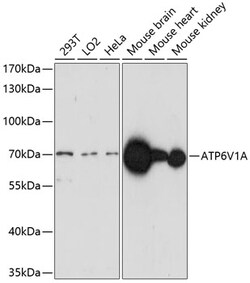
ABclonal Technology ATP6V1A Rabbit pAb
This gene encodes a component of vacuolar ATPase (V-ATPase), a multisubunit enzyme that mediates acidification of eukaryotic intracellular organelles. V-ATPase dependent organelle acidification is necessary for such intracellular processes as protein sorting, zymogen activation, receptor-mediated endocytosis, and synaptic vesicle proton gradient generation. V-ATPase is composed of a cytosolic V1 domain and a transmembrane V0 domain. The V1 domain consists of three A and three B subunits, two G subunits plus the C, D, E, F, and H subunits. The V1 domain contains the ATP catalytic site. The V0 domain consists of five different subunits a, c, c, c", and d. Additional isoforms of many of the V1 and V0 subunit proteins are encoded by multiple genes or alternatively spliced transcript variants. This encoded protein is one of two V1 domain A subunit isoforms and is found in all tissues. Transcript variants derived from alternative polyadenylation exist.
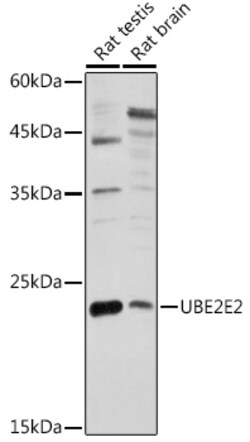
ABclonal Technology UBE2E2 Rabbit pAb
Enables ISG15 transferase activity and ubiquitin conjugating enzyme activity. Involved in protein modification by small protein conjugation. Acts upstream of or within cellular response to DNA damage stimulus and positive regulation of G1/S transition of mitotic cell cycle. Predicted to be active in nucleus.
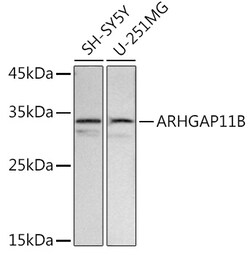
ABclonal Technology ARHGAP11B Rabbit pAb
Predicted to enable GTPase activator activity. Involved in cerebral cortex development and negative regulation of mitochondrial membrane permeability. Acts upstream of with a positive effect on glutamine catabolic process. Located in mitochondrial matrix.
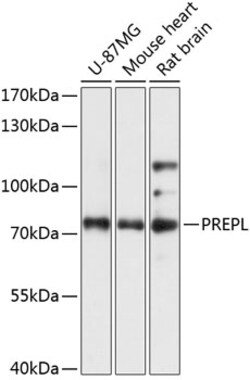
ABclonal Technology PREPL Rabbit pAb
The protein encoded by this gene belongs to the prolyl oligopeptidase subfamily of serine peptidases. Mutations in this gene have been associated with hypotonia-cystinuria syndrome, also known as the 2p21 deletion syndrome. Several alternatively spliced transcript variants encoding either the same or different isoforms have been described for this gene.

Enzo Life Sciences Prestained Protein Ladder (3.5 - 245 kDa) (500µl)
Enzo's Protein ladder is a three-color protein standard with 13 prestained proteins, covering a wide range molecular weights from 3.5 to 245 kDa. Proteins are covalently coupled with a blue chromophore except for two reference bands (one green and one red band at 25 kDa and 75 kDa respectively) when separated on SDS-PAGE (Tris-glycine buffer). Our Protein ladder is designed for monitoring protein separation during SDS-polyacrylamide gel electrophoresis, verification of Western transfer efficiency on membranes (PVDF, nylon, or nitrocellulose) and for approximating the size of proteins. The ladder is supplied in gel loading buffer and is ready to use. Do not heat, dilute or add reducing agent before loading. Formulation: Approximately 0.1~0.4 mg/ml of each protein in the buffer (20mM Tris-phosphate, pH 7.5 at 25°C), 2% SDS, 10mM Dithiothreitol, 3.6 M Urea, and 15% (v/v) Glycerol). Long Term Storage: -20°C. Applications: SDS-PAGE.
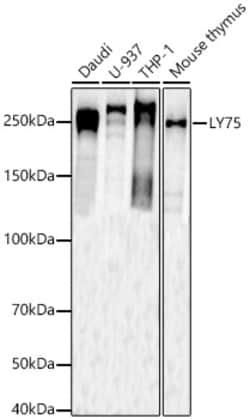
ABclonal Technology LY75 Rabbit pAb
Predicted to enable signaling receptor activity. Predicted to be involved in immune response and inflammatory response. Located in extracellular exosome.
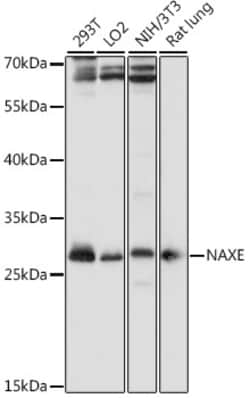
ABclonal Technology NAXE Rabbit pAb
The product of this gene interacts with apolipoprotein A-I (apoA-I), the major apolipoprotein of high-density lipoproteins (HDLs). It is secreted into some bodily fluids, and its synthesis and secretion are stimulated in vitro by incubating cells with apoA-I. The human genome contains related pseudogenes.
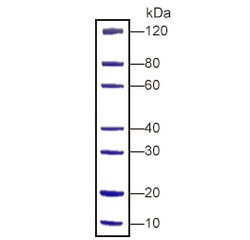
Genscript Corporation PAGE-MASTER Protein Standard (for SDS-PAGE)
PAGE-MASTER Protein Standard (for SDS-PAGE) is a protein standard specially designed by GenScript. It consists of seven bands with molecular weight of 10 kD, 20 kD, 30 kD, 40 kD, 60 kD, 80 kD and 120 kD. All bands are highly purified, thus exhibit excellent performance in SDS-PAGE gels.
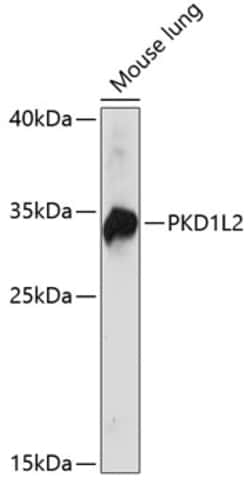
ABclonal Technology PKD1L2 Rabbit pAb
This gene encodes a member of the polycystin protein family. This protein may function as a G-protein-coupled component or regulator of cation channel pores. The long isoform of this protein contains 11 transmembrane domains, a latrophilin/CL-1-like GPCR proteolytic site (GPS) domain, and a polycystin-1, lipoxygenase, alpha-toxin (PLAT) domain. Alternative splicing results in multiple transcript variants encoding distinct isoforms. This gene is a polymorphic pseudogene in humans.