
Primary Antibody Matched Pairs

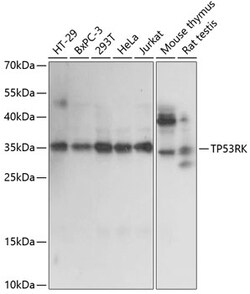
ABclonal Technology TP53RK Rabbit pAb

Enables p53 binding activity and protein serine/threonine kinase activity. Involved in protein phosphorylation. Located in cytoplasm and nucleus. Part of EKC/KEOPS complex. Implicated in Galloway-Mowat syndrome 4.


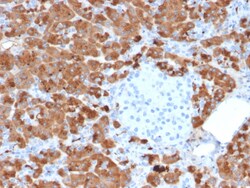
Biotium Carboxypeptidase A1 / CPA1 (Pancreatic Cancer Marker)(CPA1/2712), CF568 conjugate, 0.1mg/mL
Carboxypeptidase A1 (CPA1) is a secreted zinc metalloprotease that is highly expressed in pancreatic tissue. It catalyzes the release of C-terminal amino acids from a variety of proteins, thereby playing a key role in protein digestion and degradation. Human pancreatic procarboxypeptidase A exists as three different active forms, two of which are carboxypeptidase A1 (CPA1) and carboxypeptidase A2 (CPA2). Abnormal levels of CPA1 are associated with pancreatic cancer, suggesting a possible role in either tumor progression or tumor suppression events. Primary antibodies are available purified, or with a selection of fluorescent CF Dyes and other labels. CF Dyes offer exceptional brightness and photostability. Note: Conjugates of blue fluorescent dyes like CF405S and CF405M are not recommended for detecting low abundance targets, because blue dyes have lower fluorescence and can give higher non-specific background than other dye colors.

Medchemexpress LLC Fatty acid synthase (human), recombinant, His-tagged | 9045-77-6 | 50UG
Recombinant human fatty acid synthase (FASN) expressed in Sf9 insect cells and supplied as a His-tagged, 0.22 μm filtered protein solution suitable for biochemical and structural studies.
- His tag for affinity purification and detection.
- Molecular weight 47.2 kDa.
- Formulated in 50 mM HEPES, 200 mM NaCl, 10% glycerol, 1 mM DTT, pH 7.5.
- Endotoxin <1 EU/μg (LAL method).
- Stored at -80°C; stable at -20°C for 3 months after opening.
- Avoid repeated freeze-thaw; aliquot for extended storage.
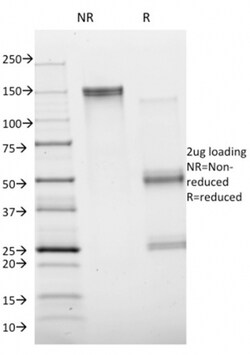
Biotium Annexin A1 / (Hairy Cell Leukemia Marker)(ANXA1/1672), 0.2mg/mL
Annexin A1 belongs to the annexin family. It plays a role in glucocorticoid-mediated down-regulation of the early phase of the inflammatory response. In resting conditions Annexin A1 is localized to the cytoplasm. Upon activation it is mobilized to the membrane and secreted. Annexin A1 and contains 4 annexin repeats. A pair of annexin repeats may form one binding site for calcium and a phospholipid. Expression of the ANXA1 gene is upregulated in hairy cell leukemia (HCL). Detection of ANXA1 provides a simple, highly sensitive and specific assay for diagnosing HCL. Annexin A1 has also been found to be protective against DNA damage induced by heat in breast cancer cells, suggesting it is involved in tumor suppressive and protective activities, and also is associated with treatment resistance. Primary antibodies are available purified, or with a selection of fluorescent CF Dyes and other labels. CF Dyes offer exceptional brightness and photostability. Note: Conjugates of blue

Human CFHR2 ELISA Pair Set 15PP (Sino Biological)
Each vial contains 25 ng of recombinant Human CFHR2. Reconstitute with 1 mL detection antibody dilution buffer. After reconstitution, store at -20℃ to -80℃ in a manual defrost freezer. A seven-point standard curve using 2-fold serial dilutions in sample dilution buffer, and a high standard of 600 pg/mL is recommended.
Sino Biological Anti-Cathepsin D Antibody, Rabbit Polyclonal 100 µL
Produced in rabbits immunized with purified, recombinant Human Cathepsin D (rh Cathepsin D; Catalog#12517-H08H; P07339; Met1-Leu412). Cathepsin D specific IgG was purified by Human Cathepsin D affinity chromatography.
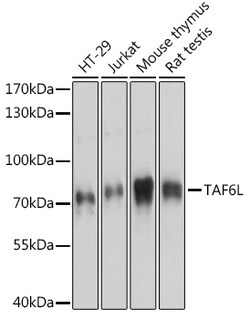
ABclonal Technology TAF6L Rabbit pAb
This gene encodes a protein that is part of the PCAF histone acetylase complex, which plays a key role in myogenic transcription and differentiation. The protein is structurally similar to TAF6, a histone-like component of the TFIID complex. TFIID coordinates RNA polymerase II transcription by binding to the core promoter and assembling the transcription complex. TFIID consists of the TATA-binding protein (TBP) and TBP-associated factors (TAFs), which aid in basal transcription, promoter recognition, and transcription initiation. The PCAF complex, made up of over 20 polypeptides, including TAFs, is essential for gene regulation during differentiation.
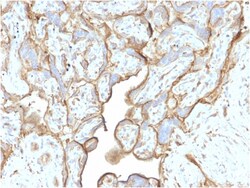
Biotium Annexin A1 / (Hairy Cell Leukemia Marker)(CPTC-ANXA1-1), CF647 conjugate, 0.1mg/mL
Annexin A1 belongs to the annexin family. It plays a role in glucocorticoid-mediated down-regulation of the early phase of the inflammatory response. In resting conditions Annexin A1 is localized to the cytoplasm. Upon activation it is mobilized to the membrane and secreted. Annexin A1 and contains 4 annexin repeats. A pair of annexin repeats may form one binding site for calcium and a phospholipid. Expression of the ANXA1 gene is upregulated in hairy cell leukemia (HCL). Detection of ANXA1 provides a simple, highly sensitive and specific assay for diagnosing HCL. Annexin A1 has also been found to be protective against DNA damage induced by heat in breast cancer cells, suggesting it is involved in tumor suppressive and protective activities, and also is associated with treatment resistance. Primary antibodies are available purified, or with a selection of fluorescent CF Dyes and other labels. CF Dyes offer exceptional brightness and photostability. Note: Conjugates of blue fluo
American Research Products Inc PrEST Antigen LRG1
PrEST Antigen LRG1 antigen APrEST84390 for leucine-rich alpha-2-glycoprotein 1 Recombinant protein fragment of Human LRG1

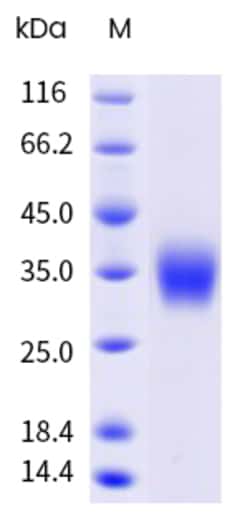
Sino Biological Recombinant Human Bikunin/AMBP Protein (His Tag), Biotinylated, HPLC-verified 20 µg
A DNA sequence encoding the alpha-1-microglobulin of human AMBP (NP_001624.1) (Met1-Val203) was expressed with a C-terminal polyhistidine tag. The purified protein was biotinylated in vitro.
Sino Biological Protein Human IL6R IL6 1MG
A DNA sequence encoding the Human IL-6/IL-6R alpha Chimera (P08887 & P05231) (Leu20-Asp358 & Val30-Met212) was expressed, with a polyhistidine tag at the N-terminus.
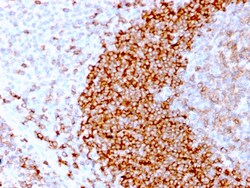
Biotium CD79b (B-Cell Marker)(IGB/3170R), CF405S conjugate, 0.1mg/mL
CD79 (also designated Ig chains, designated CD79B or B29. The B cell antigen receptor complex (BCR) is formed by the association of CD79 with a membrane immunoglobulin, such as IgM or IgD. The membrane immunoglobulins IgM and IgD achieve surface expression and antigen presentation function in response to CD79 association. The cytoplasmic tails of both CD79A and CD79B contain an ITAM (immuno-receptor tyrosine-based activation) motif, which acts to initiate the BCR signaling reactions by binding to and activating tyrosine kinases. Primary antibodies are available purified, or with a selection of fluorescent CF Dyes and other labels. CF Dyes offer exceptional brightness and photostability. Note: Conjugates of blue fluorescent dyes like CF405S and CF405M are not recommended for detecting low abundance targets, because blue dyes have lower fluorescence and can give higher non-specific background than other dye colors.
Genscript Corporation Mesothelin His Human
Mesothelin also known as MSLN is a 40 kDa protein that is expressed in mesothelial cells It has been reported that this protein is over expressed in several human tumors including mesothelioma ovarian cancer pancreatic adenocarcinoma lung adenocarcinoma and cholangiocarcinoma Mesothelin can bind MUC16 (also known as CA125) indicating that the interaction of mesothelin and MUC16 may contribute to the implantation and peritoneal spread of tumors by cell adhesion Since mesothelin is overexpressed in several cancers and is immunogenic the protein could be exploited as tumor marker or as the antigenic target of a therapeutic cancer vaccine

Human IL18BP ELISA Pair Set 15PP (Sino Biological)
Each vial contains 47 ng of recombinant Human IL18BP / IL18BPa. Reconstitute with 1 mL detection antibody dilution buffer. After reconstitution, store at -20℃ to -80℃ in a manual defrost freezer. A seven-point standard curve using 2-fold serial dilutions in sample dilution buffer, and a high standard of 3000 pg/mL is recommended.