
Substrates

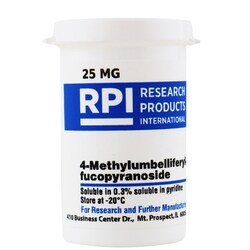
Research Products International Corp 4-Methylumbelliferyl-a-L-Fucopyranoside, 25 Milligrams

Fluorescent substrate for α-L-Fucosidase.
4-Methylumbelliferone <50ppm.


Enzo Life Sciences FLUOR DE LYS-Green substrate (50µl)
The FLUOR DE LYS-Green substrate offers a highly sensitive and convenient alternative to radiolabeled, acetylated histones or peptide/HPLC methods for the assay of histone deacetylases. The assay procedure has two steps. First, the FLUOR DE LYS-Green Substrate, which comprises an acetylated lysine side chain, is incubated with a sample containing HDAC activity (HeLa nuclear or other extract, purified enzyme, bead-bound immunocomplex, etc.). Deacetylation of the substrate sensitizes the substrate so that, in the second step, treatment with the FLUOR DE LYS Developer (BML-KI105) produces a fluorophore. The FLUOR DE LYS-Green substrate has a higher wavelength excitation and emission than the original FLUOR DE LYS substrate (BML-KI104). This avoids interference by quenching or fluorescence from compounds absorbing and/or emitting in the near UV and blue range. Formulation: 50mM solution in DMSO. Purity: ≥95% (HPLC). Long Term Storage: -80°C.

Medchemexpress LLC D-luciferin potassium | 115144-35-9 | 100.0% | 318.41 | C11H7KN2O3S2 | 250MG
D-Luciferin potassium is the potassium salt of D-luciferin, the natural substrate for firefly luciferase. In the presence of ATP and appropriate cofactors it undergoes enzymatic oxidation to produce rapid, proportional chemiluminescent light, making it suitable for reporter gene assays, cell viability measurements, and sensitive ATP detection. Supplied as a high-purity solid and available in multiple pack sizes for research use.
- High-purity potassium salt for reliable luminescent assays.
- Produces rapid, proportional chemiluminescent signal.
- Compatible with luciferase-based reporter and ATP assays.
- Supplied as a solid, stable form for storage and handling.
- Available in a range of pack sizes to suit experimental needs.
Enzo Life Sciences OMNIMMP fluorogenic substrate (1mg)
Fluorogenic substrate for nearly all matrix metalloproteinase (MMP) enzymes, and ADAM17/TACE. This highly-quenched (99.5%) substrate is useful for inhibitor screening and kinetic analysis. Ex.: 328 nm, Em.: 393 nm, although the following Ex/Em have been used: 320-340/400-420. Also available: OMNIMMP Fluorogenic Control Peptide (BML-P127). Alternative name: Mca-Pro-Leu-Gly-Leu-Dpa-Ala-Arg-NH2 . AcOH, Matrix metalloproteinase substrate. Purity: ≥98%. Solubility: Soluble in methanol (1mg/ml) or DMSO (20mg/ml). Long Term Storage: -20°C. Applications: WB Assay.

CHEMPEP INC Ubiquitin-AMC, 100 μg, Fluorogenic substrate for DUB activity assays, C388H636N106O119S, Molecular Weight 8722.2 g/mol, Fluorescence Excitation 380 nm, Emission 460 nm
Ubiquitin-AMC is a highly sensitive fluorogenic substrate essential for measuring deubiquitinating enzyme (DUB) activity in biochemical assays. This versatile reagent, composed of ubiquitin conjugated to the AMC fluorophore, facilitates real-time monitoring of DUB activity by releasing a fluorescent signal. It is particularly advantageous for high-throughput screening and detailed kinetic studies in various cellular processes.
- 100 μg quantity
- Molecular formula: C388H636N106O119S
- Molecular weight: 8722.2 g/mol
- Fluorogenic substrate type
- Target enzyme class: Deubiquitinating enzymes (DUBs)
- Real-time monitoring capability
- High sensitivity for biochemical research
- Uses aqueous buffers for solubility
- Storage temperature: -20°C or below
- Avoid repeated freeze-thaw cycles
- Purity of ≥95%
- Synthetic source of ubiquitin
- Supplied as lyophilized powder or solution in DMSO


Medchemexpress LLC H-Asp(AMC)-OH | 133628-73-6 | MFCD00236804 | 99.8% | 290.27 g/mol | C14H14N2O5 | 10 MG
H-Asp(AMC)-OH is an aspartic acid derivative linked to 7-amino-4-methylcoumarin (AMC) used as a fluorescent substrate in biochemical and enzymatic assays. It is supplied in small research quantities and characterized for assay use with reported high purity and defined storage recommendations.
- Fluorescent aspartic acid derivative for use as a substrate in assays.
- Does not inhibit glycine transport at a concentration of 0.25 mM.
- High purity (99.75%) suitable for research applications.
- Molecular weight 290.27 g/mol; formula C14H14N2O5.
- Available in a 10 mg pack size for laboratory use.
- Store sealed, away from moisture and light; in solvent: -80°C for 6 months, -20°C for 1 month.

Medchemexpress LLC Z-leu-leu-glu-AMC | 348086-66-8 | MFCD01074989 | 99.5% | 664.75 g/mol | C35H44N4O9 | 1MG
Z-Leu-Leu-Glu-AMC is a fluorogenic tripeptide substrate used to measure post-acidic (caspase-like) hydrolytic activity of the 20S proteasome. Proteolytic cleavage releases 7-amino-4-methylcoumarin (AMC), producing a fluorescent signal suitable for kinetic assays, inhibitor screening, and proteasome activity profiling in biochemical research.
- High purity (≈99.5%) for reliable assay performance.
- Releases AMC for sensitive fluorometric detection.
- Suitable for 20S/26S proteasome activity and inhibitor assays.
- Available as solid and 10 mM DMSO solution formats.
- Supplied in small research pack sizes for convenient use.
Enzo Life Sciences Ac-YVAD-AFC (10mg)
Substrate for caspase-1 and -4. Fluorogenic substrate for caspase-1 and -4. Alternative name: Caspase 1 substrate (fluorogenic), Caspase 4 substrate (fluorogenic). Formula: C33H36F3N5O10. MW: 719.7. Purity: ≥97% (HPLC). Appearance: White to off-white powder. Solubility: Soluble in DMSO. Long Term Storage: -20°C. Use/Stability: Solid product is stable for 1 year in desiccator when stored at room temperature. Stock solutions are stable for 6 – 8 months when stored at –20°C. Keep sealed after removing from the freezer until its temperature equilibrates with room temperature. Handling: Keep cool and dry.

Medchemexpress LLC Glp-Asn-Pro-AMC | 291752-43-7 | 99.3% | 497.50 | 25 MG
Glp-Asn-Pro-AMC is identified as an inhibitor of thyrotropin-releasing hormone degrading enzyme (TRH-DE), exhibiting a Ki value of 0.97 μM.
- Inhibitor of thyrotropin-releasing hormone degrading enzyme (TRH-DE)
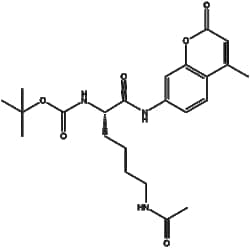
Apexbio Technology LLC Boc-Lys(Ac)-AMC 233691-67-3 10mM (in 1mL DMSO)
Boc-Lys Ac -AMC (CAS 233691-67-3) is a fluorescently labeled peptide substrate designed for analyzing enzymatic activity of histone deacetylases (HDACs) It enables monitoring of HDAC-mediated deacetylation reactions Boc-Lys Ac -AMC exerts its biological activity primarily through acting as a fluorogenic substrate for HDACs where deacetylation leads to subsequent fluorescence release following proteolytic cleavage Based on these properties Boc-Lys Ac -AMC holds research potential in biochemical assays and drug screening studies for characterizing HDAC enzyme kinetics and assessing inhibitor potency related to epigenetic modulation

Abcam Ac-WEHD-pNA, 25MG
This product is manufactured by BioVision, an Abcam company and was previously called B2282 Ac-WEHD-pNA.
The product is subject to the following: Abcam Restricted Use Statement
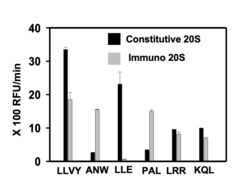
Ubpbio SUC-LLVY-AMC, 25MG
Fluorescent Peptides/Protein Substrates – SUC-LLVY-AMC (UBPBio catalog# G1100, G1101) – Suc-LLVY-AMC is a fluorogenic substrate for the chymotrypsin – like activity of the 20S and 26S proteasomes. Working concentrations of this substrate is 50-200 µM. The released AMC can be detected by a fluorimeter or plate reader at excitation/emission wavelengths of 380 nm/460 nm, respectively. When used to determine proteasome activity in cell lysates, cell lysates that are pre-treated with a proteasome inhibitor such as MG132, PS341 or epoxomicin can be used to determine the fluorescence contributed by other cellular proteases that cleave this substrate. Readings from proteasome inhibitor-treated lysates should be subtracted.
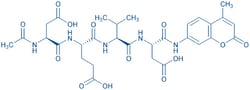
Bachem Ac-Asp-Glu-Val-Asp-AMC
Ac-Asp-Glu-Val-Asp-AMC Ammonium, 169332-61-0, C30H37N5O13, Mr 675.65, 5mg. Ac-DEVD-AMC, Apopain Substrate. A continuous fluorometric assay employing Ac-DEVD-AMC has been developed for the measurement of caspase-3, a cysteine protease also called apopain, Yama or CPP-32. The design of this substrate Ac-DEVD-AMC was based on the substrate motif that has been used successfully with caspase-1, using the poly(ADP-ribose) polymerase cleavage site P1-P4 tetrapeptide.
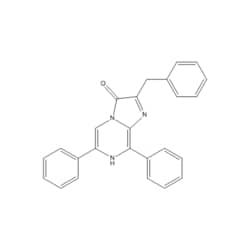
Medchemexpress LLC HY-111382 10mg Medchemexpress, Diphenylterazine CAS:344940-63-2 Purity:>98%
Medchemexpress, HY-111382 10mg Diphenylterazine CAS:344940-63-2 Diphenylterazine is a bioluminescence agent. Purity:>98% Medchemexpress has over 10000 novel life-science reagents, reference compounds, APIs and natural compounds for laboratory and scientific use. Other quantity can also be offered.
Enzo Life Sciences Furin convertase substrate (fluorogenic) (1mg). CAS: 136132-77-9
Fluorogenic substrate for furin/SPC1/PACE/PCSK3 and other subtilisin/kexin-like proprotein convertases such as Kex2, SPC2/PC2/PCSK2, SPC3/PCSK1, PACE4/SPC4/PCSK6, SPC5/PC4/PCSK4, SPC6/PC5/PC6/PCSK5, and SPC7/LPC/PC7/PC8/PCSK7. Can be used on live cells. Ex: 360-380 nm, Em: 440-460 nm. Alternative name: Boc-RVRR-AMC, Boc-Arg-Val-Arg-Arg-AMC. Formula: C38H62N14O8. MW: 843.0. Purity: ≥95% (HPLC; TLC). Appearance: White to off-white powder. Solubility: Soluble in water (10mg/ml) or DMSO. Long Term Storage: -20°C. Handling: Protect from light.