Learn More
Description
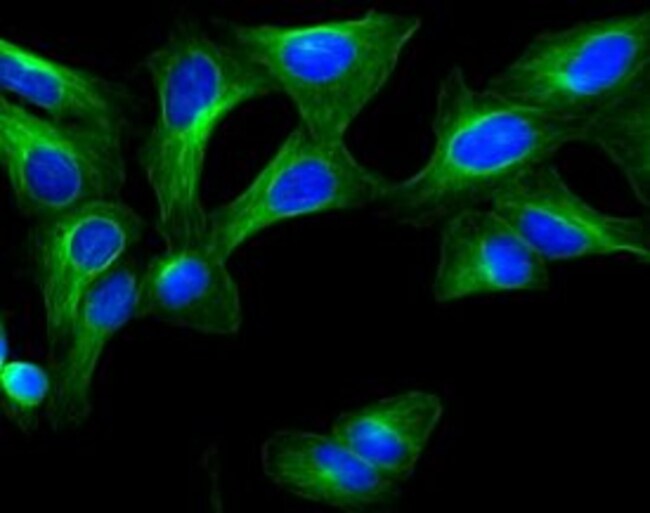
Tubulin is a highly conserved protein with a molecular weight of ∽50 kD. The self-assembly of tubulin leads to microtubules, hollow cylinders that are one of the major components of the eukaryotic cytoskeleton. Microtubules play key roles in chromosome segregation in mitosis, intracellular transport, ciliary and flagellar bending, and structural support of the cytoskeleton. There are two main classes of tubulin isoforms, α - and β -tubulin, which are usually products of separate genes. Microtubules are made from protofilaments, strings of alternating α - and β -tubulin spaced 4nm apart and pointing in the same direction. Tubulin can be posttranslationally modified in several ways, including phosphorylation, acetylation, glutamylation, and detyrosination. For example, microtubules that turn over slowly tend to be acetylated and detyrosinated.

Specifications
Specifications
| Antigen | β-Tubulin |
| Applications | In vitro Assay |
| Classification | Monoclonal |
| Clone | 5H1 |
| Conjugate | Alexa Fluor 488 |
| Formulation | Aqueous buffered solution containing BSA and ≤0.09% sodium azide. |
| Host Species | Mouse |
| Purification Method | Affinity Purified |
| Quantity | 100 Tests |
| Regulatory Status | RUO |
| Show More |
By clicking Submit, you acknowledge that you may be contacted by Fisher Scientific in regards to the feedback you have provided in this form. We will not share your information for any other purposes. All contact information provided shall also be maintained in accordance with our Privacy Policy.