Promotional price valid on web orders only. Your contract pricing may differ. Interested in signing up for a dedicated account number?
Learn More

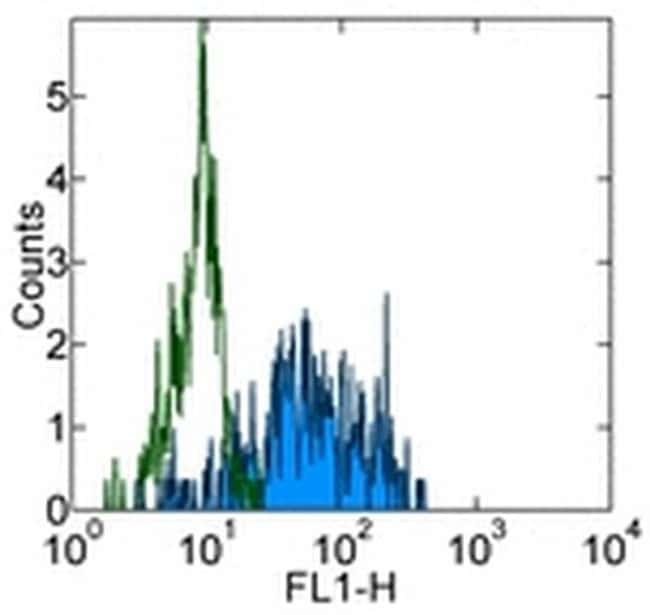
Invitrogen™ CD163 Monoclonal Antibody (eBioGHI/61 (GHI/61)), eBioscience™, Invitrogen™

Catalog No. p-7218357
Encompass_Preferred
Change view
Click to view available options
Quantity:
2 mg
1 product options available for selection
Product selection table with 1 available options. Use arrow keys to navigate and Enter or Space to select.
Catalog No. Quantity
14-163-937 2 mg
Use arrow keys to navigate between rows. Press Enter or Space to select a product option. 1 options available.
1 options
Catalog No. 14-163-937 Supplier Invitrogen™ Supplier No. 14163937
Only null left
Add to Cart
Add to Cart

Mouse Monoclonal Antibody

The eBioGHI/61 MAb reacts with human CD163 (Haemoglobin Scavenger Receptor, M130), a member of the macrophage scavenger receptor family. CD163 is expressed by tissue macrophages, circulating blood monocytes, and some reports suggest that it may also be expressed by haematopoietic progenitor cells. CD163 functions as a high affinity scavenger receptor for the complex of haemoglobin and haptoglobin which forms to clear haemoglobin from the blood. The high affinity for CD163 is specific for the haemoglobin-haptoglobin complex, whereas haemoglobin or haptoglobin display no to low affinity toward CD163. Upon ligand binding, CD163 initiates signal transduction which leads to the production of IL-6 and IL-10. Furthermore, it has been demonstrated that cytokines such as IL-6 and IL-10 can induce expression of CD163, whereas proinflammatory stimuli, such as LPS or TNF alpha, can cause shedding of a soluble form of CD163, whose function is unclear.

CD163 (M130 antigen, Ber-Mac3, Ki-M8, SM4) is a 130 kDa membrane glycoprotein, a member of the scavenger receptor cysteine-rich superfamily, and a receptor for the hemoglobin-haptoglobin complex. CD163 protects tissues from free hemoglobin-mediated oxidative damage, and may play a role in the uptake and recycling of iron, via endocytosis of hemoglobin/haptoglobin and subsequent breakdown of heme. CD163 is expressed exclusively on the cell surface of human monocytes and macrophages that evolve predominantly in the late phase of inflammation. Specifically, CD163 is present on all circulating monocytes and most tissue macrophages except those found in the mantle zone and germinal centers of lymphoid follicles, interdigitating reticulum cells and Langerhan's cells. CD163 is present on all CD14 positive monocytes, most CD64 positive monocytes, and shows higher expression on CD16 positive monocytes. CD163 is upregulated on mononuclear phagocytes by IL-10, IL-6 and dexamethasone. Lipopolysaccharide (LPS) and phorbol myristate acetate (PMA) both induce shedding of CD163 from the cell surface into plasma or cell supernatant. CD163 binds hemoglobin/haptoglobin complexes in a calcium-dependent and pH-dependent manner, and exhibits a higher affinity for complexes of hemoglobin and multimeric haptoglobin of HP1F phenotype than for complexes of hemoglobin and dimeric haptoglobin of HP1S phenotype. Further, CD163 also induces a cascade of intracellular signals that involves tyrosine kinase-dependent calcium mobilization, inositol triphosphate production and secretion of IL6 and CSF1.
TRUSTED_SUSTAINABILITY

Specifications

Antigen CD163
Applications Flow Cytometry, Western Blot
Classification Monoclonal
Clone eBioGHI/61 (GHI/61)
Concentration 0.5 mg/mL
Conjugate Unconjugated
Formulation PBS with 0.09% sodium azide; pH 7.2
Gene CD163
Gene Accession No. Q86VB7
Gene Alias CD163; CD163 antigen; CD163 molecule; CD163v2; CD163v3; Hemoglobin scavenger receptor; M130; macrophage-associated antigen; MM130; putative CD163 antigen; SCARI1; Scavenger receptor cysteine-rich type 1 protein M130; sCD163; Soluble CD163; Soluble sCD163
Gene Symbols CD163
Host Species Mouse
Purification Method Affinity chromatography
Quantity 2 mg
Regulatory Status RUO
Primary or Secondary Primary
Gene ID (Entrez) 9332
Target Species Human
Content And Storage 4°C
Product Type Antibody
Form Liquid
Isotype IgG1 κ
Show More Show Less
Product Title
Select an issue

By clicking Submit, you acknowledge that you may be contacted by Fisher Scientific in regards to the feedback you have provided in this form. We will not share your information for any other purposes. All contact information provided shall also be maintained in accordance with our Privacy Policy.