

Learn More
Invitrogen™ CD272 (BTLA) Monoclonal Antibody (6F7), PE, eBioscience™


Description
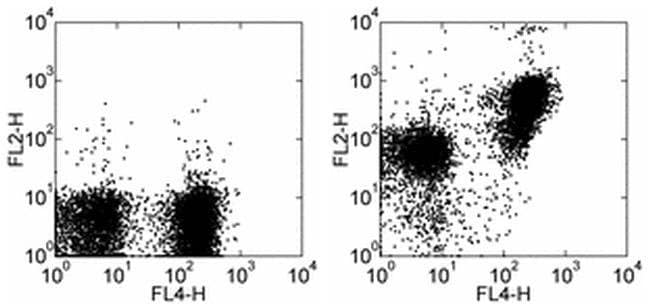
Description: The BTLA antibody reacts with mouse BTLA, B and T lymphocyte attenuator. BTLA is expressed by peripheral lymphocytes, splenic macrophages, developing B cells in the bone marrow and developing T cells in the thymus and mature, but not immature bone marrow-derived dendritic cells. BTLA has been implicated as a negative regulator of the activation and/or function of various hemopoietic cell types. It is reported that BTLA binds to B7-H4, but further studies are needed to confirm this interaction. Note: The anti-mouse BTLA monoclonal antibody 6F7 is reported to stain CD4^+ and CD8^+ single-positive (SP) thymocytes (Hurchla et al). However, other anti-mouse BTLA clones generated simultaneously with 6F7 (8F4, 3F9.D12, 6G3 and 6H6) do not stain SP thymocytes. It is not understood why there is a discrepancy in thymocyte staining however clones 8F4, 3F9.D12, 6G3 and 6H6 stain similar populations to 6F7 in splenocytes and bone marrow cells. Applications Reported: This 6F7 antibody has been reported for use in flow cytometric analysis. Applications Tested: This 6F7 antibody has been tested by flow cytometric analysis of mouse splenocytes. This can be used at less than or equal to 0.125 μg per test. A test is defined as the amount (μg) of antibody that will stain a cell sample in a final volume of 100 μL. Cell number should be determined empirically but can range from 10^5 to 10^8 cells/test. It is recommended that the antibody be carefully titrated for optimal p...

Specifications
Specifications
| Antigen | CD272 (BTLA) |
| Applications | Flow Cytometry |
| Classification | Monoclonal |
| Clone | 6F7 |
| Concentration | 0.2 mg/mL |
| Conjugate | PE |
| Formulation | PBS with 0.09% sodium azide; pH 7.2 |
| Gene | BTLA |
| Gene Accession No. | Q7TSA3 |
| Gene Alias | A630002H24; B and T lymphocyte associated; B and T lymphocyte associated protein; B and T lymphocyte attenuator; B- and T-lymphocyte attenuator; B- and T-lymphocyte-associated protein; BTLA; BTLA_HUMAN; BTLA1; CD272; CD272 antigen; FLJ16065; MGC129743 |
| Show More |
By clicking Submit, you acknowledge that you may be contacted by Fisher Scientific in regards to the feedback you have provided in this form. We will not share your information for any other purposes. All contact information provided shall also be maintained in accordance with our Privacy Policy.