Learn More
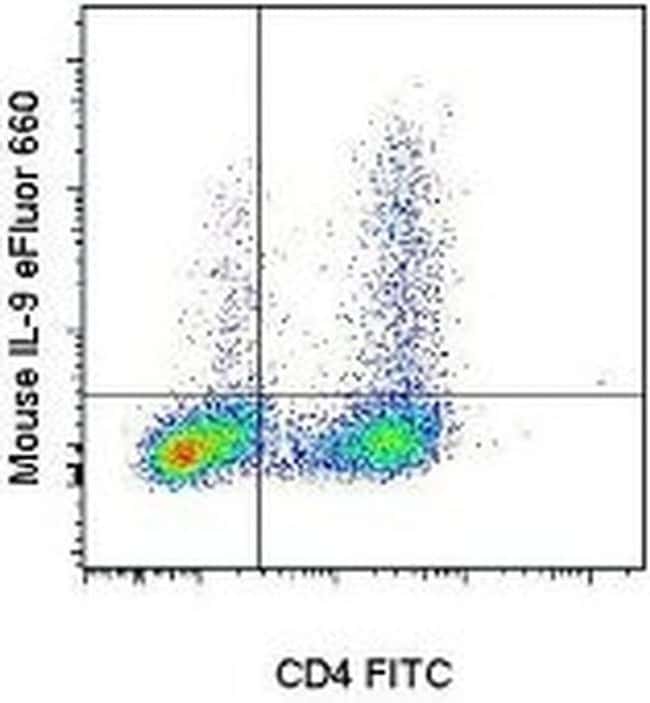
Invitrogen™ IL-9 Monoclonal Antibody (RM9A4), eFluor™ 660, eBioscience™


Description
Description: This monoclonal RM9A4 antibody reacts with mouse Interleukin-9 (IL-9). IL-9 is a 14 kDa cytokine originally named P40 and identified by its proliferative effects on T cell populations. The receptor, which is a heterodimer of the gamma chain portion of the IL-2 receptor and the IL-9R chain, activates Jak/STAT signaling pathways upon binding its ligand. Since the discovery of IL-9, numerous other functions have been observed. It induces Th17 and Treg differentiation in CD4+ T cells, IgE production in B cells, and the differentiation and proliferation of mast cells. IL-9 expression was initially observed in Th2 cells, but has since been found in Th17, eosinophil, and mast cells. Th9 cells, a newly discovered subset of CD4+ T cells, are characterized by the secretion of large amounts of IL-9 and IL-10. Th9 development is induced by stimulation of undifferentiated CD4+ with IL-4 and TGF beta. Th2 cells can also be driven towards a Th9 phenotype in the presence of TGF beta. Applications Reported: This RM9A4 antibody has been reported for use in intracellular staining followed by flow cytometric analysis. Applications Tested: This RM9A4 antibody has been tested by intracellular staining followed by flow cytometric analysis of cultured mouse splenocytes. This can be used at less than or equal to 0.06 μg per test. A test is defined as the amount (μg) of antibody that will stain a cell sample in a final volume of 100 μL. Cell number should be determined empiric...

Specifications
Specifications
| Antigen | IL-9 |
| Applications | Flow Cytometry |
| Classification | Monoclonal |
| Clone | RM9A4 |
| Concentration | 0.2 mg/mL |
| Conjugate | eFluor 660 |
| Formulation | PBS with 0.09% sodium azide; pH 7.2 |
| Gene | Il9 |
| Gene Accession No. | P15247 |
| Gene Alias | cytokine P40; homolog of mouse T cell and mast cell growth factor 40; HP40; IL9; IL-9; ILN; Interleukin; interleukin 9; Interleukin9; interleukin-9; P40; p40 cytokine; p40 T-cell and mast cell growth factor; T-cell growth factor P40 |
| Show More |
Frequently Asked Questions (FAQs)
Our options will depend on the samples you are analyzing.
If cell viability is not critical, you can store your stained samples at 4 degrees C or on ice overnight in the dark and analyze the following day.
For samples stained with eFluor organic fluorochromes, we recommend that cells be suspended in 100 uL of Flow Cytometry Staining Buffer (Cat. No. 00-4222) and 100 uL of eBioscience IC Fixation Buffer (Cat. No. 00-8222); samples can be incubated for up to 3 days at 4 degrees C in the dark. Alternatively, the 1-step Fix/Lyse Solution (Cat. No. 00-5333) can be used. This is a great option when working with whole blood but also works for other cell types.
Yes, in-house studies have demonstrated that the eFluor 660 fluorochrome is recognized by Anti-Cy5/Alexa Fluor 647 beads. Side by side studies with Alexa Fluor 647 versus eFluor 660 conjugated antibodies have demonstrated comparable results.
The eFluor Organic Dyes (eFluor 450, APC-eFluor 780, PerCP-eFluor 710, eFluor 710) are conventional fluorochromes. In contrast, the eVolve line of products are Quantum dots.
As with other fluorochromes, we recommend minimal exposure to light to maintain optimal signal.
Safety and Handling
By clicking Submit, you acknowledge that you may be contacted by Fisher Scientific in regards to the feedback you have provided in this form. We will not share your information for any other purposes. All contact information provided shall also be maintained in accordance with our Privacy Policy.