Promotional price valid on web orders only. Your contract pricing may differ. Interested in signing up for a dedicated account number?
Learn More

TLR4 Polyclonal Antibody, Rockland™
SDP

Catalog No. 501992317
Encompass
Encompass_Preferred
Change view
Click to view available options
Quantity:
100 μg
25 μL
2 product options available for selection
Product selection table with 2 available options. Use arrow keys to navigate and Enter or Space to select.
Catalog No. Quantity
50-199-2317 25 μL
50-199-2316 100 μg
Use arrow keys to navigate between rows. Press Enter or Space to select a product option. 2 options available.
2 options
Catalog No. 50-199-2317 Supplier Rockland Immunochemicals Supplier No. 600401MK3S
Add to Cart
Add to Cart

Rabbit Polyclonal Antibody

Store vial at -20°C prior to opening. Aliquot contents and freeze at -20°C or below for extended storage. Avoid cycles of freezing and thawing. Centrifuge product if not completely clear after standing at room temperature. This product is stable for several weeks at 4°C as an undiluted liquid. Dilute only prior to immediate use. Directed against human TLR4 protein. A BLAST analysis was used to suggest reactivity with TLR4 protein from human based on 100% homology with the immunizing sequence. The analysis also shows 100% cross-reactivity with gorilla and bonobo, and canine species.

TLR4 is member of the Toll like receptor (TLR) family which plays a fundamental role in pathogen recognition and activation of innate immunity. TLRs are highly conserved from Drosophila to humans and share structural and functional similarities. This receptor is most abundantly expressed in placenta, and in myelomonocytic subpopulation of the leukocytes. Mammalian cells respond to LPS by activating TLR4. TLR4 belongs to the multi-protein complex of lipopolysaccharide (LPS) receptor, containing CD14, LY96 and TLR4, and is involved in signal transduction events induced by lipopolysaccharide (LPS) found in most gram-negative bacteria. TLR4 aids in the recognition of pathogen-associated molecular patterns (PAMPs) that are expressed on infectious agents, and mediate the production of cytokines necessary for the development of effective immunity. The various TLRs exhibit different patterns of expression. Mutations in the TLR4 gene have been associated with differences in LPS responsiveness. Also, several transcript variants of the TLR4 gene have been found, but the protein coding potential of most of them is uncertain. TLR4 is expressed by peripheral blood monocytes and a small population of B-cells and is also expressed in human placenta. Studies with TLR4-deficient mice indicate that the main ligand for TLR is lipopolysaccharide. Consequently, these mice also showed increased susceptibility to Gram-negative sepsis.

Specifications

Antigen TLR4
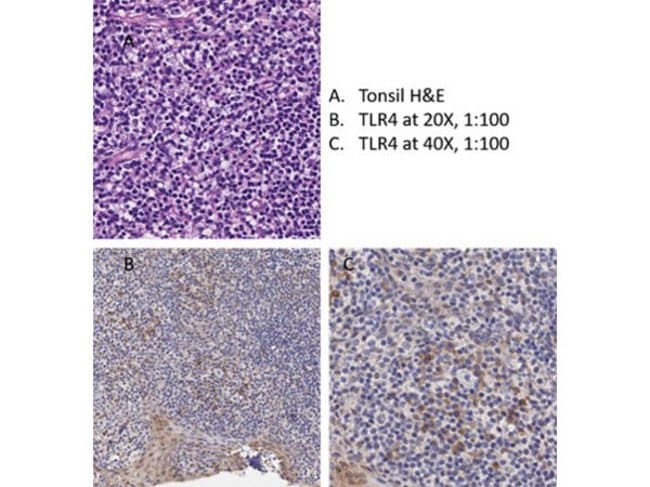
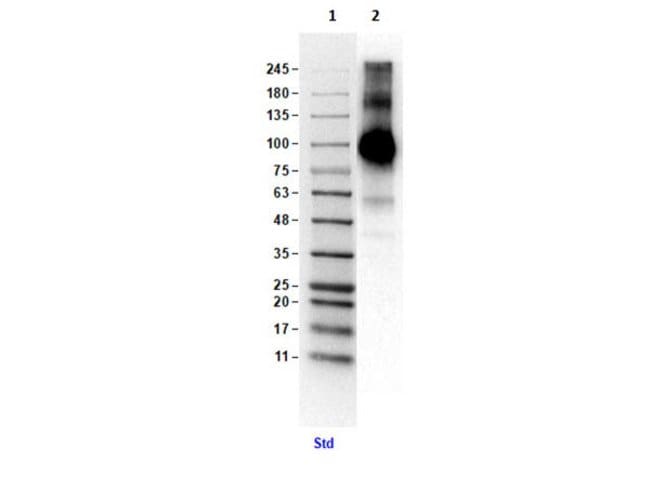
Applications ELISA, Immunohistochemistry, Immunoprecipitation, Western Blot
Classification Polyclonal
Concentration 1 mg/mL
Conjugate Unconjugated
Formulation 0.02M potassium phosphate with 0.15M NaCl and 0.01% sodium azide; pH 7.2
Gene TLR4
Gene Accession No. O00206
Gene Alias ARMD10; BOS_9391; CD284; EGK_07381; homolog of Drosophila toll; hToll; lipopolysaccharide response; Lps; Ly87; Ran/M1; Rasl2-8; Tlr4; TLR-4; TOLL; toll like receptor 4; Toll4; Toll-like receptor 4; Toll-like receptor 4-like protein; Toll-like receptor4 protein
Gene Symbols TLR4
Host Species Rabbit
Quantity 25 μL
Regulatory Status RUO
Primary or Secondary Primary
Gene ID (Entrez) 7099
Target Species Human
Content And Storage -20°C, Avoid Freeze/Thaw Cycles
Product Type Antibody
Form Liquid
Show More Show Less
Product Title
Select an issue

By clicking Submit, you acknowledge that you may be contacted by Fisher Scientific in regards to the feedback you have provided in this form. We will not share your information for any other purposes. All contact information provided shall also be maintained in accordance with our Privacy Policy.