

Promotional price valid on web orders only. Your contract pricing may differ. Interested in signing up for a dedicated account number?
Learn More
Learn More


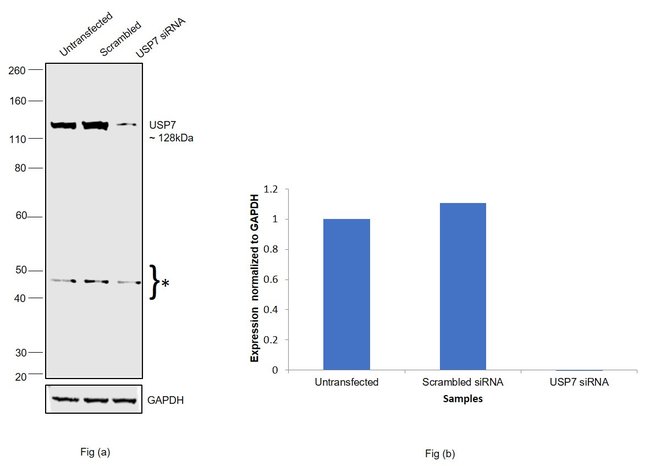
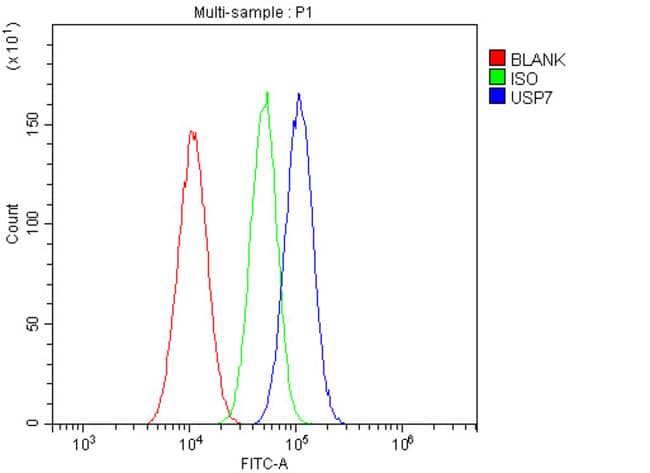
Invitrogen™ USP7 Polyclonal Antibody

Description
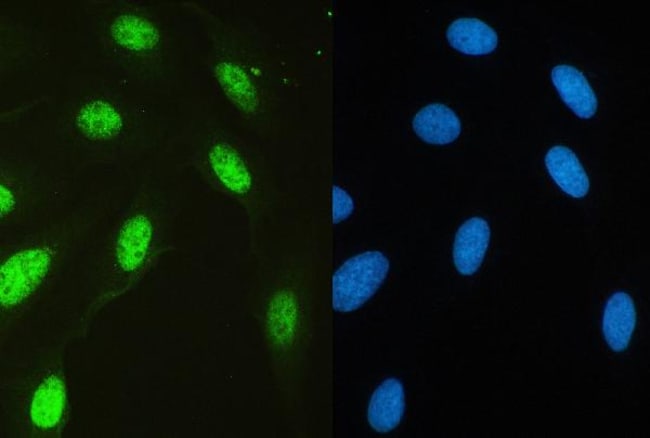
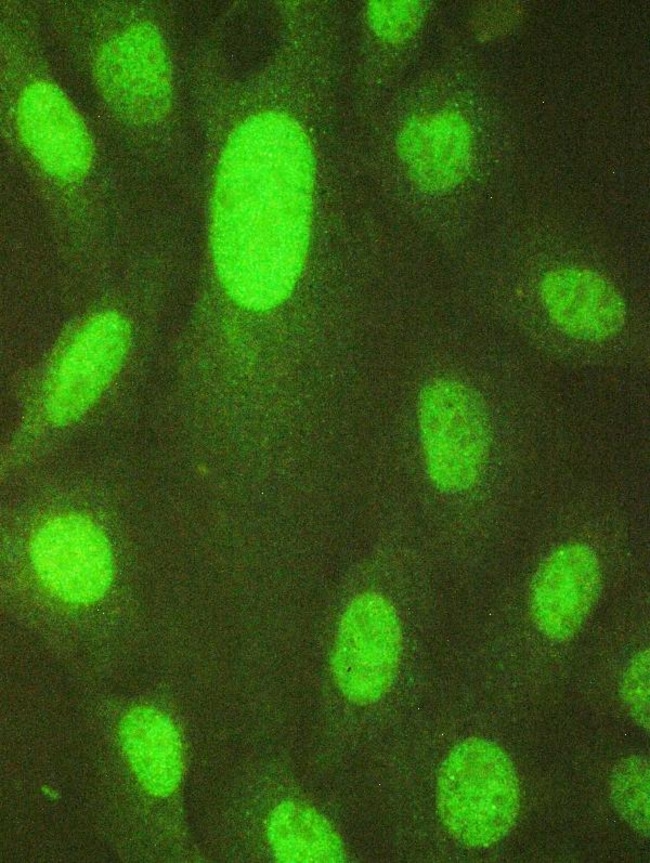
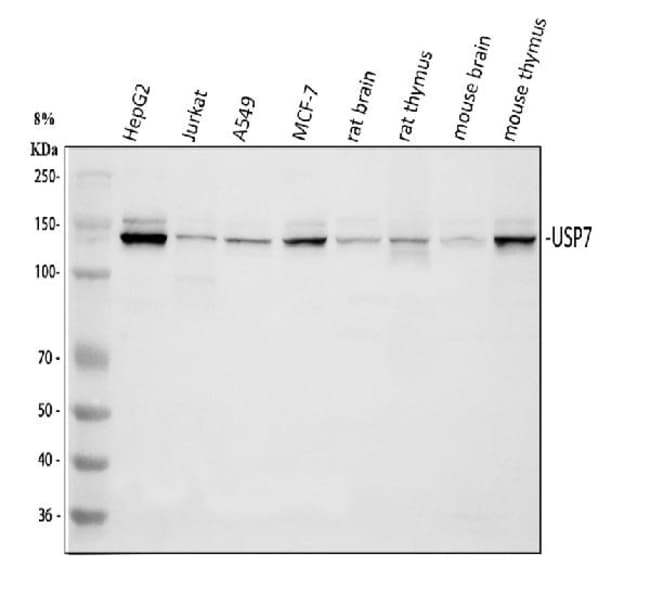
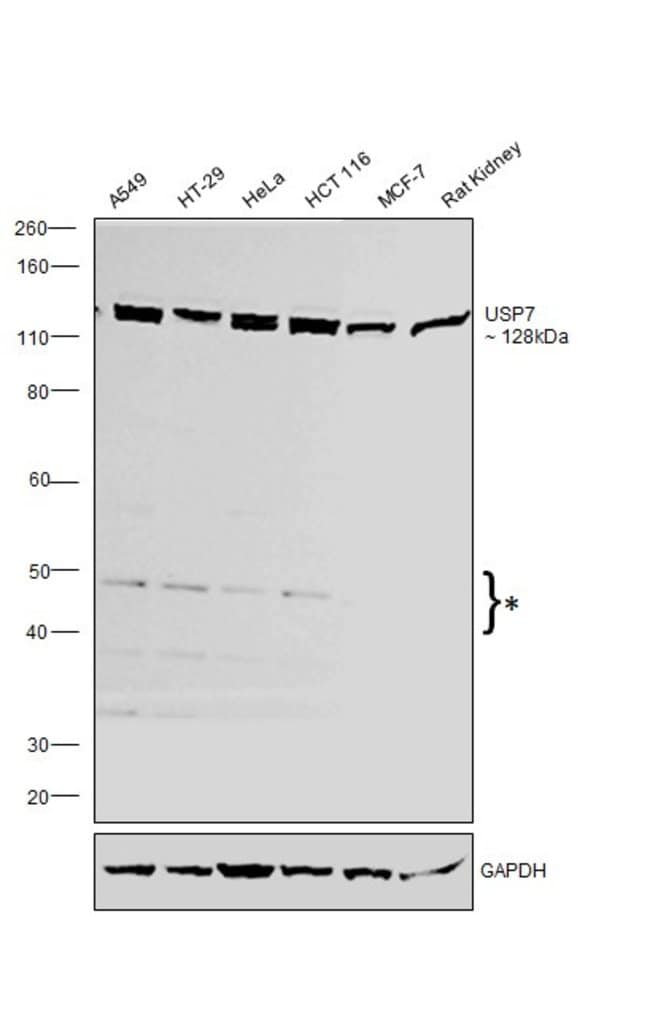
Reconstitute with 0.2 mL of distilled water to yield a concentration of 500 μg/mL. Positive Control - WB: human HepG2 whole cell, human Jurkat whole cell, human A549 whole cell, human MCF-7 whole cell, rat brain tissue, rat thymus tissue, mouse brain tissue, mouse thymus tissue. IHC: human mammary cancer tissue, human placenta tissue, mouse Lymph nodes tissue. ICC/IF: U20S cell, U20S cell. Flow: A549 cell.
USP7 or HAUSP is a ubiquitin specific protease or a deubiquitylating enzyme that cleaves ubiquitin from its substrates. Since ubiquitylation (polyubiquitination) is most commonly associated with the stability and degradation of cellular proteins, HAUSP activity generally stabilizes its substrate proteins. HAUSP is most popularly known as a direct antagonist of Mdm2, the E3 ubiquitin ligase for the tumor suppressor protein, p53. Normally, p53 levels are kept low in part due to Mdm2-mediated ubiquitylation and degradation of p53. Interestingly, in response to oncogenic insults, HAUSP can deubiquitinate p53 and protect p53 from Mdm2-mediated degradation, indicating that it may possess a tumor suppressor function for the immediate stabilization of p53 in response to stress. Another important role of HAUSP function involves the oncogenic stabilization of p53. Oncogenes such as Myc and E1A are thought to activate p53 through a p19 alternative reading frame (p19ARF, also called ARF)-dependent pathway, although some evidence suggests ARF is not essential in this process. An intriguing possibility is that HAUSP provides an alternative pathway for safeguarding the cell against oncogenic insults.

Specifications
Specifications
| Antigen | USP7 |
| Applications | ELISA, Flow Cytometry, Immunohistochemistry (Paraffin), Western Blot, Immunocytochemistry |
| Classification | Polyclonal |
| Concentration | 500 μg/mL |
| Conjugate | Unconjugated |
| Formulation | PBS with 4mg trehalose and 0.05mg sodium azide |
| Gene | USP7 |
| Gene Accession No. | Q4VSI4, Q6A4J8, Q93009 |
| Gene Alias | 2210010O09Rik; AA409944; AA617399; AU019296; AW548146; C80752; deubiquitinating enzyme 7; Hausp; Herpes virus-associated ubiquitin-specific protease; herpes-virus-associated ubiquitin-specific protease; herpesvirus-associated ubiquitin-specific protease; mHAUSP; protease; rHAUSP; TEF1; Ubiquitin carboxyl-terminal hydrolase 7; ubiquitin specific peptidase 7; ubiquitin specific peptidase 7 (herpes virus-associated); ubiquitin specific protease 7; ubiquitin specific protease 7 (herpes virus-associated); ubiquitin thioesterase 7; ubiquitin thiolesterase 7; ubiquitin-specific-processing protease 7; UBP; USP7 |
| Gene Symbols | USP7 |
| Show More |
Product Title
By clicking Submit, you acknowledge that you may be contacted by Fisher Scientific in regards to the feedback you have provided in this form. We will not share your information for any other purposes. All contact information provided shall also be maintained in accordance with our Privacy Policy.
Spot an opportunity for improvement?