
Quinolines and derivatives


Medchemexpress LLC Acridine orange (euchrysine 3RX) zinc chloride salt | 10127-02-3 | MFCD00081043 | 90% | 100 MG

Acridine Orange (Euchrysine 3RX) zinc chloride salt is a cell-penetrable nucleic acid-selective fluorescent dye. It produces orange fluorescence when binding to single-stranded DNA (ssDNA) or RNA, and green fluorescence when binding to double-stranded DNA (dsDNA). The excitation is at 488 nM, with green fluorescence emitted at 530 nm and orange fluorescence at 640 nm.
- Cell-penetrable nucleic acid-selective fluorescent dye.
- Produces orange fluorescence with ssDNA or RNA.
- Produces green fluorescence with dsDNA.
- Excitation at 488 nM.
- Green fluorescence emission at 530 nm.
- Orange fluorescence emission at 640 nm.


Medchemexpress LLC N,N,N',N'-tetrakis(pyridin-2-ylmethyl)ethane-1,2-diamine | 16858-02-9 | MFCD00036918 | 424.54 g/mol | C26H28N6 | 200 MG
TPEN (also called TPEDA) is a cell-permeable heavy-metal chelator used in biochemical and cellular research to selectively bind zinc ions. It is commonly used to probe zinc-dependent biological processes, induce oxidative stress, and study apoptosis and DNA damage in vitro. The compound is supplied as a powder with specified cold-storage recommendations to preserve stability.
- cell-permeable heavy-metal chelator useful for zinc depletion studies.
- higher affinity for Zn2+ than for Mg2+ or Ca2+.
- induces intracellular reactive oxygen species and DNA damage in cell models.
- useful for studying apoptosis and metal-dependent cellular pathways.
- supplied as a powder with established cold-storage conditions to maintain stability.
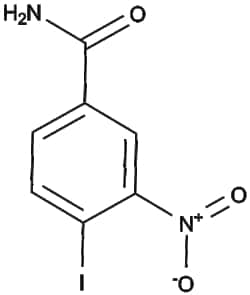
Apexbio Technology LLC Iniparib (BSI-201) 160003-66-7 200mg
Iniparib (BSI-201) (CAS 160003-66-7) is a small-molecule inhibitor initially characterized as targeting poly(ADP-ribose) polymerase-1 (PARP1) It is designed to inhibit PARP1 by promoting oxidation of zinc finger motifs leading to zinc ejection and suppression of enzyme activity Iniparib exerts its biological activity primarily through metabolism into a C-nitroso intermediate which modifies cysteine residues in multiple proteins In cellular assays Iniparib demonstrates growth-inhibitory activity with reported IC50 values approximately ranging from 40 to 100 M in cancer cell lines Based on these pharmacological properties Iniparib holds research potential in oncology studies particularly in treatment-resistant and solid tumor models
![Apexbio Technology LLC prostate apoptosis response protein PAR-4 (2-7) [Homo sapiens] 25mg](https://assets.fishersci.com/TFS-Assets/CCG/product-images/5000097078.png-250.jpg)
Apexbio Technology LLC prostate apoptosis response protein PAR-4 (2-7) [Homo sapiens] 25mg
Prostate apoptosis response protein PAR-4 2-7 is a short peptide targeting transcriptional regulation pathways It is designed to modulate transcription factor activity thereby influencing apoptosis mechanisms particularly in prostate cells PAR-4 2-7 exerts its biological activity primarily through interaction with transcription factors via a leucine zipper zinc finger domain facilitating apoptosis in transformed or malignant cells while sparing normal cells Based on these properties PAR-4 2-7 holds research potential in studies investigating tumor suppression mechanisms and transcription-mediated apoptosis regulation in oncology and therapeutic research
![Apexbio Technology LLC prostate apoptosis response protein PAR-4 (2-7) [Homo sapiens] 1mg](https://assets.fishersci.com/TFS-Assets/CCG/product-images/5000096894.png-250.jpg)
Apexbio Technology LLC prostate apoptosis response protein PAR-4 (2-7) [Homo sapiens] 1mg
Prostate apoptosis response protein PAR-4 2-7 is a short peptide targeting transcriptional regulation pathways It is designed to modulate transcription factor activity thereby influencing apoptosis mechanisms particularly in prostate cells PAR-4 2-7 exerts its biological activity primarily through interaction with transcription factors via a leucine zipper zinc finger domain facilitating apoptosis in transformed or malignant cells while sparing normal cells Based on these properties PAR-4 2-7 holds research potential in studies investigating tumor suppression mechanisms and transcription-mediated apoptosis regulation in oncology and therapeutic research
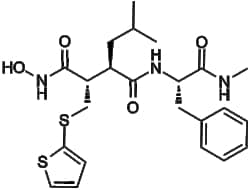
Apexbio Technology LLC Batimastat (BB-94)(Synonyms: BB-94, Batimastat, MMP inhibitor BB-94), 10mg, CAS: 130370-60-4.
Batimastat (BB-94 CAS 130370-60-4) is a synthetic small-molecule inhibitor targeting matrix metalloproteinases (MMPs) Structurally a polypeptide-like analogue of collagen substrates batimastat contains a peptidic backbone and a hydroxamate moiety that binds the catalytic zinc atom of MMPs It inhibits several MMP subtypes markedly including MMP-1 MMP-2 MMP-3 MMP-7 and MMP-9 with reported IC50 values of 3 4 20 6 and 4 nM respectively In preclinical studies batimastat demonstrates inhibitory effects on tumor growth and angiogenesis across various tumor models including ovarian and colon carcinoma xenografts making it relevant for cancer research and therapeutic development
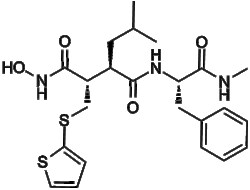
Apexbio Technology LLC Batimastat (BB-94)(Synonyms: BB-94, Batimastat, MMP inhibitor BB-94), 25mg, CAS: 130370-60-4.
Batimastat (BB-94 CAS 130370-60-4) is a synthetic small-molecule inhibitor targeting matrix metalloproteinases (MMPs) Structurally a polypeptide-like analogue of collagen substrates batimastat contains a peptidic backbone and a hydroxamate moiety that binds the catalytic zinc atom of MMPs It inhibits several MMP subtypes markedly including MMP-1 MMP-2 MMP-3 MMP-7 and MMP-9 with reported IC50 values of 3 4 20 6 and 4 nM respectively In preclinical studies batimastat demonstrates inhibitory effects on tumor growth and angiogenesis across various tumor models including ovarian and colon carcinoma xenografts making it relevant for cancer research and therapeutic development
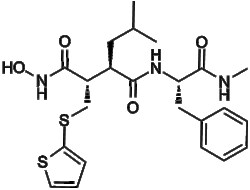
Apexbio Technology LLC Batimastat (BB-94)(Synonyms: BB-94, Batimastat, MMP inhibitor BB-94), 5mg, CAS: 130370-60-4.
Batimastat (BB-94 CAS 130370-60-4) is a synthetic small-molecule inhibitor targeting matrix metalloproteinases (MMPs) Structurally a polypeptide-like analogue of collagen substrates batimastat contains a peptidic backbone and a hydroxamate moiety that binds the catalytic zinc atom of MMPs It inhibits several MMP subtypes markedly including MMP-1 MMP-2 MMP-3 MMP-7 and MMP-9 with reported IC50 values of 3 4 20 6 and 4 nM respectively In preclinical studies batimastat demonstrates inhibitory effects on tumor growth and angiogenesis across various tumor models including ovarian and colon carcinoma xenografts making it relevant for cancer research and therapeutic development
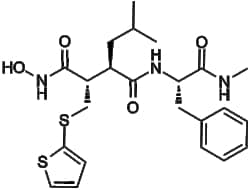
Apexbio Technology LLC Batimastat (BB-94)(Synonyms: BB-94, Batimastat, MMP inhibitor BB-94), 1mg, CAS: 130370-60-4.
Batimastat (BB-94 CAS 130370-60-4) is a synthetic small-molecule inhibitor targeting matrix metalloproteinases (MMPs) Structurally a polypeptide-like analogue of collagen substrates batimastat contains a peptidic backbone and a hydroxamate moiety that binds the catalytic zinc atom of MMPs It inhibits several MMP subtypes markedly including MMP-1 MMP-2 MMP-3 MMP-7 and MMP-9 with reported IC50 values of 3 4 20 6 and 4 nM respectively In preclinical studies batimastat demonstrates inhibitory effects on tumor growth and angiogenesis across various tumor models including ovarian and colon carcinoma xenografts making it relevant for cancer research and therapeutic development