
Ethylene Glycol


Ethylene Glycol/IPA/Water, 40/40/20, Reagents
CAS: 107-21-1 Molecular Formula: C2H6O2 Molecular Weight (g/mol): 62.07 InChI Key: LYCAIKOWRPUZTN-UHFFFAOYSA-N Synonym: Antifreeze IUPAC Name: ethane-1,2-diol SMILES: OCCO

Aqua Solutions Monoethylene Glycol 3,000 ppm w/v Solution (1L)
Monoethylene Glycol 3,000 ppm w/v Solution (1L)

Medchemexpress LLC Ethylene glycol | 107-21-1 | 99.9% | 62.07 | 500 G

Ethylene glycol is an organic compound utilized as an antifreeze agent and coolant. It exhibits antifreeze activity by forming hydrogen bonds with water molecules, thereby lowering the freezing point. It also serves as a raw material for synthesizing polymers, including polyester fibers and polyurethanes.
- Reduces freezing point by forming hydrogen bonds with water molecules.
- Serves as a raw material in the synthesis of polymers.
- Acts as a solvent and reducing agent in nanomaterial synthesis experiments.
- Promotes the formation of monodisperse metal nanocrystals.
- Soluble in DMSO at concentrations of 100 mg/mL or greater.
- Suitable for research use only.
Sigma Aldrich Fine Chemicals Biosciences Polyethylene glycol tested1KG
Poly(ethylene glycol) (PEG) is a non-toxic water-soluble polymer. PEG term is used for the polymer chains with molecular weights below 20 000 while poly(ethylene oxide) (PEO) refers to the higher molecular weight polymers. PEG has various biomedical applications. It forms complexes with cyclodextrins. Engineering of PEG hydrogel particles by mesoporous silica (MS) templating method has been reported.

Medchemexpress LLC Ethylene glycol | 107-21-1 | MFCD00002885 | 99.9% | 62.07 | 100 G
Ethylene glycol is an organic compound often used as an antifreeze agent and coolant. It lowers the freezing point by forming hydrogen bonds with water molecules, thereby exerting antifreeze activity. It is also used as a raw material in the synthesis of polymers such as polyester fibers and polyurethanes.
- Used as an antifreeze agent and coolant
- Lowers freezing point by forming hydrogen bonds with water molecules
- Raw material in the synthesis of polymers (e.g., polyester fibers, polyurethanes)
- Acts as a solvent and reducing agent in nanomaterial synthesis
- Promotes formation of monodisperse metal nanocrystals
- Exhibits cytotoxicity against human HL60 cells (CC50 of 221 μM for 1,2-ethanediol)
- Exhibits cytotoxicity against human HSC2 cells (CC50 of > 400 μM for 1,2-ethanediol)
- Exhibits cytotoxicity against human HSC4 cells (CC50 of 385 μM for 1,2-ethanediol)
Sigma Aldrich Fine Chemicals Biosciences Polyethylene glycol averag20KG
Polyethylene glycol (PEG) is a hydrophilic polymer. It can be easily synthesized by the anionic ring opening polymerization of ethylene oxide into a range molecular weights and variety of end groups. When crosslinked into networks PEG can have high water content forming hydrogels. Hydrogel formation can be initiated by either crosslinking PEG by ionizing radiation or by covalent crosslinking of PEG macromers with reactive chain ends. PEG is a suitable material for biological applications because it does not trigger an immune response.
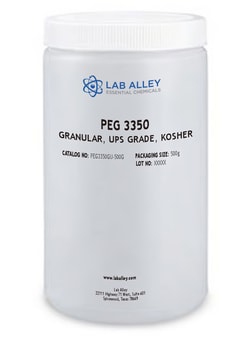
LAB ALLEY Polyethylene Glycol (PEG) 3350 Granular USP Grade Kosher
Polyethylene Glycol is synthesized by ring-opening polymerization of ethylene oxide. This synthesis process gives PEG a range of molecular weights and distributions from 300 grams per mole to 10000000 grams per mole. PEG 3350 has a molecular weight of 3350 and is shipped in granular form. It can be hydrated to be a clear colorless viscous liquid. Polyethylene Glycol is colorless inert odorless and non-volatile. PEG is biocompatible (it will not damage tissues or cells) hydrophilic dissolves readily in water without changing the color odor or taste and is nontoxic. PEG is appropriate for the indirect use for food drugs or medical uses due to its purity level and certified from the United States Pharmacopeia (USP). It is the responsibility of the user to understand and adhere to current FDA regulations as well as any other applicable regulations regarding PEG 3350.
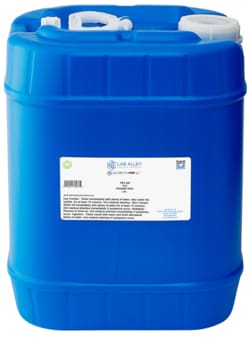
LAB ALLEY Lab Alley Polyethylene Glycol (PEG) 400 Food Grade (FCC) Halal
Polyethylene Glycol is synthesized by ring-opening polymerization of ethylene oxide. This synthesis process gives PEG a range of molecular weights and distributions from 300 grams per mole to 10000000 grams per mole. PEG 400 has a molecular weight of 400 and is a clear colorless viscous liquid. Polyethylene Glycol is colorless inert odorless and non-volatile. PEG is biocompatible (it will not damage tissues or cells) hydrophilic dissolves readily in water without changing the color odor or taste and is nontoxic. Due to the high purity of Polyethylene Glycol 400 it is certified by the United States Pharmacopeia (USP) grade and the Food Chemicals Codex (FCC) grade.
- 1
- 2