
Custom Rearray cDNAs, shRNAs, siRNAs, and PCR Probes


Abnova™ EWSR1/ATF1 Translocation FISH Probe
Labeled FISH probes for identification of gene translocation using Fluoresecent In Situ Hybridization Technique.

Abnova™ MYB/NFIB Translocation FISH Probe
Labeled FISH probes for identification of gene translocation using Fluoresecent In Situ Hybridization Technique.

Abnova™ EGFR CISH Probe
EGFR CISH Probe is designed for the qualitative detection of human EGFR gene in formalin-fixed, paraffin-embedded specimens by chromogenic in situ hybridization (CISH).
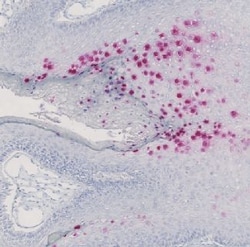
Abnova™ HPV type 6/11 CISH Probe
HPV type 6/11 CISH Probe is designed for the qualitative detection of human papillomavirus (HPV) type 6/11 DNA in formalin-fixed, paraffin-embedded specimens by chromogenic in situ hybridization (CISH).

Abnova™ CCND1 Split CISH Probe
CCND1 Split CISH Probe is designed for the qualitative detection of human CCND1 gene at 11q13.3 in formalin-fixed, paraffin-embedded specimens by chromogenic in situ hybridization (CISH).

Abnova™ 1p36/1q25 CISH Probe
1p36/1q25 CISH Probe is designed for the qualitative detection of human chromosome 1p36.31 and 1q25.3 specific sequences in formalin-fixed, paraffin-embedded specimens by chromogenic in situ hybridization (CISH).

Abnova™ TFEB Split FISH Probe
Labeled FISH probes for identification of gene split using Fluoresecent In Situ Hybridization Technique.

Abnova™ HPV type 31/33 CISH Probe
HPV type 31/33 CISH Probe is designed for the qualitative detection of human papillomavirus (HPV) type 31/33 DNA in formalin-fixed, paraffin-embedded specimens by chromogenic in situ hybridization (CISH).

Abnova™ CREM Split FISH Probe
Labeled FISH probes for identification of gene split using Fluoresecent In Situ Hybridization Technique.

Abnova™ MYB/CEN6p FISH Probe
Labeled FISH probes for identification of gene amplification using Fluoresecent In Situ Hybridization Technique.
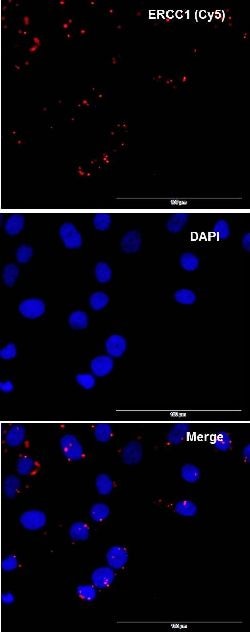
Abnova™ mutaFISH™ ERCC1wt RNA Probes
mutaFISH™ ERCC1wt RNA Probes is designed to detect human ERCC1 gene on single strand RNA in cells using padlock probe and in situ rolling-circle amplification technology.

Abnova™ DDIT3 Split CISH Probe
DDIT3 Split CISH Probe is designed for the qualitative detection of human DDIT3 gene at 12q13.3 in formalin-fixed, paraffin-embedded specimens by chromogenic in situ hybridization (CISH).

Abnova™ FGFR1/CEN8 CISH Probe
FGFR1/CEN8 CISH Probe is designed for the qualitative detection of the human FGFR1 gene and chromosome 8 alpha satellites in formalin-fixed, paraffin-embedded specimens by chromogenic in situ hybridization (CISH).

Abnova™ KDM2B Split FISH Probe
Labeled FISH probes for identification of gene split using Fluoresecent In Situ Hybridization Technique.

Abnova™ MDM2 CISH Probe
MDM2 CISH Probe is designed for the qualitative detection of human MDM2 gene in formalin-fixed, paraffin-embedded specimens by chromogenic in situ hybridization (CISH).