
Protein Labeling Reagents


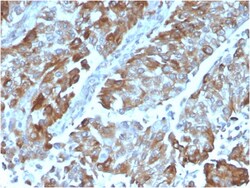
Biotium OX40 / CD134/ TNFRSF4 (Immuno-Oncology Target)(OX40/3108), Biotin conjugate, 0.1mg/mL
ThisMAb recognizes a protein of 43 kDa, identified as OX40, which is also known as CD134. OX40 is a type I integral membrane glycoprotein and member of the tumor necrosis factor/nerve growth factor receptor (TNFR/NGFR) family. It is expressed on activated T lymphocytes, hematopoietic precursor cells and fibroblasts. It functions as a T cell co-stimulatory receptor when bound by OX40 Ligand/TNFSF4 that is expressed by antigen presenting cells. OX40 thereby plays roles in T-cell activation as well as the regulation of differentiation, proliferation or apoptosis of normal and malignant lymphoid cells. OX40 is upregulated at the sites of inflammation, especially in case of multiple sclerosis and psoriatic lesions. Primary antibodies are available purified, or with a selection of fluorescent CF Dyes and other labels. CF Dyes offer exceptional brightness and photostability. Note: Conjugates of blue fluorescent dyes like CF405S and CF405M are not recommended for detecting low a

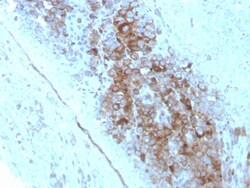
Biotium CD63 (Late Endosomes Marker)(LAMP3/2789), Biotin conjugate, 0.1mg/mL
This MAb recognizes protein of 26 kDa-60 kDa, which is identified as CD63. Its epitope is different from that of MAb LAMP3/529. The tetraspanins are integral membrane proteins expressed on cell surface and granular membranes of hematopoietic cells and are components of multi-molecular complexes with specific integrins. The tetraspanin CD63 is a lysosomal membrane glycoprotein that translocates to the plasma membrane after platelet activation. CD63 is expressed on activated platelets, monocytes and macrophages, and is weakly expressed on granulocytes, T cell and B cells. It is located on the basophilic granule membranes and on the plasma membranes of lymphocytes and granulocytes. CD63 is a member of the TM4 superfamily of leukocyte glycoproteins that includes CD9, CD37 and CD53, which contain four transmembrane regions. CD63 may play a role in phagocytic and intracellular lysosome-phagosome fusion events. CD63 deficiency is associated with Hermansky-Pudlak syndrome and is stro
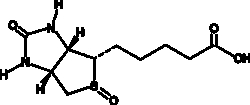
Cayman Chemical BIotIn SulfoxIde 10mg
A racemic mixture of biotin (R)-sulfoxide and biotin (S)-sulfoxide
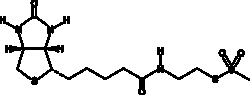
Cayman Chemical MTSEA-bIotIn 10mg
A thiol-reactive probe that can be used to label proteins at cysteine residues
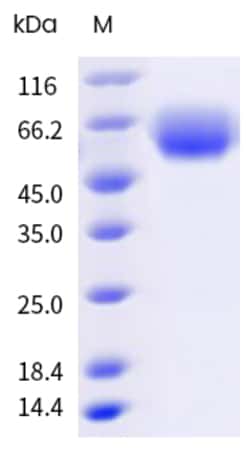
Sino Biological Recombinant Human ST2/IL-1 RL1 Protein (His Tag), Biotinylated, HPLC-verified 20 µg
A DNA sequence encoding the human IL1RL1 isoform 2 (NP_003847.2) (Met1-Phe328) was expressed fused with a polyhistidine tag at the C-terminus. The purified protein was biotinylated in vitro.
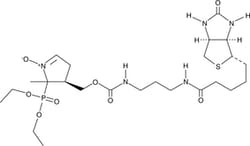
Cayman Chemical DEPMPO-bIotIn 100ug
A biotinylated form of DEPMPO, which is used to spin trap reactive O-, N-, S-, and C-centered radicals; offers monitored biodistribution in cells, tissues and organs when used with an avidin-conjugated reporter; binds free radicals on proteins, producing adducts that can be analyzed via the biotin tag.
Biotium CD63 (Late Endosomes Marker) (LAMP3/2990R), Biotin conjugate, 0.1mg/mL
This MAb recognizes protein of 26 kDa-60 kDa, which is identified as CD63. Its epitope is different from that of MAb LAMP3/529. The tetraspanins are integral membrane proteins expressed on cell surface and granular membranes of hematopoietic cells and are components of multi-molecular complexes with specific integrins. The tetraspanin CD63 is a lysosomal membrane glycoprotein that translocates to the plasma membrane after platelet activation. CD63 is expressed on activated platelets, monocytes and macrophages, and is weakly expressed on granulocytes, T cell and B cells. It is located on the basophilic granule membranes and on the plasma membranes of lymphocytes and granulocytes. CD63 is a member of the TM4 superfamily of leukocyte glycoproteins that includes CD9, CD37 and CD53, which contain four transmembrane regions. CD63 may play a role in phagocytic and intracellular lysosome-phagosome fusion events. CD63 deficiency is associated with Hermansky-Pudlak syndrome and is strongly

Medchemexpress LLC Biotin-PEG4-dialkoxydiphenylsilane-picolyl azide | 2599839-59-3 | 95.0% | 978.24 | C47H67N9O10SSi | 5 MG

Biotin-PEG4-dialkoxydiphenylsilane-picolyl azide is a clickable, acid-cleavable biotin-picolyl azide reagent designed for labeling and enrichment of cell-surface glycoproteins. It contains an azide functionality for bioorthogonal conjugation and is compatible with both copper-catalyzed azide-alkyne cycloaddition (CuAAC) and strain-promoted alkyne-azide cycloaddition (SPAAC), supplied as a solid for research applications.
- Clickable azide functional group for CuAAC and SPAAC reactions.
- Acid-cleavable dialkoxydiphenylsilane linker enables controlled release after enrichment.
- Biotin tag enables affinity enrichment using streptavidin or avidin systems.
- PEG4 spacer improves solubility and reduces steric hindrance during conjugation.
- High purity (95.0%) for consistent labeling performance.
- Suitable for proteomics workflows targeting cell-surface glycoproteins.
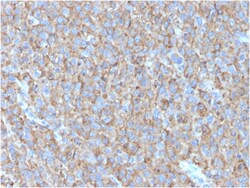
Biotium CD63 (Late Endosomes Marker)(LAMP3/2790), Biotin conjugate, 0.1mg/mL
This MAb recognizes protein of 26 kDa-60 kDa, which is identified as CD63. Its epitope is different from that of MAb LAMP3/529. The tetraspanins are integral membrane proteins expressed on cell surface and granular membranes of hematopoietic cells and are components of multi-molecular complexes with specific integrins. The tetraspanin CD63 is a lysosomal membrane glycoprotein that translocates to the plasma membrane after platelet activation. CD63 is expressed on activated platelets, monocytes and macrophages, and is weakly expressed on granulocytes, T cell and B cells. It is located on the basophilic granule membranes and on the plasma membranes of lymphocytes and granulocytes. CD63 is a member of the TM4 superfamily of leukocyte glycoproteins that includes CD9, CD37 and CD53, which contain four transmembrane regions. CD63 may play a role in phagocytic and intracellular lysosome-phagosome fusion events. CD63 deficiency is associated with Hermansky-Pudlak syndrome and is stro
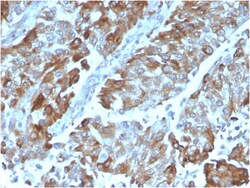
Biotium OX40 / CD134/ TNFRSF4 (Immuno-Oncology Target)(OX40/3108), Biotin conjugate, 0.1mg/mL
ThisMAb recognizes a protein of 43 kDa, identified as OX40, which is also known as CD134. OX40 is a type I integral membrane glycoprotein and member of the tumor necrosis factor/nerve growth factor receptor (TNFR/NGFR) family. It is expressed on activated T lymphocytes, hematopoietic precursor cells and fibroblasts. It functions as a T cell co-stimulatory receptor when bound by OX40 Ligand/TNFSF4 that is expressed by antigen presenting cells. OX40 thereby plays roles in T-cell activation as well as the regulation of differentiation, proliferation or apoptosis of normal and malignant lymphoid cells. OX40 is upregulated at the sites of inflammation, especially in case of multiple sclerosis and psoriatic lesions. Primary antibodies are available purified, or with a selection of fluorescent CF Dyes and other labels. CF Dyes offer exceptional brightness and photostability. Note: Conjugates of blue fluorescent dyes like CF405S and CF405M are not recommended for detecting low a

Cayman Chemical BIotIn-H10trIfluoroacetate 5mg
A biotinylated form of H10; has been used in ELISA and co-immunoprecipitation assays to assess AGR2 levels in cancer cells
Medchemexpress LLC Desthiobiotin-PEG4-acid | >98% | 461.55 | 25 MG
Desthiobiotin-PEG4-acid is a PEG-based PROTAC linker that can be used in the synthesis of PROTACs. PROTACs contain two different ligands connected by a linker; one is a ligand for an E3 ubiquitin ligase and the other is for the target protein. PROTACs exploit the intracellular ubiquitin-proteasome system to selectively degrade target proteins.
- Used as a PEG-based PROTAC linker
- Useful in the synthesis of PROTACs
- Enables selective degradation of target proteins
Medchemexpress LLC D-Desthiobiotin | 533-48-2 | 99.92% | 1 ML
D-Desthiobiotin is a biotin derivative that increases testosterone. It is utilized in affinity chromatography, protein chromatography, and for protein and cell labeling, detection, and isolation.
- Biotin derivative
- Used in affinity chromatography
- Used in protein chromatography
- Increases testosterone
- Suitable for protein and cell labeling, detection, and isolation
Medchemexpress LLC D-Desthiobiotin (Standard) | 533-48-2 | 1 G
D-Desthiobiotin is a biotin derivative that increases testosterone. It is utilized in affinity and protein chromatography, and can also be employed for protein and cell labeling, detection, and isolation.
- Biotin derivative
- Increases testosterone
- Used in affinity chromatography
- Used in protein chromatography
- Employed for protein and cell labeling
- Employed for protein and cell detection
- Employed for protein and cell isolation