
Organonitrogen Compounds





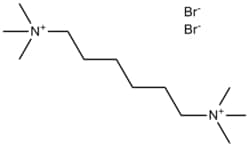
Apexbio Technology LLC Hexamethonium Bromide 55-97-0 5g
Hexamethonium Bromide (CAS 55-97-0) is a bis-quaternary ammonium compound that acts as a selective antagonist of neuronal nicotinic acetylcholine receptors (nAChRs) located in autonomic ganglia By competitively inhibiting synaptic transmission at these receptors Hexamethonium Bromide effectively blocks ganglionic neurotransmission without significant effects on muscarinic receptors or neuromuscular junctions This property makes it a valuable tool in pharmacological studies investigating autonomic nervous system function and the physiological roles of ganglionic nAChRs in various experimental models

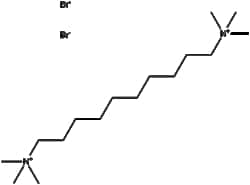
Apexbio Technology LLC Decamethonium Bromide 541-22-0 10g
Decamethonium Bromide (CAS 541-22-0) is a bis-quaternary ammonium compound targeting nicotinic acetylcholine receptors (nAChRs) at the neuromuscular junction It is designed to bind and activate muscle-type nAChRs thereby inducing sustained depolarization and neuromuscular blockade Decamethonium Bromide exerts its biological activity primarily through partial agonist-mediated depolarization block of these receptors preventing normal muscle contractions Based on these pharmacological properties Decamethonium Bromide holds research potential in the evaluation of neuromuscular blockers and in studies elucidating receptor-channel function in neuromuscular transmission

Sigma Aldrich Fine Chemicals Biosciences Decamethonium bromide crystalline | 541-22-0 | MFCD00011779 | 10G
Decamethonium bromide crystalline | Mol Wt: 418.29 | 541-22-0 | MFCD00011779 | 10G

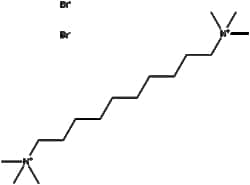
Apexbio Technology LLC Decamethonium Bromide 541-22-0 10mM (in 1mL DMSO)
Decamethonium Bromide (CAS 541-22-0) is a bis-quaternary ammonium compound targeting nicotinic acetylcholine receptors (nAChRs) at the neuromuscular junction It is designed to bind and activate muscle-type nAChRs thereby inducing sustained depolarization and neuromuscular blockade Decamethonium Bromide exerts its biological activity primarily through partial agonist-mediated depolarization block of these receptors preventing normal muscle contractions Based on these pharmacological properties Decamethonium Bromide holds research potential in the evaluation of neuromuscular blockers and in studies elucidating receptor-channel function in neuromuscular transmission

Medchemexpress LLC Decamethonium Bromide | 541-22-0 | MFCD00011779 | 98.7% | 1 ML

Decamethonium Bromide is an acetylcholine receptor inhibitor and muscle relaxant. It functions by inducing depolarization of skeletal muscles and subsequently binding to postsynaptic acetylcholine receptors, leading to persistent paralysis. For research use only.
- Acetylcholine receptor inhibitor
- Muscle relaxant
- Induces depolarization of skeletal muscles
- Binds to postsynaptic acetylcholine receptors to induce persistent paralysis

Medchemexpress LLC MDEG-541 | 98.1% | 674.83 g·mol⁻¹ | C35H38N4O6S2 | 10 MG
MDEG-541 is a PROTAC small-molecule degrader that targets the MYC-MAX dimerization complex and exhibits antiproliferative activity by reducing cellular levels of MYC, GSPT1, GSPT2, and PLK1. It is provided as a research reagent with reported physicochemical characterization and recommended storage conditions.
- Potent MYC-MAX degrader with PROTAC mechanism of action.
- Demonstrates antiproliferative activity and downregulates MYC, GSPT1, GSPT2, and PLK1.
- High reported purity suitable for research applications (≈98.1%).
- Supplied in small research quantities for biochemical and cellular studies.
- Stable as powder when stored at -20°C; follow solvent storage guidelines for dissolved material.
Medchemexpress LLC Decamethonium Bromide | 541-22-0 | 98.7% | 5 G
Decamethonium Bromide is an acetylcholine receptor inhibitor and muscle relaxant. It functions by first inducing depolarization of skeletal muscles, followed by binding to postsynaptic acetylcholine receptors to cause persistent paralysis. This product is intended for research use only and is not sold to patients.
- Inhibits acetylcholine receptors and acts as a muscle relaxant
- Initiates muscle depolarization before inducing paralysis
- Suitable for various research applications in pharmacology and neuroscience
- Soluble in DMSO (83.33 mg/mL) and H2O (≥ 50 mg/mL)
- Recommended storage at 4°C sealed, away from moisture; in solvent, -80°C for 6 months or -20°C for 1 month
Medchemexpress LLC Decamethonium (Bromide) | 541-22-0 | 99.6% | 1 G
Decamethonium Bromide is a biochemical reagent used in life science research. It acts as an acetylcholine receptor inhibitor and muscle relaxant, initially inducing skeletal muscle depolarization before binding to postsynaptic acetylcholine receptors to cause persistent paralysis.
- Biochemical reagent for life science research.
- Functions as an acetylcholine receptor inhibitor.
- Acts as a muscle relaxant.
- Has a purity of 99.6%.
- Targets nAChR.
- Involved in membrane transporter/ion channel and neuronal signaling pathways.
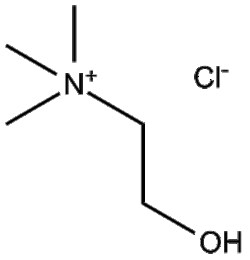
Apexbio Technology LLC Choline Chloride 67-48-1 50mg
Choline chloride (CAS 67-48-1) is a quaternary ammonium compound that serves as a precursor of the neurotransmitter acetylcholine and is integral to phospholipid biosynthesis It functions as a methyl group donor in various metabolic pathways notably in the synthesis of phosphatidylcholine and betaine In biomedical research choline chloride is utilized to investigate cellular membrane composition lipid metabolism and neurological functions It also finds application in studies of nutritional requirements and epigenetic regulation as well as in cell culture media to support cellular proliferation and viability
TARGETMOL CHEMICALS INC Cholic acid sodium 1G
Also available in 50 mg, 100 mg, 500 mg and bulk. Please contact Fisher for quotes. Cholic acid sodium (SodiumCholate) exhibits a strong spermicidal and antiviral [anti-human immunodeficiency virus (HIV)-1] activity. Purity 99.95%

Selleck Chemical LLC Epinephrine bitartrate S2521-50mg
Epinephrine bitartrate (Adrenalinium) is an alpha- and beta-adrenergic receptor stimulator

Medchemexpress LLC Ethanaminium, 2-hydroxy-N,N,N-trimethyl-, chloride (1:1)-13C3 | 67-48-1 | 99.7% | 5 MG
Choline Chloride-13C3 is the 13C-labeled Choline (chloride). It is an organic compound and a quaternary ammonium salt, an acyl group acceptor and choline acetyltransferase substrate. It is also an important additive in feed, especially for chickens, where it accelerates growth. For research use only.
- Used as a tracer
- Used as an internal standard for quantitative analysis by NMR, GC-MS, or LC-MS