
Universal Pipette Tips
Disposable pipette tips designed to fit single and multichannel pipettes from most manufacturers; offer acceptable performance compared to pipette specific tips and can be used with a variety of pipette models.
Single-use universal pipette tips are designed for compatibility with most mechanical and electronic single and multichannel pipettors.
Universal pipette tips are available in a range of types, sizes, colors, styles, and packaging configurations and may be designed for specific purposes or tasks.
- Capacity or volume based on the pipettor size
- Filters to reduce contamination and cross-contamination
- Color
- Sterility or autoclavability
- Tip style: beveled, tapered, wide bore, round, flat, or gel-loading
- Length: short or extended
- Purity: metal-free or DNase-, RNase-, ATP-, Bioburden-, PCR inhibitor-, endotoxin-, or pyrogen-free for genomic and biologic applications
- Surface treatments to reduce retention
- Packaging options to help facilitate re-stocking or eliminate waste

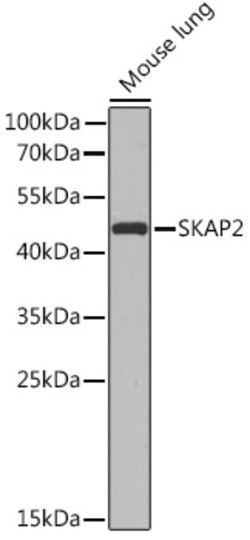
ABclonal Technology SKAP2 Rabbit pAb

The protein encoded by this gene shares homology with Src kinase-associated phosphoprotein 1, and is a substrate of Src family kinases. It is an adaptor protein that is thought to play an essential role in the Src signaling pathway, and in regulating proper activation of the immune system. This protein contains an amino terminal coiled-coil domain for self-dimerization, a plecskstrin homology (PH) domain required for interactions with lipids at the membrane, and a Src homology (SH3) domain at the carboxy terminus. Some reports indicate that this protein inhibits actin polymerization through interactions with actin assembly factors, and might negatively regulate the invasiveness of tumors by modulating actin assembly. Alternative splicing results in multiple transcript variants encoding different isoforms.

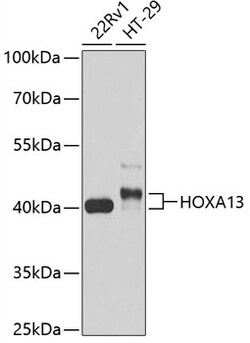
ABclonal Technology HOXA13 Rabbit pAb
In vertebrates, the genes encoding the class of transcription factors called homeobox genes are found in clusters named A, B, C, and D on four separate chromosomes. Expression of these proteins is spatially and temporally regulated during embryonic development. This gene is part of the A cluster on chromosome 7 and encodes a DNA-binding transcription factor which may regulate gene expression, morphogenesis, and differentiation. Expansion of a polyalanine tract in the encoded protein can cause hand-foot-uterus syndrome, also known as hand-foot-genital syndrome.
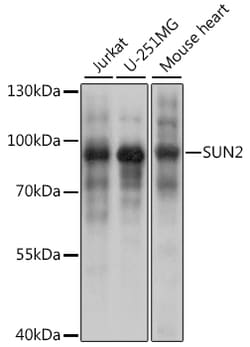
ABclonal Technology SUN2 Rabbit pAb
SUN1 (MIM 607723) and SUN2 are inner nuclear membrane (INM) proteins that play a major role in nuclear-cytoplasmic connection by formation of a bridge across the nuclear envelope, known as the LINC complex, via interaction with the conserved luminal KASH domain of nesprins (e.g., SYNE1, MIM 608441) located in the outer nuclear membrane (ONM). The LINC complex provides a direct connection between the nuclear lamina and the cytoskeleton, which contributes to nuclear positioning and cellular rigidity (summary by Haque et al., 2010 [PubMed 19933576]).
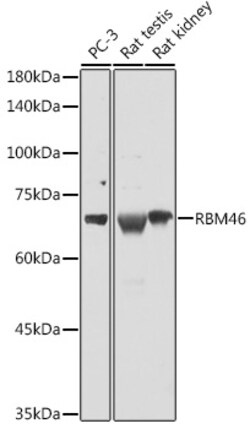
ABclonal Technology RBM46 Rabbit pAb
Predicted to enable mRNA binding activity. Predicted to act upstream of or within mRNA stabilization and trophectodermal cell differentiation. Predicted to be active in nucleus.
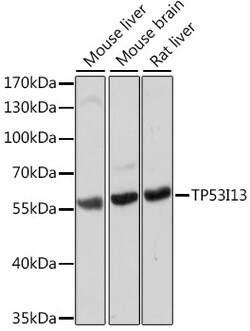
ABclonal Technology TP53I13 Rabbit pAb
Involved in several processes, including negative regulation of cell cycle, response to UV, and response to xenobiotic stimulus. Located in cytoplasm.


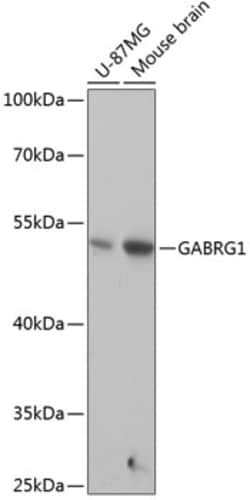
ABclonal Technology GABRG1 Rabbit pAb
The protein encoded by this gene belongs to the ligand-gated ionic channel family. It is an integral membrane protein and plays an important role in inhibiting neurotransmission by binding to the benzodiazepine receptor and opening an integral chloride channel. This gene is clustered with three other family members on chromosome 4.
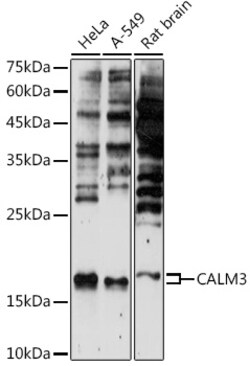
ABclonal Technology CALM3 Rabbit pAb
This gene encodes a member of a family of proteins that binds calcium and functions as a enzymatic co-factor. Activity of this protein is important in the regulation of the cell cycle and cytokinesis. Multiple alternatively spliced transcript variants have been observed at this gene.
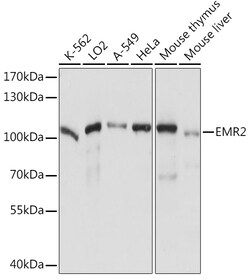
ABclonal Technology EMR2 Rabbit pAb
This gene encodes a member of the class B seven-span transmembrane (TM7) subfamily of G-protein coupled receptors. These proteins are characterized by an extended extracellular region with a variable number of N-terminal epidermal growth factor-like domains coupled to a TM7 domain via a mucin-like spacer domain. The encoded protein is expressed mainly in myeloid cells where it promotes cell-cell adhesion through interaction with chondroitin sulfate chains. This gene is situated in a cluster of related genes on chromosome 19. Alternatively spliced transcript variants encoding multiple isoforms have been observed for this gene.
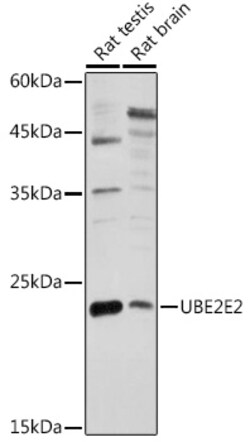
ABclonal Technology UBE2E2 Rabbit pAb
Enables ISG15 transferase activity and ubiquitin conjugating enzyme activity. Involved in protein modification by small protein conjugation. Acts upstream of or within cellular response to DNA damage stimulus and positive regulation of G1/S transition of mitotic cell cycle. Predicted to be active in nucleus.
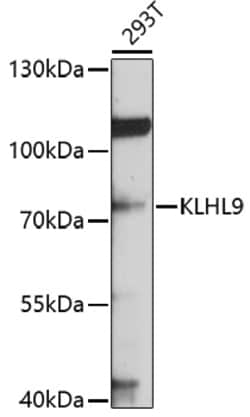
ABclonal Technology KLHL9 Rabbit pAb
This gene encodes a protein that belongs to the kelch repeat-containing family, and contains an N-terminal BTB/POZ domain, a BACK domain and six C-terminal kelch repeats. The encoded protein is a component of a complex with cullin 3-based E3 ligase, which plays a role in mitosis. This protein complex is a cell cycle regulator, and functions in the organization and integrity of the spindle midzone in anaphase and the completion of cytokinesis. The complex is required for the removal of the chromosomal passenger protein aurora B from mitotic chromosomes.

ABclonal Technology ANT1/ANT2/ANT3/ANT4 Rabbit pAb
ANTs are the mitochondrial carrier subfamily of solute carrier proteins. ANT protein functions as a gated pore that translocates ADP from the cytoplasm into the mitochondrial matrix and ATP from the mitochondrial matrix into the cytoplasm. The protein forms a homodimer embedded in the inner mitochondria membrane.
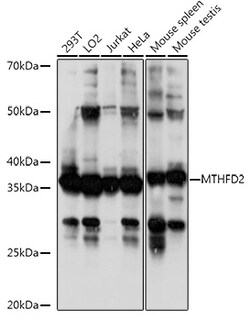
ABclonal Technology MTHFD2 Rabbit pAb
This gene encodes a nuclear-encoded mitochondrial bifunctional enzyme with methylenetetrahydrofolate dehydrogenase and methenyltetrahydrofolate cyclohydrolase activities. The enzyme functions as a homodimer and is unique in its absolute requirement for magnesium and inorganic phosphate. Formation of the enzyme-magnesium complex allows binding of NAD. Alternative splicing results in two different transcripts, one protein-coding and the other not protein-coding. This gene has a pseudogene on chromosome 7.
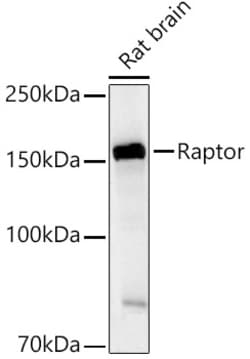
ABclonal Technology Raptor Rabbit pAb
This gene encodes a component of a signaling pathway that regulates cell growth in response to nutrient and insulin levels. The encoded protein forms a stoichiometric complex with the mTOR kinase, and also associates with eukaryotic initiation factor 4E-binding protein-1 and ribosomal protein S6 kinase. The protein positively regulates the downstream effector ribosomal protein S6 kinase, and negatively regulates the mTOR kinase. Multiple transcript variants encoding different isoforms have been found for this gene.
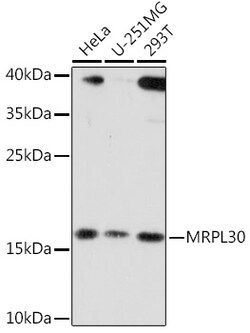
ABclonal Technology MRPL30 Rabbit pAb
Mammalian mitochondrial ribosomal proteins are encoded by nuclear genes and help in protein synthesis within the mitochondrion. Mitochondrial ribosomes (mitoribosomes) consist of a small 28S subunit and a large 39S subunit. They have an estimated 75% protein to rRNA composition compared to prokaryotic ribosomes, where this ratio is reversed. Another difference between mammalian mitoribosomes and prokaryotic ribosomes is that the latter contain a 5S rRNA. Among different species, the proteins comprising the mitoribosome differ greatly in sequence, and sometimes in biochemical properties, which prevents easy recognition by sequence homology. This gene encodes a 39S subunit protein. Alternative splicing results in multiple transcript variants. Pseudogenes corresponding to this gene are found on chromosomes 6p and 12p. Read-through transcription also exists between this gene and the neighboring upstream lipoyltransferase 1 (LIPT1) gene.