
Bioluminescence Assays and Reagents

![Promega pNLF1-N [CMV/Hygro] Vector](https://assets.fishersci.com/TFS-Assets/CCG/Promega-Corporation/product-images/FCATPRN1351.jpg-250.jpg)
Promega pNLF1-N [CMV/Hygro] Vector
Generate N-Terminal Fusions with NanoLuc™ Enzyme. The pNLF1 Vectors use traditional cloning with a multiple cloning site (MCS) to generate N-terminal fusions to NanoLuc™ luciferase. All vectors contain a mammalian selectable marker to create a stable line.

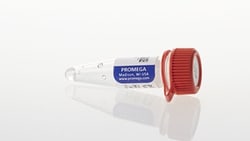
Promega pNL3.2.CMV Vector
NanoLuc (Nluc) luciferase is a small bright luminescent reporter enzyme (19.1kDa) engineered for optimal performance. Use the pNL3.2.CMV Vector as a negative control in experiments measuring regulated changes in NanoLuc luciferase expression.
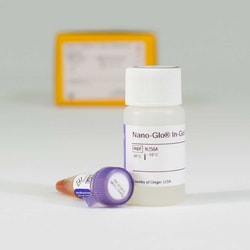
Promega Nano-Glo In-Gel Detection System, 100ml
The Nano-Glo In-Gel Detection System directly detects the luminescence of NanoLuc fusion proteins in polyacrylamide gels after protein separation by PAGE under native or denaturing SDS conditions (native PAGE or SDS-PAGE).

Promega pFN10A (ACT) Flexi™ Vector
The CheckMate/Flexi Vector Mammalian Two-Hybrid System provides a means to study suspected interactions between two proteins or domains and can also be used to generate stable cell lines for cell-based assays.
![Promega pNL3.2[<i>NlucP</i>/minP] Vector](https://assets.fishersci.com/TFS-Assets/CCG/product-images/PRN1041.jpg-250.jpg)
Promega pNL3.2[NlucP/minP] Vector
NanoLuc (Nluc) luciferase is a small enzyme (19.1kDa) engineered for optimal performance as a luminescent reporter. The Vectors offer a minimal promoter for cloning response elements of interest.
![Promega pNLCoI3[<i>luc2</i>-P2A-<i>NlucP</i>/CMV/Hygro] Vector](https://assets.fishersci.com/TFS-Assets/CCG/product-images/PRN1481.jpg-250.jpg)
Promega pNLCoI3[luc2-P2A-NlucP/CMV/Hygro] Vector
The pNLCoI Vectors comprise a second-generation coincidence reporter vector system that allow expression of both firefly luciferase (luc2) and NanoLuc Luciferase fused to a PEST destabilization domain (NlucP) from the same mRNA transcript.
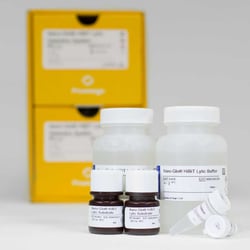
Promega Nano-Glo HiBiT Lytic Detection System, 10 x 100ml
Accurately quantify Any HiBiT Tagged Protein Expressed in Cells in an antibody free, plate based method.
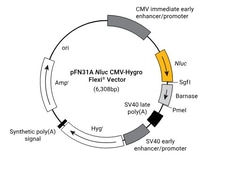
Promega pFC32A Nluc CMV-Hygro Flexi™ Vector
Generate C-Terminal Fusions to NanoLuc™ Luciferase Reporter. The pFC32A and pFC32K Nluc CMV-neo Flexi™ Vectors use a directional cloning method based on two rare-cutting restriction enzymes, SgfI and PmeI, and contain a mammalian selectable marker to create a stable line.
![Promega pNLF1-secN [CMV/Hygro] Vector](https://assets.fishersci.com/TFS-Assets/CCG/product-images/PRN1371.jpg-250.jpg)
Promega pNLF1-secN [CMV/Hygro] Vector
Generate N-Terminal Fusions with N-Terminal Secreted NanoLuc™ Luciferase. The pNLF1 Vectors use traditional cloning with a multiple cloning site to generate N-terminal fusions to NanoLuc™ luciferase. All vectors contain a mammalian selectable marker to create a stable line.
![Promega pNLCoI1[<i>luc2</i>-P2A-<i>Nluc</i>P/Hygro] Vector](https://assets.fishersci.com/TFS-Assets/CCG/product-images/PRN1461.jpg-250.jpg)
Promega pNLCoI1[luc2-P2A-NlucP/Hygro] Vector
The pNLCoI Vectors comprise a second-generation coincidence reporter vector system that allow expression of both firefly luciferase (luc2) and NanoLuc Luciferase fused to a PEST destabilization domain (NlucP) from the same mRNA transcript.

Promega Nano-Glo™ Dual-Luciferase™ Reporter Assay/pNL1.1.TK Bundle
The Nano-Glo™ Dual-Luciferase Reporter (NanoDLR) Assay System is a homogeneous reagent system that allows you to sequentially detect the activities of firefly (Photinus pyralis) luciferase and NanoLuc luciferase (Nluc) from a single sample.

Promega pFN11A (BIND) Flexi™ Vector
The CheckMate/Flexi Vector Mammalian Two-Hybrid System provides a means to study suspected interactions between two proteins or domains and can also be used to generate stable cell lines for cell-based assays.

Promega pFN31K Nluc CMV-neo Flexi™ Vector
Generate N-Terminal fusions to NanoLuc™ Luciferase Reporter. The pFN31A and pFN31K Nluc CMV-neo Flexi™ Vectors use a directional cloning method based on two rare-cutting restriction enzymes, SgfI and PmeI, and contain a mammalian selectable marker to create a stable line.
![Promega pNL1.1.TK[<i>Nluc</i>/TK] Vector](https://assets.fishersci.com/TFS-Assets/CCG/product-images/PRN1501.jpg-250.jpg)
Promega pNL1.1.TK[Nluc/TK] Vector
The promoter-driven NanoLuc (Nluc) control vectors can be used to co-transfect with experimental firefly luciferase vectors when using the Nano-Glo™ Dual-Luciferase Reporter (NanoDLR) Assay System.
![Promega pNLF1-NRF2 [CMV/neo] Vector](https://assets.fishersci.com/TFS-Assets/CCG/product-images/PRN1391.jpg-250.jpg)
Promega pNLF1-NRF2 [CMV/neo] Vector
NanoLuc Stability Sensors are ready-to-use vector systems that utilize the advantages of the NanoLuc luciferase reporter for stability studies of two key signaling proteins, HIF1A and NRF2, providing a way to directly measure the primary signaling event.